
The American Dream had become a Nightmare!
1930’s great depression and Steinbeck’s inspiration.

What happened? The Great Depression began in 1929 when the entire world suffered an enormous drop in output and an unprecedented rise in unemployment. World economic output continued to decline until 1932 when it clinked bottom at 50% of its 1929 level. Unemployment soared, in the United States it peaked at 24.9% in 1933. It remained above 20% for two more years, reluctantly declining to 14.3% by 1937. It then leapt back to 19% before its long-term decline. Since most households had only one income earner the equivalent modern unemployment rates would likely be much higher. Real economic output (real GDP) fell by 29% from 1929 to 1933 and the US stock market lost 89.5% of its value.
Why did it happen? The 1929 stock market crash marked the beginning of the Depression. Prior to the crash the stock market had been an important source of funding for industry; thus the crash itself was a contributing factor to the downturn as well as a harbinger of things to come. Since stock prices are based on estimates of future earnings potential, the stock market performance of the 1920’s tells a story of runaway optimism for the future. When it peaked a few weeks before the crash, The Dow Jones had risen 597% over the previous 8 years. It was soon to become a symbol of runaway pessimism.
By the 1930s money was scarce because of the depression, so people did what they could to make their lives happy. Movies were well liked, parlour games and board games were popular. People gathered around radios to listen to the Yankees. Young people danced to the big bands. Franklin Roosevelt influenced Americans with his Fireside Chats. The golden age of the mystery novel continued as people escaped into books, reading writers like Agatha Christie, Dashielle Hammett, and Raymond Chandler.
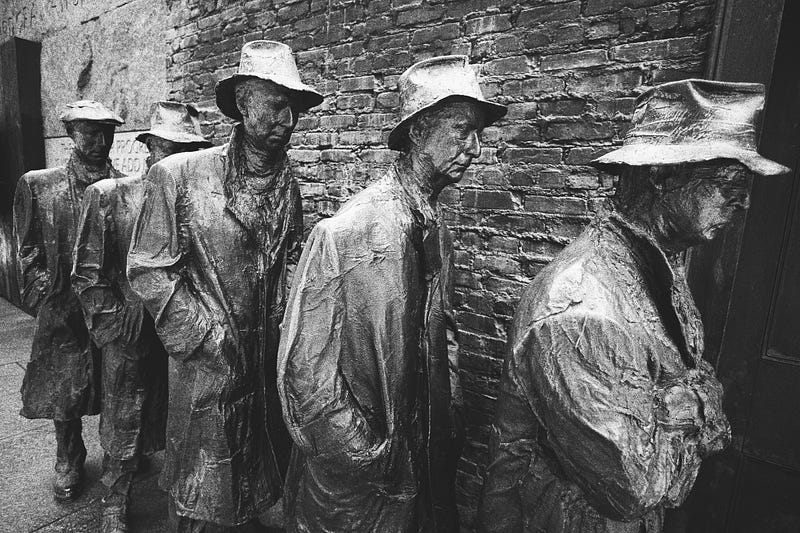
In the Great Depression the American dream had become a nightmare. What was once the land of opportunity was now the land of desperation. What was once the land of hope and optimism had become the land of despair. The American people were questioning all the maxims on which they had based their lives, democracy, capitalism, individualism. The best hope for a better life was California. Many Dust Bowl farmers packed their families into cars, tied their few possessions on the back, and sought work in the agricultural fields or cities of the West, their role as independent land owners gone forever. Between 1929 and 1932 the income of the average American family was reduced by 40%, from $2,300 to $1,500.
John Steinbeck was born in Salinas, California in 1902. His most famous books were written in the 1930s and 1940s, and are set in California. They deal with the lives and problems of working people. Many of the characters in his books are immigrants from Mexico or from other parts of the United States who went to California looking for work or a better life.
The Setting of Of Mice and Men. Of Mice and Men is set in the farmland of the Salinas valley, where John Steinbeck was born and which he knew all his life. Steinbeck’s father owned land in the area, and as a young man Steinbeck had worked as a farm hand. The ranch in the story is near Soledad, which is south-east of Salinas on the Salinas river. The countryside described at the beginning of the book, and the ranch itself, would have been very familiar to John Steinbeck.
Migrant Farm Workers. By the time that Of Mice and Men was published almost half of America’s grain was harvested by huge combine harvesters. Five men could do what would have taken 350 men a few years earlier. George and Lennie are some of the last of the migrant farm workers. Huge numbers of men travelled the countryside between the 1880s and the early 1930s harvesting wheat. They earned $2.50 or $3.00 a day, plus food and very basic accommodation. During the 1930s, when there was very bad unemployment in the United States, agencies were set up under the New Deal to send farmworkers to where they were needed. George and Lennie got their work cards from Murray and Ready’s, one of these agencies.
The American Dream. From the 17th Century, when the first settlers arrived, immigrants dreamed of a better life in America. People went there to escape from persecution or poverty, and to make a new life for themselves or their families. They dreamed of making their fortunes in the goldfields. For many the dream became a nightmare. The horrors of slavery, of the American Civil War, the growth of towns with slums as bad as those in Europe, and the corruption of the American political system led to many shattered hopes. For the American society as a whole the dream ended with the Wall Street crash of 1929. This was the start of the Great Depression that would affect the whole world during the 1930s. However the dream survived for individuals. Thousands made their way west to California to escape from their farmlands in the midWest. George and Lennie dreamt of their ‘little house and a couple of acres’. The growing popularity of cinema was the last American Dream for many, Curley’s wife was one: ‘Coulda been in the movies, an’ had nice clothes.’
Why Of Mice and Men? The title of the novel comes from a poem by the Scottish poet Robert Burns (1759–96):
The best laid schemes o’ mice and men Gang aft agley [often go wrong] And leave us nought but grief and pain For promised joy!
Article written by Drama Llama | Educator | Writer | Academic | Consultant