
A Novel
The Alchemist of Goreau — Chapter 5
Follow me to make sure you get new chapters as they are released
The Alchemist of Goreau is a fantasy novel set in late 1800’s in a mountainous Central European country with magic, incredible and unbelievable situations, and a healthy dose of humor. The story follows Donwillo, a mid-twenties alchemist struggling to make a name for himself in the world. When the world starts to crumble, he’s the most likely suspect. Follow his journey as he seeks to clear his name.
Are you ready to join Donwillo on a fantastical journey?
Chapter 5 — Sondheim
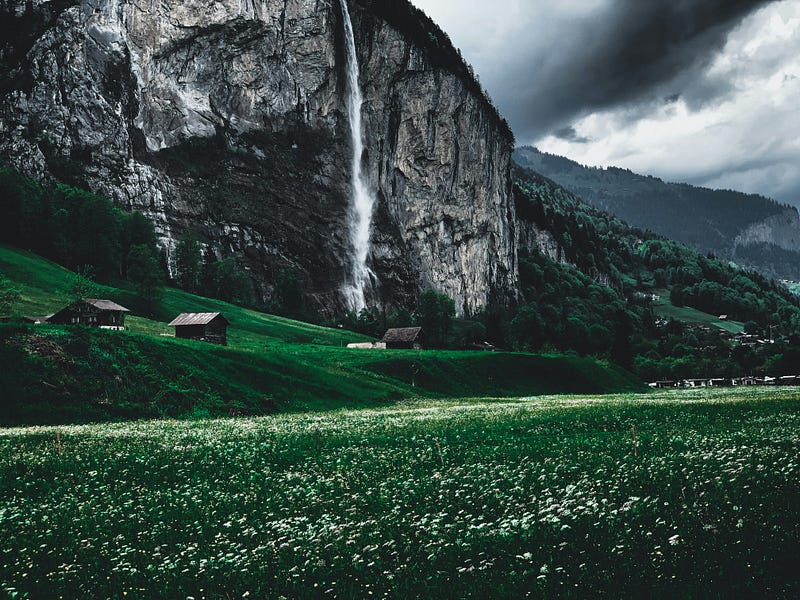
The air misted off the waterfall and sprinkled the pasture with delicate touches. A wind had swept through the Goreau valley, melting the snow and turning the ground to mush.
Thondhor’s son Sondheim, his widow Mae, family and friends, colleagues from the foundry, and the pastor had gathered on a farm on the outskirts of Goreau in the shadow of an enraged waterfall swollen by the melted snow.
Everyone flocked to their familiar. The foundry workers spoke in hushed tones that held a certain conspiracy to it.
Mae stood somber and regal like she was held up by an invisible scaffolding. She maintained an air of dignity.
Sondheim calmly took in the scene.
He had sprinted through the stages of grief, speed-running his emotions. He had always felt that he was behind in life and that he had to rush to catch up. He tried to experience all life had to offer at once.
Guilt was the first emotion he worked through. He’d laid awake at night wondering why he hadn’t been in the foundry that day with his father. He cursed himself for joining the strike.
Guilt gave way to anger. He tortured himself with questions of “why?”Eventually, he realized “why?” only led to more “why’s?” and he switched to “what?” What could be done? Nothing.
Next was bargaining. He’d gone through his father’s belongings, looking for some item or token or perhaps a journal that would impart some sense of meaning following his passing. He’s found nothing. Thondhor hadn’t been a man of letters or sentimentality.
The bargain, he realized, was his father. To have a good father is the best bargain there is.
Depression he discounted as a stage of grief, as he’d felt depressed long before his father passed.
Finally, he arrived at acceptance. He accepted his father was gone. He had climbed the highest peak in Goreau and screamed until his lungs hurt. He expelled every ounce of denial through his vocal cords, spewing verbal hurt. Then he hiked back down.
Acceptance was realizing that life would never be the same and that all he could do was carry on.
The funeral procession trudged through the pasture towards the creek where Thondhor had been born many decades before. The pasture belonged to the couple his parents sold their property to many years ago. They had become friends, allowing Thondhor and Mae to stage various celebrations on their land after discovering what the place meant to them.
The waterfall created a stream on one side, but there was also a nearby creek that fed into the stream. This was where Thondhor had slid out while his pregnant mother had been milking a cow.
He had floated down the stream for quite a distance before one of their cows stepped into the river and stopped his journey. His mother had called for help, and Thondhor was retrieved, freshly bathed.
The landowners, now quite old, leaned against the pasture fence at an appropriate distance, offering their condolences from afar.
The cows looked blankly onward, their shiny bells gently swaying in the breeze.
The funeral party carried the ashes across the field, watching their step as they scanned for treasures left by the cows. The wet ground schmucked their boots.
Once the party reached the edge of the creek, the pastor began his speech.
“Thondhor Metalhummer was a beloved man who loved, who lost, and who marched through our broken world with heedless courage. He was a rare breed.
“Patient and kind, Thondhor proved once again that actions speak louder than words.
“His actions reverberated across the lives of his loved ones.
“Thondhor was not fond of BS.
“We can all learn from his kindness.
“I believe the best way we can carry him in our hearts is to be the kind of person Thondhor exemplified.
“So I ask that we all look for the goodness in ourselves today and promise to nurture it, to feed the goodness we possess. In my mind, there is no better way to honor the beloved Metalhummer.”
Mae struggled to maintain her composure.
She was met with a legion of support from mourners who moved in to offer comfort.
Sondheim’s internal monologue went haywire, and he had to remind himself that he’d already been through the stages of grief.
The pastor finished up his soliloquy, and Thondhor’s ashes were spread across the creek.
“He left the way he came,” said the pastor respectfully.
The moments following were a cathartic release of bottled sadness for most in attendance.
The foundry workers who had loved and respected Thondhor’s leadership all, to some degree, blamed themselves for his death, even though they knew it was a freak accident.
Gradually, the deep mourning broke like daybreak, allowing pockets of sunshine to cross faces one by one.
There was a smile here, a suppressed laugh after a funny anecdote was shared, and soon, the goodness of Thondhor had wound its way through the funeral party.
Thondhor’s death invited a rare scene of laughter only possible when a truly incredible human goes forth into eternity.
Sondheim watched this happen with great confusion.
“Joy is not a stage of grief,” he thought, finding bits of anger flowing through his blood.
He sidled up to a loud congregation of foundry workers who were sharing story after story that ended in fits of laughter.
“Pretty funny,” he said with an ironic smile.
The laughter passed away.
Sondheim chuckled.
Hogar, sensing Sondheim’s annoyance, tried to diffuse the situation.
“I’m so sorry, Sondheim. Thondhor was a great man. We were just remembering him.”
Sondheim nodded diplomatically.
“I heard a rumor,” said Bjorn. Bjorn was a single-expression individual — a perpetual look that suggested he was puzzled by his own existence.
A murmur of disapproval spread through the workers as they tried to hush Bjorn.
Bjorn didn’t notice.
“Some think it wasn’t just an accident,” he said boldly.
Sondheim furrowed his brow, but Bjorn powered on.
“I heard that looney alchemist on the hill had something to do with it.”
“What the hell are you talking about?” asked Sondheim, his rising voice catching glances from the wider audience.
Well,” said Bjorn, “I talked to the postman the other day. He said the last time he was up there to deliver a parcel, it left his ears ringing for three days. Something in the packages, he thought.”
“And what on God’s green earth does that have to do with my father?”
Bjorn’s Adam’s apple bobbed as he swallowed. He was realizing far too late that this was not the time nor the place. Still, he soldiered on.
“I saw flames coming from the hillside just a few days ago,” he said. “Postman said the blasted idiot burned down his own house doin’ some mad experiment.”
Sondheim clenched his fists. “You better have a real good reason for bringing this up,” he said, barely keeping the lid on his anger.
“I mean the sinkholes, the foundry accident, the weird weather, it can’t just be a coincidence. I think he was working on something big and it went haywire.”
“And what proof do you have?” asked Sondheim, fuming.
Bjorn shrugged. “Like I said, it was just a rumor.”
Sondheim experienced a sudden emotional upheaval.
“How dare you!” he shouted at Bjorn.
Bjorn’s expression changed from confused to fearful for the first time in his life.
Sondheim ran towards him. Bjorn booked it.
Sondheim reached down, grabbed a cow pie, and flung it, striking Bjorn in the back.
Sondheim lost it, plowing through the pasture, kicking every cow pie in sight, sending dried and undried turds every which way.
The cows backed toward the fence.
Sondheim tripped and stumbled into the creek where his father’s ashes had been tossed minutes before. They had since made their way downstream.
He sat in the river while family and friends made an attempt to coax him out, but he was like a baby in a bathtub, legs sprawled wide, eyes misty as the nearby waterfall.
Thondhor’s acquaintances quietly left.
Mae couldn’t handle it, and she stormed off in disgust.
All the stages of grief Sondheim thought he’d dealt with came rushing back all at once, and they congealed into one, hard-packed coal of an emotion, a diamond of hatred and fury.
He burned.
The water from the creek could not cool him.
He resolved to pursue the thing he knew wouldn’t bring his father back.
But he didn’t care about healing anymore. He cared about hurting.
“Revenge is such a silly word,” he thought. “It’s not revenge I seek. It’s suffering. I seek to inflict equal suffering.” He promised himself that no other cause would distract him from his goal of bringing Donwillo to ruin.
The cow pie residue on his clothing gently washed away, floating downstream until they mingled with the ashes of Thondhor. Then the mixture continued its long, long journey in search of the ocean.