
A Novel
The Alchemist of Goreau — Chapter 10
Follow me to make sure you get new chapters as they are released
The Alchemist of Goreau is a fantasy novel set in late 1800’s in a mountainous Central European country with magic, incredible and unbelievable situations, and a healthy dose of humor. The story follows Donwillo, a mid-twenties alchemist struggling to make a name for himself in the world. When the world starts to crumble, he’s the most likely suspect. Follow his journey as he seeks to clear his name.
Are you ready to join Donwillo on a fantastical journey?
Chapter 10 — Rile the Population
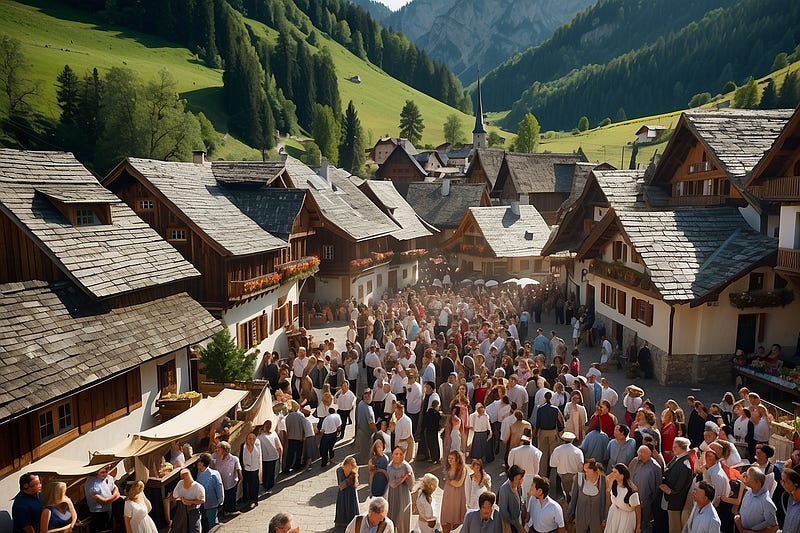
The center of Goreau bubbled like a witch’s cauldron, simmering with human activity.
Panic had spread quickly throughout the town, driving the population from their safe hearths into the central nervous system of downtown, where several kiosks and booths had been setup by the city council to help assuage fears of the apocalypse.
These fears were not unfounded. Too many odd occurrences, disasters, and deadly incidents had taken place for people not to be concerned. The problem is that now they were demanding answers.
Unfortunately for them, the aid workers dispatched by the city council were ill equipped to explain the strange phenomenon. Nonetheless, they had helped establish lines and queues for people to stand in, in hopes that this would ease the tension.
People appreciated the organization, since this indicated on a subconscious level that things were still in order.
Most of the lines were so long that the people in them didn’t realize that they circled back around upon themselves, the individuals shuffling in an infinite loop.
Sondheim made his way into town, striding with purpose, his shoulders thrown back as he surveyed the chaos.
Since the funeral debacle where he’d sworn to destroy Donwillo, he had attempted a few calming exercises. He tried deep breathing but found the extra air didn’t agree with his body’s natural adrenaline-spiked system. He was like a goat that subsisted on a diet of old shoes, bale string, and cow feed. It would be sick for days if it attempted to consume anything healthy or normal.
He’d also tried sitting with his thoughts in quiet, calm meditation. This didn’t help much because his mind was always buzzing with purpose. He decided that meditation was for other people. He simply did not have that capacity for inner peace inside him.
He’d emerged from each coping mechanism more furious and determined than ever to seek vengeance.
However, he needed allies, which is why he braved the cries, lamentations, and crowds of the city center. His goal was to drum up enough support so that he could drive Donwillo from the immediate area. He could do it himself, but he wanted to send a message. He wanted to start a mob. A mob sent a message that the time for debate, rationality, and discussion was over. It said the verdict was unanimous, and that it was dangerous not to comply.
Sondheim found a wooden staircase with wheels chalked by some triangular blocks. On it, locals stood waiting in line. At the top of the stairs was a small landing and then nothing. There was literally nowhere to go once you reached the top. He pushed his way past and ascended the stairs to the landing so that he could overlook the broader scene. Scowls, frowns, and grumbles greeted him as he cut in line. But nobody did anything. The general unease of the situation caused a tentative nature amongst the citizens.
From this angle, the throng of people had almost a livestock feel to it.
It was as if the whole city center had been turned into a human meat lot, the idling figures below just awaiting their turn to be slaughtered. The Goreau people had enjoyed peace for so long that their ability to withstand change or deal with crises had atrophied like an unused muscle.
”This could be to my benefit,” he thought. “If I could take on the air of a shepherd dog. I could shepherd people.”
He began by barking. Loud, robust woofs that resounded throughout the town center.
“WOOF,” he shouted.
Nobody seemed to notice.
“WOOF! WOOF! WOOF!”
An older woman clutching a satchel as if it contained all her life’s valuables turned and looked at him. Her scowl indicated she had spent several decades calling perfectly decent young men “whippersnappers.”
“What did you call me?” she demanded.
Sondheim went off like a territorial dog, barking his head off. His chest shook and shuddered as he inhaled great gulps of air and then expelled them rapidly. He barked his throat raw.
“Pipe down, will ya?” said a person holding two cups with tea bags in them. Sondheim didn’t trust anyone who drank tea, especially in tea bags. He felt that tea was a drink for those too indecisive for water and too cowardly for something stronger like coffee.
“This will work,” Sondheim thought to himself, “just keep barking.” He was persistent in all things, mostly because he refused to believe his ideas were ever wrong in the first place.
“Shut your trap,” a youth shouted, standing with his parents.
Something about the kid made him go against his nature, and he decided to change tactics instead, throwing his head back towards the sun as he began to howl at the sky.
Just then, he spotted out of the corner of his eye a mangy dog sniffing through piles of rubbish in the street.
The dog was just doing its thing, being a dog.
It made Sondheim feel oddly self-conscious.
He was doing a poor imitation of a creature that was perfectly comfortable being itself.
It wasn’t that his idea was wrong, it was that he was the wrong person to execute it.
Since he couldn’t become a dog, he reverted to human behavior.
“Hello!” he said evenly.
People turned and looked. Somehow, his voice had slipped into that familiar register that taps into the primordial listening center of the brain.
“I would like to say something,” Sondheim said, puffing up his chest, trying to sound like a king making a proclamation.
“As I glance around, I see a lot of tired and weary faces,” said Sondheim.
Nothing but blank stares.
“Perhaps you lost a loved one in the foundry accident, or to a sinkhole?” he prompted.
A couple more heads turned his way.
Sondheim could nearly taste the desperation sweating off the people of Goreau — as if their bodies were releasing chemicals of fear the same way a cornered animal might.
He raised his hands in a manner he thought might be calming.
“You’ve come here looking for answers. You’re here because you want someone to blame for the tragedies sweeping the town. I know the person responsible.”
He paused to let this sink in.
“Go ahead and stand in your queues that go nowhere, waiting for answers from people who haven’t a clue what’s going on.”
A skinny gentleman roughly the size and shape of a flagpole was listening intently.
Sondheim singled him out.
“And why have you come here?” asked Sondheim.
“My brother died at the foundry!” replied the Flagpole.
“I’m so sorry, dear sir. And who else is here because of some terrible tragedy?”
“My baby got shingles! He put a spell on that child, said it had a face that only a mother could love!” said a mother in mourning.
Sondheim forced his expression to remain determined and sympathetic.
“My dearest sympathies. I bet there’s not a person here who hasn’t been affected in some way by the alchemist,” he said.
People started leaving their queues and gathering in front of him.
“It’s time to take our fate into our own hands.”
He continued to reel them in like an expert fisherman by working the crowd, asking questions, offering sympathy, and then redirecting their anguish toward a common enemy.
Gradually, the crowd was won over.
They lifted their fists, raised their voices, and looked around for the nearest pitchforks.
“It’s time for Donwillo to go. Follow me!” he shouted, and most of them did.


