
MEMOIR | AIDS | ‘80s
The AIDS Memorial Quilt Represented Our National Sorrow and Fury
The tremendous fabric represented thousands of lives lost — and I cried for Kody when I saw the quilt in the ‘80s
When I was a nineteen-year-old girl, I went to the local funeral home. It was the night before my brother’s service and I demanded his coffin be unlocked. The funeral director came to know me as that-girl-with-attitude. He advised against it, “It’s a closed casket for a reason.”
Then, he unlocked the light blue coffin. I felt faint. I wanted to see my brother.
And I approached my brother like an animal approaches another, slowly and fearfully, sniffing, touching. The strangely combed hair. The clasped hands. Nothing the normal way. I had to be with him though.
In the late ’80s, my grandma died and I ended up back at the funeral home. While I was there, I had questions about my high school friend, Kody.
I was a courageous kid. Not the person to shrink back with unanswered questions. So as long as I was at the Funeral Home, I decided to ask. Some might say that’s morbid. I’ve also come to learn that people who work in the funeral industry are used to questions.
The ’80s weren’t all fun and joy, Madonna and big hair. Even while we young edgy twenty-somethings danced at Ember’s — a huge nightclub with shirtless guys dancing in cages — an underlying dread existed.
That dread was AIDS. Our friends were dying. That included Kody.
So in my little rural hometown, I asked the Canby Funeral Home director. I had to know. He confirmed that yes, my high school friend Kody had been the first person in Oregon to die of AIDS.
The director said they didn’t know how to deal with a person who came in back in those days. Could they get ill handling him? It was stressful and frightening, he said.
Now, I imagine how hard the illness was on my friend, a sweet boy who lived in rural Oregon near me. He was an only child to an old farmer guy who didn’t talk, just trudged around in overalls and worked. Kody must have been like a rainbow on a cloudy day. Always smiling. I’m not sure his dad noticed. I never saw a mom.
In high school when Kody was alive, he strutted — and his shiny straight hair went everywhere. He was always laughing, and wore his jeans low on his hips. He had silver braces that flashed when he smiled. He knew cars, and worked on mine more than once. He was gentle but capable.
When I was sixteen, I went to his house. He showed me a little tanning apparatus he used on his face. It was a vulnerable moment.
“Why do you use that?” I asked.
“I like having some color,” he said, smiling and throwing his hair back. We took turns using it. He wasn’t hitting on me. We were kids hanging out. That was all. I found it kind of curious. Boys were usually so forward. Not Kody.
Later, a group of us — twenty-somethings puzzled about his death — wondered if he was gay. He wouldn’t have told us, we decided. Our hometown could be a cruel world to anyone different, especially someone gay.
Kody went to New York on a whim after he got out of high school in our rural community. He didn’t last long after he came back.
I didn’t judge him, not at all. I was mostly with women in the ’80s.
In ’88, when the AIDS Memorial Quilt came to Portland, Oregon, I had to see the exhibit. I told Patty about it, although I was getting tired of her. She drank too much, and things needed to change. Every weekend, she wanted to go dancing and drinking. It was getting boring.
“Why do you want to see it?” she asked. I told her about Kody. And I was furious at the deaths of so many gay men. I’d just finished my two-year degree and was getting ready to transfer to University of Oregon. I was a Democrat, true blue and didn’t have any faith in the Reagan administration.
Case in point — why wasn’t our country doing more to support all the sick people?
Why wasn’t the AIDS crisis a national emergency? President Reagan wasn’t doing anything — this line is repeated in many articles — it wasn’t until April of 1987 that he addressed the nation about AIDS, which had surfaced in 1981. Thousands of people were dying. Nothing was being done by our government. My college friends and I drank beer and bitched about the Reagan administration nonstop.
“They don’t give a damn about us,” we said, “If their family members were dying, they would.”
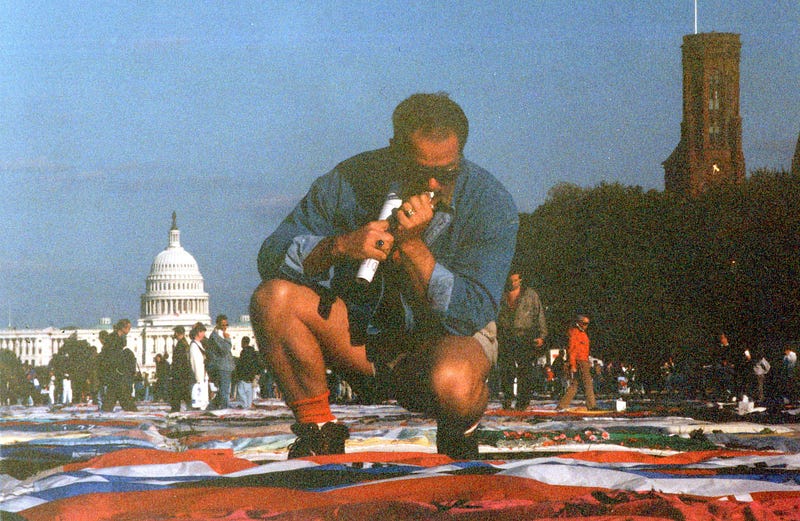
As a political college student and a girl dealing with complicated grief, I wanted nothing more than to view the AIDS Memorial Quilt. The grassroots effort of creating quilt panels in memory of those who died of AIDS was part of the movement. Listen to us, see us. Help us.
“It’s kind of a strange thing to do on a weekend, but I’ll go,” Patty said.
Patty and I wouldn’t last much longer. I’ll hand it to her, though. She went along without further complaint.
My memory’s strange. It’s been thirty-five years, and I see pictures and hear snippets of conversation in my mind. I have impressions of interior spaces. I think the AIDS Memorial Quilt was on display in a synagogue in SW Portland. I’m not sure about that detail.
I cried silently the entire time I walked around — that memory is clear. Patty trailed me, holding my hand or with her arm around me.
The space seemed sort of round — and maybe it was. Or maybe it was looping around the fabric panels over and over that gives me that sense.
Even now, I’m crying, remembering that day. How somber. How heavy the feeling. The colors of many, many panels laid out, and spaces between the panels for people to walk. I felt dizzy, full of sorrow. The loss of my brother made my grief worse, as I had issues with his death — now I know it as ‘complicated grief.’ With complicated grief, you can’t move beyond grieving. Nothing gets easier. No ‘new normal,’ as they say now. Every morning, I woke up and thought, “My brother is still dead.”
And now, viewing this massive quilt, the weight of thousands of grieving families buried me.
I read so many words. I read, and read, and read.
Joseph, you were the light of my life. Our brother, our friend, our beloved. You will never be replaced. I will remember you every day of my life. Courage and grace.
Words, so many words. And a kaleidoscope of colors and patterns and stitches. Many of the quilt panels were cried on, without a doubt. The enormous display of fabric represented people from all over the USA. California, Wyoming, Oregon, Minnesota, Michigan, Washington, Alabama, Tennessee, Rhode Island. Every state.
At one point, I saw black permanent markers and panels with scrawled words, I love you, I miss you. Rest in peace.
I kneeled on the floor and I wrote my friend’s name. I now realize his full name has traveled all over the USA, and his spirit, and mine, travel on a piece of fabric. What did I write? I don’t remember. I cried. That much I recall.
In hindsight, I’ll say this.
Kody, I miss you. I regret we didn’t have medicine for you in the early ’80s when you died. I’m sorry I wasn’t there with you, and for you.
I like to think I could have been there, without fear, but I don’t know. I just can’t say. But I’m sorry, and I loved you.
Thank you for reading my memoir.
Here is some information about the AIDS Memorial Quilt project.
Deep gratitude to Brenda Thom for sharing this amazing song by “Sweet Honey in the Rock,” about the AIDS Memorial Quilt. It is simply stunning.