The AI Copyright Problem
Should we really stifle the wider flow of information? Dancing Elephants Press
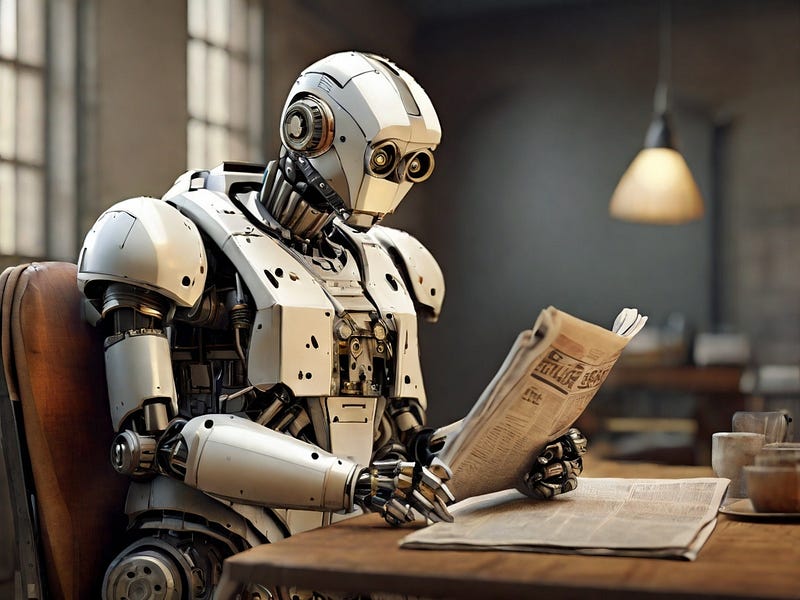
I can’t speak for all writers. I can tell you that my wish as I write is to offer some clues, some inspiration, and some hope to others in the world. My hope is that someone will read or be inspired by what I say. I want to nourish humanity and have a world of continuous learning. I am worried about the lawsuits against Artificial Intelligence. Openai Chat GPT has already broadened my world.
I know that if a writers do not want their stuff stolen. Even I have a couple of scripts that I have been working on for some time that I cherish and have copyrights in place.
But the big problem for most writers is: Who is really reading their works?
The big hope is that anyone, someone will read and get value. If you have ever visited the dollar bin in a gigantic book store you will see the tragedy of years of work by well-meaning dedicated writers whose books no longer sell on the stores shelves.
And then on top of that there is all that growing and twisted misinformation spreading like wildfire. Accessible AI may be the antidote.
Printed newspapers with real honest content struggle to stay afloat and staff are being cutback.
So the lawsuits from these publications may kill the new kid on the block that millions want to read and that may trigger interest in reading further.
It is a problem that AI that can grab content without proper attribution.
I read and admire the NY Times, the Washington Post, and other legitimate publications. Their real purpose is to inform. If the use of the information they offer is meant be siloed to only those who purchase the paper then I submit that only a few will ever be able to access that info on a given day.
The problem of AI and copyrights can be fixed.
The solution might not be to sue AI systems but rather to encode in some way through special type that shows this information is lifted whole cloth and other encoding that shows this information has been rewritten or reconfigured.
There is already an effort to find ways to watermark images so that the deep fake problem can be addressed. Embedded tiny holograms can be immersed across newspaper and book content to scramble or mark the effort of AI lifting. Holograms are already embedded in US currency to prevent counterfeiting.
It is a wonderful thing that a doctor across the world in a remote region can read or see information on a medical technique that may have been locked in numerous research documents. It is exciting that this information can be shared and configured so that it can be accessed when needed.
The AI systems are only mimicking what humans already do. When you read a book or a newspaper, or hear a report, you are storing that information. It may not be remembered or easily accessible but it is recorded in our brains. Who is to say that a new idea that comes from a human isn’t already an aggregation of previously gathered content?
Isn’t it a universal wish to make humans smarter? Putting AI in the palm of hands will help.
The Process of Aggregating Information is not new. AI is just faster.
News operations have always read each other shared content and used sources like AP (Associated Press) and in the old days UPI (United Press International.)
Publication marketers value distribution and even include a measurement called the pass-along rate.
Definition from Mansi Media: Readers of a publication in addition to the initial buyer.
“Also called “secondary audience” or simply “readership,” this number offers a more accurate portrait of the number of people reading the print edition of the newspaper and potentially seeing your advertising message. As a rule of thumb, you can determine readership by multiplying the circulation by 2.1 (ex. circulation of 50,000 would result in a pass-along readership of 105,000).”
Openai. Chat GPT is just a faster aggregator of information that’s already been published (that’s already made public.)
There are unanswered questions that even caused members of Sag-AFTRA to strike. Actors and writers objected to the regenerated content by AI without compensation. A scene requiring thousands of extras can be easily created without rehiring the actors from day to day. This is a problem that is being addressed in new contracts for now.
My concern is that this technology will be stifled due to lawsuits. I don’t want authors and news publications to suffer from whole cloth plagiarism but I don’t want to spoil the amazing soup that occurs from the blending of ideas and information that big brain systems can generate.
I put my actions into practice. I signed an agreement that Grok a new AI bot system can have access to my writing on X. You can ask me how I feel when I see my words somewhere I didn’t put them.
PS: Grok was a term created by Robert Heinlein in his popular Science Fiction novel: Stranger in a Strange Land 1961.
For more perspectives on Artificial Intelligence versus Human Intelligence read:
Newspapers distribute news for public consumption. There is even something called a pass along rate where friends and family can read.
If you finish the newspaper on a train and leave it behind. Does the next person have to pay who reads it?
News outlets read each other’s publications and discuss the leads of other outlets to decide which way they are going to go. It is a kind of “aggregation” though of course less efficient than AI systems.
The biggest problem for most publications is the decreasing readership not the fact that AI is using and mixing content.
The fact that there can be a place where information is easy to access changes the landscape of the sharing of ideas and necessary information.
Why should you have to go into a brick and mortar building to get information?
✍ — Published by Warren Brown, at Dancing Elephant Press. Click here for submission guidelines.


