
The Age of Unreason
Ignorance and Capital Rule a New Dark Era
It is increasingly more apparent that we are witnessing a profound and historic societal shift, one that has been a very long time in the making, and whose progress — until now — has been so slow and silent as to be almost imperceptible. Having reached a tipping point, we are now facing what is undeniably a large scale move away from reliance on reason and the evidence of our senses. We are ravaged by war, successive climate disasters, economic uncertainty, and a deadly civilization-threatening global disease. The dream of an open, democratic society is under siege, and the dark forces of authoritarianism and fascism are ascendant.
A new forbidding era — the Age of Unreason — is upon us.
Just as the western world changed dramatically at the onset of the Enlightenment, so now are we faced with what can only be described as the embrace of ignorance and a return to the oppression, superstition, exploitation and the stupidity of a dangerous new Dark Age.
How in the world did we arrive at this unsavory place? What forces are at work? Weren’t we supposed to be making progress toward a better world? Though it may seem to have appeared out of nowhere, getting to the here and now began hundreds of years ago.
With the Enlightenment providing a solid base of values, the West seemed to be moving in the right direction. This intellectual and philosophic awakening (which took place roughly between the years 1685 and 1815) was characterized by a new paradigm: the renunciation of unthinking adherence to tradition; the repudiation of mindless submission to group dynamics; and an abandonment of reliance on superstition and mysticism to explain the world.
Instead, during this period of human advancement, individual decisions, choices about personal lifestyles, societal and governmental operations were to be based on reason, as practiced by citizens operating through their own self agency and not according to tradition, questionable media reports, the edicts of a religion, or a monarch, or a ruling aristocratic class.
Enlightenment core principles included liberty, progress, toleration, fraternity, constitutional government, and separation of church and state. One especially revered priority was to bring about universal human happiness, arrived at by Knowledge gained through the application of Reason based on the evidence of the senses.
A group of groundbreaking thinkers — Descartes, Locke, Hume, Newton and others — led the way to this great awakening. The virtue of Reason was also extolled by dozens more prominent thinkers, including Kant, Goethe, Voltaire, and Rousseau.
The reaction to this new movement by the church and those aristocrats already in control of society was anything but welcoming: egalitarian Enlightenment principles threatened the privileged lives they enjoyed. The general mood was definitely one of violent opposition to hereditary privilege, and aristocrats were understandably wary; after all, resentment toward them was so vehement that it would ultimately give rise to the Reign of Terror, resulting in thousands of deaths. Though delivered a horrific blow, especially by the Guillotine-happy French, the aristocratic and propertied class persevered, however shaky its position.
But, by means of what would be later called natural selection, the memeplex that had produced and maintained the old power structure expressed an adaptation — a counter-paradigm that had appeared during this era — Capitalism. This new schema, along with the nascent Industrial Revolution, proved extremely useful to the propertied class.
Advances in learning, especially about the physical world, had been taking place at a furious rate. Application of the New Science to industry was bringing about the rise of mass mechanization, which was quickly replacing a feudal mode of production: no longer did manufacturing rely on apprenticeship, craftsman’s guilds, and limited hand-crafted production. In this environment of societal evolution, the rich and propertied class were given, at a stroke, a gift: the emerging Industrial Revolution provided a perfect mechanism, a new vehicle by which they could maintain their grip on society without incurring its wrath; Capitalism contributed by providing a philosophical justification, an epistemology based on a doctrine of individual rights.
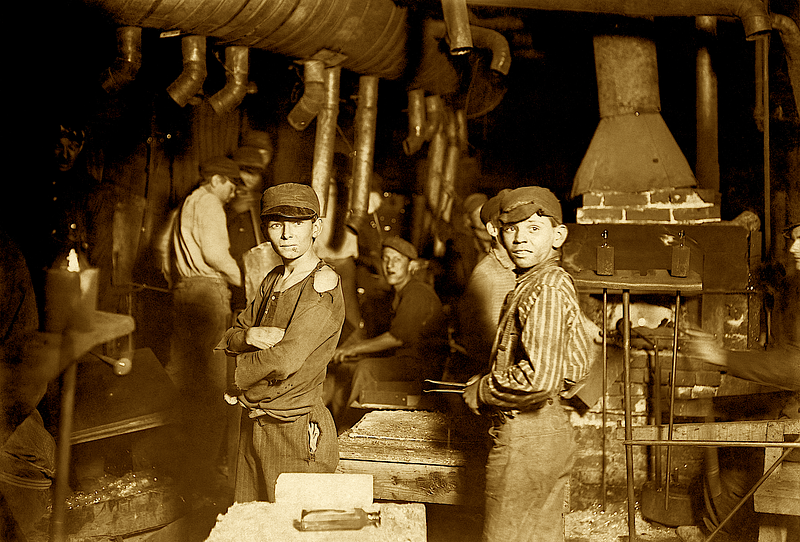
Like every large-scale social phenomenon, the Capitalist paradigm needed a philosophy, a charter, a rationale, a set of ideas which might convince others of its legitimacy and validity. Apologists, like Adam Smith, quickly emerged. Pretending to be egalitarian, and paying lip service to Enlightenment precepts, Capitalism preached to the masses that economic gain and security was “democratically” available to anyone. The reality — that the means of production was, and remained firmly, in the control of those who had always had it — was kept out of sight. Nor was it mentioned that this new economic scheme was essentially exploitative, and relied on cheap laborers, essentially wage slaves, who worked almost around the clock in truly appalling conditions that would have made Nero blush. And let’s not forget that it institutionalized a class system; an upper class that benefited from private ownership of the means of production, and ownership, or at least access to most of the natural resources; a lower, working class that did all the work; and a tenuous middle managerial class hoping to make the almost impossible jump upward.
Appealing to avarice and an inherently selfish human nature, and with an unlimited profit motive as an incentive, young well-born men were encouraged to “go into business;” indeed there was hardly any obstacle to it: minimal government intervention, a compliant and submissive workforce, and little or no competition.
As balm for the consciences of the oligarchs, and like a wolf in sheep’s clothing, Capitalism disguised itself, its rhetoric borrowing heavily from the language of the Enlightenment. Terms such as “free enterprise,” and “open marketplace” became catchphrases. To the “free market” was attributed great wisdom, with the power to somehow almost magically resolve many of society’s ills. “Private ownership” institutionalized the large holdings of the propertied class, allowing it to keep what it already had — most of the property. “Free enterprise” meant that emerging capitalists were free to prey on workers and consumers alike. “Equal competition” allowed consumer prices to rise to as high as the market would bear, to the point of revolt, while competition for factory jobs kept wages at the bare minimum. Workers and consumers were offered “freedom of choice,” but of course, in reality, there was very little freedom or choice among workers or consumers.
Thus, in its overall outcome, the Industrial Revolution was a reactionary event that mostly maintained the status quo, and had a net result of keeping in power those aristocrats and oligarchs who might have had to change their ways had the Enlightenment’s liberal egalitarian ideals prevailed.
Since the Enlightenment’s emphasis on Reason also challenged religious mysticism, as well as the divine right of the aristocracy to openly suppress and oppress the people, the wealthy class and organized religion, especially Protestantism, were natural allies. Capitalism became the new “gospel of wealth” and it enshrined a new god: Capital.
Note that the very early Church held views that were definitely at odds with the elite propertied class. Early Christianity renounced rank, money, private ownership of property, the charging of interest, and the accumulation of wealth.
Though they were concerned for their souls, wealthy aristocrats were always suspicious of the early Church’s asceticism and communistic leanings. Since Martin Luther and his Protestant Reformation attacked the Church, it was a forgone conclusion that the propertied class would support him. Not only did the Reformation redistribute authority away from the Pope and into the hands of Bible- and pamphlet-reading pastors and princes, it sanctioned private ownership of property, the charging of interest on loaned money, the accumulation of wealth, and defended as “morally right” the capitalist’s entitlement to all of the excess labor of his workers in perpetuity, an eternal reward for making an initial one-time investment — adding up to far more than the costs of production, even with profit added. Calvinists even went as far as declaring success in business as sign of god’s pleasure.
Thus could the souls of the industrialists once again entertain the hope of reaching heaven, even as they exploited their fellows here on earth, all the while paying lip service to the Enlightenment’s lofty goals.
For lip service was what it was.
Beginning in the nineteenth century, truly enormous, unheard of increases in personal wealth were beginning to take place. While the Capitalists may have been pretending to praise the values of the Enlightenment, they really were making money hand-over-fist by competitively striving to obtain maximum surplus-value from the employment of labor, resulting in an equally gigantic increase of productivity and capital resources.
Thanks to an easy working relationship between the capitalists, banks and governments, this “gigantic increase” was on a larger and larger scale convertible into money and was expressed in money, i.e., wealth. The New Aristocrats, the Captains of Industry, the Gilded Age, came into being, and history witnessed the creation of prodigous fortunes, soon followed by the spectacle of huge charitable organizations emerging from these vast seas of wealth, endowing libraries, concert halls, schools — all built for illiterate workers who labored twelve hour days, six-and-a-half day weeks. Though well-intentioned people worked to further the Enlightenment’s promise, and made some progress toward restraining Capitalism’s worst excesses, the concentration of wealth into fewer and fewer hands continued and accelerated, resulting in these unconceivable fortunes, vast beyond their possessors ability to spend in hundreds of lifetimes.
By the end of the twentieth century, even cursory commitment to high-minded Enlightenment maxims had wound down to almost nothing. To be sure, Enlightenment rhetoric made its appearance at state and national capitals on Founder’s Day celebrations, and other events where no one paid too much attention. But for all practical purposes, they were mostly abandoned, replaced instead by the ”dog-eat-dog” ethos of Social Darwinism, with “survival of the fittest” as the rule, casting aside any concern for the weaker, the vanquished, who became despised “losers,” whose lack of economic success was somehow their own fault. The Enlightenment prerequisite of placing the good of society over and above that of the individual was forgotten, replaced by a dictatorship of viciously competing “free” individuals. Society as a whole didn’t much matter, only what we were able to get for ourselves. Capitalistic short-sightedness rose to ludicrous, even insane, heights, ready to destroy all of the earth’s human environment in the name of quarterly dividends and profits.

The key to maintaining power over the masses by the wealthy is and was fragmentation and ignorance. Communities banding together and acting in concert are anathema to authoritarians. Trade unions were — and are — especially opposed, frequently violently. Keeping individuals isolated from one another, encouraging competition instead of cooperation emerged as a fundamental divisional strategy.
What’s more, technological advances — especially in data-driven, personalized, focussed communications — now give the propagandists new, unprecedented access to our homes and private lives, to devastating effect. Fuel — in the form of misinformation and disinformation — can be thrown upon the fires of misogyny and racism, and other divisive issues, at will.
You’ve probably heard the saying, “It takes a village to raise a child.” At the heart of this folk maxim, and others like it, is the realization of the importance of strong, viable communities. In a sleight of hand, however, after World War I the narrative began to change. Emphasis was transposed: “the community” was no longer the basic societal unit; it was replaced instead by “the family.”
You might say, “What on earth could be wrong with elevating the family above the community?”
On its face, nothing. Solid, stable families are important. But by this seemingly innocuous rhetorical move, the calculus was shifted; instead of large groups, like labor unions, and community organizations working together, families were pitted against families.
Instead of working with neighboring families to produce strong and resilient communities, families found themselves competing with one another, struggling to get an ever-dwindling piece of the pie of economic well-being.
Given this almost continuous opposition to and erosion of Enlightenment values, the way has become increasingly clear for the succession of fascism and authoritarianism.
When Enlightenment goals are subsumed by capital and profit, by greed and exploitation, who loses?
We all do.
Our great universities have become expensive training centers for the military, government, and corporate interests. In many instances, government has ceded its authority to private enterprise: industry lobbyists write the self-serving laws that govern the corporations that hire them. Society’s decisions are made based on profitability to companies, corporations and the oligarchs who own them. Tax dollars are used to pay private companies to develop products that are sold at great profit to them.
In the name of capital and profit, we are witnessing the destruction of the very earth, its ecosphere, its multitude of species. Banks, corporations and rich aristocrats are pillaging our dying planet.
And we have been willing partners to this destruction. But in our defense, we are vain, weak, greedy creatures, easily seduced by the good things provided by Capitalism — Yes! Capitalism has produced good things! We have all especially benefitted from the advances brought about in Capital’s name in science and technology. And modern medicine, even with all its shortcomings, is a very good thing. But we should have actually used Reason, not just talked about it, as we merrily burned through our resources, our future. What were we thinking?
It would seem that the Enlightenment has failed.
But, I suspect that the failure is not due to a failure of Enlightenment principles per se, so much as it is a failure of our pitiful adherence to them. As Voltaire points out in Candide, even with Reason as our guide, ultimately we must change ourselves from within. We must learn to listen to reason and restrain our more base urges. We are advised to “tend our gardens,” to live simply and not take more than we need, nor exploit others. We are told that a happy, fulfilled human life guided by reason is entirely possible, as is human happiness in general.
Voltaire may be right, and perhaps human happiness is possible.
We’ll see.
For further reading.