
They Tied My Dad To His Bed
As a Gen X woman it’s my turn to care for my aging dad. But when I saw him bound and drugged, I didn’t know if I could.
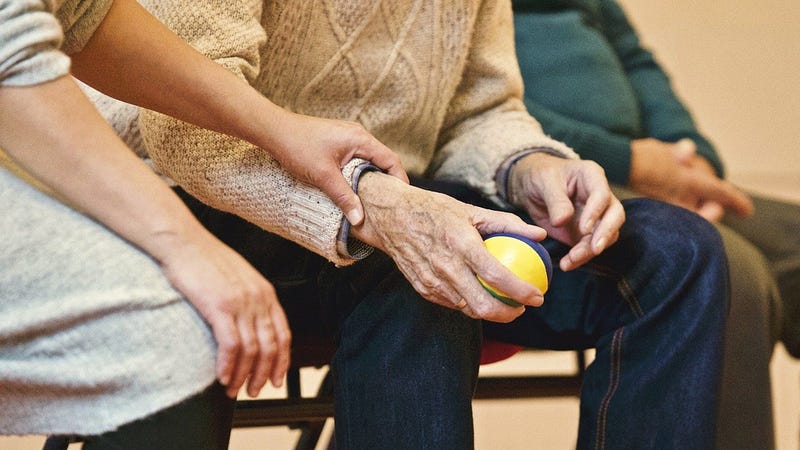
The first time I saw my father tied to a bed in four-point restraints, his wrists and ankles raw and bruising where he’d chafed at his bonds, my heart broke a little. What must it have been like for him to see me? But he hadn’t.
The times I’d been physically and chemically restrained, I was alone; my incidents predicated by an abuse of drugs and alcohol and escapism. And while it’s impossible to be sure — especially now, decades after the fact — I believe that abuse was what got me strapped to various beds. I’ve not been kept against my will anywhere since I stopped.
Substance abuse is not my father’s issue. A lifelong health enthusiast, he bought a health club that he ran for the final 35 years of his career. This past September, at 85, he had a seizure. His first. The doctors have not diagnosed a cause, and it’s likely Dad has made their efforts more difficult. In this we are very much alike.
Standing over six feet tall, until mid-September he’d been living on his own. He maintained an enormous yard, did his shopping and cooking, and still worked out five days a week. During his first hospital stay, he clawed and kicked at his bonds till they added giant padded mittens. He went at those with his teeth, struggling to pull his hand to his jaw to bite mitt. As his mind started coming back, he asked repeatedly for knives or scissors.
Though we don’t live in the same state, I happened to be in town for a friend’s wedding when he collapsed. That visit was the first time I’d seen him since before the pandemic. He was a little dotty, and we joked about how much time he spent in the bathroom, but otherwise he seemed well. I was already in airport departures when I got word he’d collapsed in the hospital’s parking garage. Coincidentally, he’d been at an appointment with their dental school for a cleaning.
In the time it took me to get a car and get to the hospital, Dad was catheterized, heavily sedated, and already tied to the bed.
Aghast, I raced to the hall to look for a doctor, but there were none to be found. What was everywhere were patients — men and women, young and old, all lying in various states of distress on gurneys in the hallway. This is healthcare in today’s Covid-ravaged America, critically overloaded.
Eventually I found a nurse who told me he was groggy because of the Haldol. Haldol? Beyond the fact that, according to their own label, Haldol can worsen symptoms, this antipsychotic has been called out for abuse in overwhelmed nursing homes as a chemical restraint. Who knew what it was doing to my father? Dad could barely speak, but he was not schizophrenic.
Back in the room I heard my dad moan. I found him chafing against his restraints, furiously trying to remove his Foley catheter. That’s when I noticed his hands and sheets were bloody. This horror show went on for three or four days until at last there was a room available in the hospital. Staff was maddeningly resistant to stopping the Haldol since he kept going after his catheter. I insisted, but had to keep checking. The doctors continued to prescribe it.
Was I helping at all?
Certainly not in the same way my dad had helped me when I was a sophomore at OSU. He saved me when no one else could or would.
When a searing pain in my abdomen developed to the point I could no longer walk to classes, I called an ambulance to get to the emergency room. Without much examination I can recall, medical professionals there told me to see a gynecologist. I was pretty sure the trouble wasn’t in my vagina, but when I returned the next day they said I couldn’t come back until I did. Begrudgingly, I went. But the OB-GYN’s internal prodding elicited screams. He took one look at my chart and told me not to come back till I’d seen a psychiatrist. By then I’d already been institutionalized twice.
Somehow I managed to drive myself to Pittsburgh where my dad took me to his internist. After watching a barium drink go through my digestive tract, his doc diagnosed a bleeding ulcer. No one asked about my substance use, but I stopped drinking. For a short while anyway. I didn’t quit smoking pot.
A lingering impact of that experience has been a suspicion of U.S. healthcare, a model that keeps patients alive in order to discharge them as soon as possible—evaluate, medicate, evacuate. Damn the torpedoes!
That suspicion flared more recently, when my mother broke her collarbone and an ER visit turned in-patient. At that point she’d survived seven years with Stage IV cancer without being in-patient for anything. I was already in high alert mode when I heard her bark at an attendant. My heart seized, remembering the second-to-last time I’d been committed.
I’d been staring at the nurse in the “day” room, the one where we had a TV. Not that I could watch; my vision was too blurred from the raft of chemicals coursing through my veins. But I could see that the nurse was wearing an ankle boot. “What happened?”
Peering at me over the magazine she’d been reading, she frowned. “You don’t remember?”
I could only offer a stunned look of, Remember what?
“You kicked me.”
I did?
I had no recollection of kicking her or anyone else, but I did recall many terrible mornings of this same woman waking me up by jabbing me with a needle and hissing in my ear, “Take that you little bitch.” Now I understood why.
At the hospital with Mom I urged caution. “Play nice. There’s never a good time to be a problem patient.” Being reasonable, my mother changed her demeanor. While she could.
In just five days she went from sitting upright and delivering witty commentary to an inability to keep her eyes open, paired with incomprehensible slurring. Haldol never came up, but I thought it obvious that they were giving her too much narcotic medication.
I was wrong.
On the sixth day she died, riddled with cancers that were more likely the cause of her impairments. That was December 1, 2014. Well before Covid and the current strain on the healthcare environment. My father’s case is another story.
Over the course of his stay we learned that Dad a raging urinary tract infection; he’d been self-administering catheters at home for some time. Apparently this is common treatment for enlarged prostates? What he wasn’t doing was taking the meds meant to shrink his prostate, or planning on getting surgery to remove it.
UTIs alone can cause seizures. But we also learned he had dementia.
Despite our protestations, after a week in the hospital my dad went home. He does not live within walking distance to anything and had lost his license because of the seizure. He claimed he’d simply call for cars, but it became my sister’s burden to take him to the grocery store and various medical appointments. Though nearby, she also lives alone and works full-time.
Then in November, Dad had a second seizure. He’s been in the hospital since.
I have no doubt my dad would be in better shape if he’d had a frank discussion about his care needs prior to being hospitalized, but our family has never discussed such things. Despite my mother’s seven-year cancer battle, she had legal will or no end-of-life directives. Yet about six months ago, my father suddenly announced he was making my sister his power of attorney. Had he known about the dementia?
After the second seizure, dad went into the ICU where he was intubated and once again put on Haldol. This time I wasn’t there, and he was on Haldol for a week before I was able to get his doctor on the phone. Since his first stay, I’d discovered that Haldol is potentially fatal for dementia patients. This new physician knew nothing of my father’s prostate issues, though he agreed to take him off Haldol. I could only hope he would; I’d been told that before. I hopped on another plane and spent several days by Dad’s side, trying to coordinate communication among his caregivers.
Still I question, am I helping?
No one is more surprised than me at this urge. Our relationship has long been fraught. No one in my family was thrilled when Dad bought that gym, but I was particularly put out at having to use food stamps for school lunches, especially since I was working for him. He was obsessed with his business, it was the only thing that held his attention. In protest, at 15 I ran away from home for three months. If I could’ve enrolled in high school I’m not sure I would have returned. When dad saw the boxes I’d packed up my senior year he asked what they were for. He didn’t pay for my college, though he did claim me as a dependent.
Though he never involved himself in my psychiatric care, I’ve never even considered whether his oversight — or any medical advocate — would’ve made a difference. Even after the bleeding ulcer was discovered, I went back to my waste bin approach to using, taking as much of whatever drugs or alcohol I could get my hands on. I never took my psych meds properly, I’d cheek them on the floor and take them only sporadically if at all on discharge. Until I could stop abusing substances, my medical troubles piled up.
I’m not sure what the solution is for Dad. The cycle he’s in is vicious. When he’s lucid enough, he fights his restraints, forgetting he has a catheter but well aware he’s in pain. Then there’s a cycle known as “sundowning” where, as the sun goes down, the patient becomes more disoriented. It hits my dad hard. I’ve witnessed some of it, but not the middle of the night events, when no visitors are allowed. He’s fallen, been verbally abusive, and punched staff.
He keeps getting worse, but when I’m there, I unclip his restraints anyway.
RELATED READS:
For a first look at my essays and news of my forthcoming memoir, Blissful Thinking, head over to my free monthly email, Notable, humor, stories and inspiration that won’t make you gag.


