
The Absurdity of the Court Pretending Words Mean What They Want
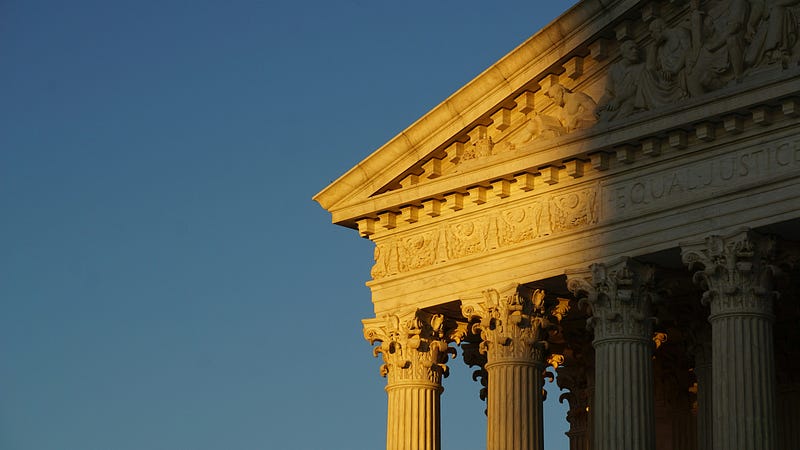
The Supreme Court of the United States seems poised to overrule the Colorado Supreme Court and put Trump on that state’s ballot.
The voters don’t get to decide if someone who will still be under 35 on inauguration day can become president. Nor can voters elect someone who is foreign born.
I’ve never heard the argument that we can simply ignore those rules because they disenfranchise voters. We can’t have President Schwarzenegger, no matter how much we like him, unless and until the Constitution is amended to permit a foreign-born president.
And so it is with those who are disqualified from the presidency by Section 3 of the 14th amendment. Want to be president? Insurrectionists need not apply.
The enforcement of ballot eligibility has always rested with the States. In this case, the Secretary of State of Colorado determined that Trump was ineligible based on the 14th amendment section 3. Had Trump been 20 years old or born in Bolivia, he could have made the same ruling — and nobody would be questioning that he had the authority to do so.
Ridiculous Rationales for Violating the Constitution
I’ve listened to the oral arguments regarding the Colorado case now before the Court. I agree with the vast majority of analysts who conclude that the Court is leaning strongly to restoring Trump to the ballot.
They are grasping at straws, not laws, to do so. As an American, I find this spectacle embarrassing.
The Arguments
So this is what we are hearing…
- This part of the Constitution doesn’t apply to a president; he is not an officer
- Allowing the single state of Colorado to remove Trump from the ballot would affect the election outcome and therefore dis-enfranchise voters from other states.
- The amendment does not definitively block Trump. There is a condition. He CAN legally become president (despite his involvement in the insurrection) IF 2/3rds of Congress votes to make him eligible after he wins election but before he is slated to be sworn in.
We heard little dispute that Trump was involved in the insurrection, either through his active support, or by providing aid and comfort to insurrectionists. Many of us heard Trump publicly say at the time, live on TV, to the insurrectionists that he loved them.
The arguments before the Court largely center on the three points listed above.
The wording of the amendment uses similar words to those appearing elsewhere in the Constitution referring to various officials and officeholders but NOT the president. Therefore, we are supposed to conclude that this amendment excludes the president.
If so, it’s really hard to see what the rationale of the authors was for doing so. Would they have been okay, for example, if Jefferson Davis ran and was sworn in as president? Nothing like that appears in the actual Congressional discussions that preceded ratification of the amendment. This is an invented argument with no historical basis. I might add that the authors of this amendment wrote it 90 years or so after the framers wrote the Constitution itself. So, maybe they used their own wording.
“I Don’t Like The Result” Is NOT a Legal Argument
We heard some Justices suggest that allowing the State of Colorado to enforce the 14th amendment by removing an illegal candidate like Trump from the ballot would cause chaos. Other states would do what THEY want, and the whole thing would be a mess.
So, yeah, IF a state decided to remove Biden on the argument that HE engaged in insurrection they can do that. And the case would go to a higher court, and if it’s determined that Biden did, in fact, engage in insurrection or provide aid and comfort to insurrectionists, the Court would affirm his exclusion.
But if not, the Justices would (or at least should) tell the state to kiss our asses in Macy’s window. Which would be the appropriate response.
The job of the Court is to interpret and clarify the law. That’s it. What happens next is up to others.
Running Just In Case
Point number three seems silly but logically the best case for keeping Trump on the ballot. It is, in fact, true that there is no logical contradiction in the argument that the amendment does not clearly specify that an insurrectionist (or insurrectionists comforter) cannot RUN for the presidency. It simply says he cannot hold the office UNLESS 2/3 of each house of Congress votes to allow him to serve.
Legally speaking, under this perfectly logical yet strange reasoning, Trump COULD be permitted to stay on the ballot. HOWEVER, it’s still questionable whether or not the state of Colorado should be compelled to keep him on the ballot.
But, I would say, that IF Trump is retained on the ballot on the basis of hypothetical conditions that would allow Trump to serve, we owe it to voters to remind them of the conditions. They can then select Trump and elect him if they choose. Even if he wins the election, he CANNOT become president unless 2/3 of each house of Congress removes the disqualification, as specified in the amendment itself.
Any observer can see that the possibility of such an outcome is vanishingly small.
Back in the year 2000, in Bush v. Gore, the Court unapologetically effectively disenfranchised the majority of American voters and gave the single state of Florida the power to invalidate their votes. Somehow, back then, in the case of presidential elections, the Court was fine with a single state determining the outcome. What’s changed? Only the person who stands to benefit.
NOTE: This is a particularly interesting paper on the history of this amendment: AMNESTY AND SECTION THREE OF THE FOURTEENTH AMENDMENT by Gerard N. Magliocca
Of particular relevance is THIS:
Turning to the text of Section Three, the first notable point involves its list of the federal offices subject to exclusion. Senators, Representatives, and electors for President and Vice President are specified. After that, the text refers to “any office, civil or military, under the United States.” One implication of this language is that Senators, Representatives, and electors do not hold an office under the United States. The other implication is that the Presidency and the Vice-Presidency are each offices under the United States. During the debate on Section Three, one Senator asked why ex-Confederates “may be elected President or Vice President of the United States, and why did you all omit to exclude them? I do not understand them to be excluded from the privilege of holding the two highest offices in the gift of the nation.”30 Another Senator replied that the lack of specific language on the Presidency and Vice-Presidency was irrelevant: “Let me call the Senator’s attention to the words ‘or hold any office, civil or military, under the United States.’”31 Practically speaking, Congress did not intend (nor would the public have understood) that Jefferson Davis could not be a Representative or a Senator but could be President.
Thanks for reading.
Please follow me on Medium. I’m not that interested in Trump. I am interested in the Supreme Court and have worked for the National Constitution Center. Nothing I write is endorsed by or reflects any position by the Center which is a non-partisan educational institution. The ideas and opinions are my own.
Most of my writing centers on the climate and The Saners movement, an emerging group dedicated to using effective non-violent actions to protect our common planet. See WeAreSaners.org.