
Mean Wage Movement
The Absolute Privilege of Life on Earth | Chapter 1
Why our planet is worth saving
← Introduction | Chapter 2 → | Latest chapter → →
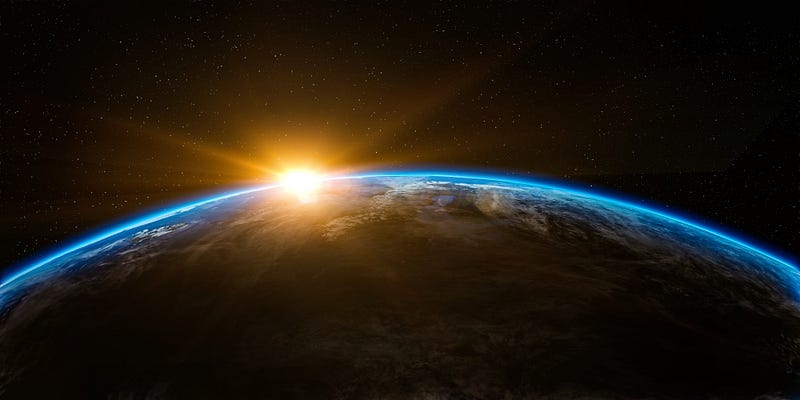
“Breathable air is all around us. Life finds a way in every possible place. Liquid water covers most of the planet. Food grows out of the ground. The temperature outside is tolerable. We are not being blasted with deadly radiation or corroded with acid.”
If those statements seem mundane, it’s only because we’ve spent our lives on a very special planet. What seems “normal” for us is anything but normal.
We don’t always stop to think about it, but these hospitable conditions exist nowhere else in the universe that we know of. We are clinging to the tiniest oasis of habitability, a little speck of an infected rock flinging its way around the galaxy.
The human body could not survive exposure to the elements anywhere except Earth. Travel up into the atmosphere even 6–7 miles, and you would die from cold and lack of oxygen. Ascend higher and the vacuum of space would kill you. Beyond Earth’s magnetic field, radiation would also kill you. Travel to any other known planet, and the conditions there would immediately kill you as well.
The universe is instantly lethal to a human — unless you’re at the bottom of Earth’s atmosphere. What a relief we’ve got such a friendly planet for a home!
Our biosphere — the part of the world where life lives — is like a thin film on the surface of a ball, and we are utterly dependent on it for our survival. Our ability to eat, drink, and breathe is the result of a complex network of ecosystems and biogeochemical interactions that have been developing for a few billion years; a system we have adapted to fit into and thrive inside. We are custom made for this planet.
We perceive Earth as expansive, stable, and predictable. Our baseline impression is that the world has “always been this way.”
However, from the first microbes through many stages of development of life, changes in atmosphere composition, formation of the oceans, continents colliding and tearing apart, mass extinctions — it’s been an epic saga just to arrive at this chapter. And it won’t stay the same forever.
It’s only in the last couple centuries that we’ve gained an appreciation for exactly how vulnerable, small, and rare a place like this is.
It used to be the default assumption that Earth was the center of the universe, a static expanse of ground around which all objects in the sky orbit. Without the tools of math, science, and technology, it’s easy to understand why someone walking on the surface of a big planet, taking their senses at face value, would naturally perceive it that way.
It was once easy to assume the Earth was here for us. We were the only sentient creatures here at the center of the universe, and we needed to understand how we got here, so we came up with origin stories. We wrote ourselves in as God’s favorite idea, the pinnacle of creation, the main reason anything exists at all.
Gradually, we made some startling realizations that dethroned us from our supremacy:
- Wait, we evolved from “lesser” creatures over many millions of years?
- Earth isn’t flat and stationary, but actually a sphere that orbits the sun?
- All those stars in the sky are the same thing as our sun?
- That cloudy swath in the night sky is billions of suns, organized into a galaxy?
- [Less than 100 years ago:] Wow, other galaxies exist outside of our own?
- [Recent decades:] There are 2 trillion other galaxies in the observable universe?
At every step of this realization — as we gain an appreciation for how small we really are in both time and space — it seems less and less likely that any divine force is keeping track of what we do to our planet, waiting to step in if we mess things up.
Earth is not invincible; as our population and our consumption have grown, we’ve seen that our actions can have a significant impact on climate and ecosystems. Our future depends largely on what we collectively choose to do right now.
I can’t say it better than Carl Sagan in his response to the “pale blue dot” photo of Earth, taken by Voyager 1 from a distance of 6 billion km / 3.7 billion miles:
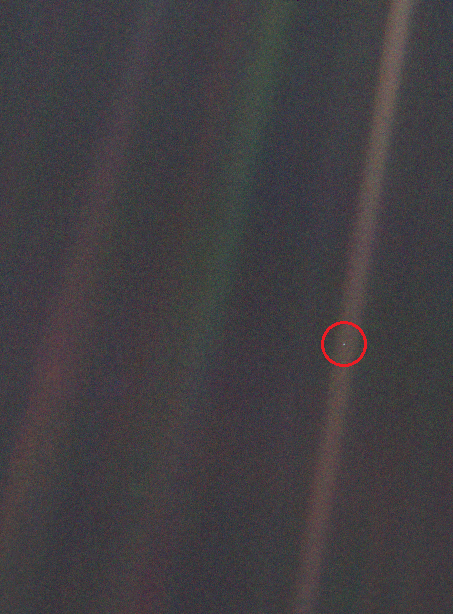
Look again at that dot. That’s here. That’s home. That’s us. On it everyone you love, everyone you know, everyone you ever heard of, every human being who ever was, lived out their lives. The aggregate of our joy and suffering, thousands of confident religions, ideologies, and economic doctrines, every hunter and forager, every hero and coward, every creator and destroyer of civilization, every king and peasant, every young couple in love, every mother and father, hopeful child, inventor and explorer, every teacher of morals, every corrupt politician, every “superstar,” every “supreme leader,” every saint and sinner in the history of our species lived there — on a mote of dust suspended in a sunbeam.
The Earth is a very small stage in a vast cosmic arena. Think of the rivers of blood spilled by all those generals and emperors so that, in glory and triumph, they could become the momentary masters of a fraction of a dot. Think of the endless cruelties visited by the inhabitants of one corner of this pixel on the scarcely distinguishable inhabitants of some other corner, how frequent their misunderstandings, how eager they are to kill one another, how fervent their hatreds.
Our posturings, our imagined self-importance, the delusion that we have some privileged position in the Universe, are challenged by this point of pale light. Our planet is a lonely speck in the great enveloping cosmic dark. In our obscurity, in all this vastness, there is no hint that help will come from elsewhere to save us from ourselves.
The Earth is the only world known so far to harbor life. There is nowhere else, at least in the near future, to which our species could migrate. Visit, yes. Settle, not yet. Like it or not, for the moment the Earth is where we make our stand.
It has been said that astronomy is a humbling and character-building experience. There is perhaps no better demonstration of the folly of human conceits than this distant image of our tiny world. To me, it underscores our responsibility to deal more kindly with one another, and to preserve and cherish the pale blue dot, the only home we’ve ever known.
— Carl Sagan
It’s been 25 years since Sagan wrote those words, and it’s still true: there is nowhere else to go. We can visit the moon, and maybe Mars, but settling there is not feasible in the near future.
Earth is our only home, and it will be for a very long time, so it’s worth caring about what happens to it. We have no backup plan if things go wrong on this planet. If the ecosystems we depend upon collapse, we will go down with them.
Some people like Elon Musk believe the way to ensure human survival is to create a backup civilization on Mars in case something catastrophic were to happen on Earth. The idea is that we can’t count on Earth being a safe place forever, so we need to learn to expand into new habitats in space, and someday even become an interstellar species.
In general, I think that’s a good goal to work towards. You never know when that stray asteroid might decide to pay Earth a visit. Might as well have some redundancy.
The problem is: the odds of something random like a devastating asteroid strike happening in the next few thousand years is very low. Meanwhile, the odds of our extinction from global warming are rising every day, and that’s something we’re causing, something we can control. From a species-survival standpoint, it might not make much sense to spend a great deal of time, effort, and money on interplanetary travel right now when climate change is the more immediate threat.
If we can’t figure out how to live sustainably on a planet that literally provides us our every need, what chance do we have of making it work on Mars, where it’s horribly cold, we can’t breathe, and nothing grows?
If we can learn how to maintain a functional civilization on Earth without compromising our environment, then maybe we’ll have enough time to figure out how to live in space and terraform planets and travel to other star systems, and by then our mindset will be better geared toward building sustainable habitats.
If we manage to avoid a climate catastrophe, we’ll have time to try to solve the countless other problems society faces. If we face a collapse instead, those social problems won’t matter anymore because we won’t be here at all.
That’s why I focus on climate change as the most important threat to address.
Earth is beyond priceless and we shouldn’t give up on it — living somewhere else is not viable. Yes, we’re already seeing some irreversible effects of climate change, and it is too late to stop those, but we can still choose not to make it worse than it has to be.
This is a book about solutions, so I’m not here to convince you that climate change is a problem. I’m sure you’re quite aware that the vast majority of climatologists all around the world have been telling us that for a long time. However, I need to devote chapter 2 to describing the problems we are up against, just so we’re all on the same page, before I can dive into some ideas for positive change. Stay tuned for that next week!
Be notified when I release new chapters!