
The Absence of Silence: How Tinnitus Ruins Lives
How Tinnitus ruined my life and how I got it back

Exhaustion pushed me to write these words today. Maybe, like it happens when I’m sad or worried, writing about it will invert my mood. I always find relief in writing.
Starting from the beginning.
What is Tinnitus?
The British Association of Tinnitus defines it as “the perception of noises in the head and/or ear which have no external source. (…) those living with the condition may have to endure a ringing, buzzing, hissing, whistling or other noise.”
My Tinnitus is a high pitch noise in both ears and often, also in the brain. I invite you to listen to this clip, so you know what I’m talking about.
Dear reader, welcome to my noisy brain:
I’ve been living with this fucking ringing inside my head for 2,5 years.
It all started with a ring at night, only perceptible in silence. I didn’t pay it much attention. I always used headphones to write, my thought was “I put the music too loud today”.
Unless there’s a medical condition behind Tinnitus (like brain cancer or a perforated tympan), it’s impossible to pinpoint the cause for it. Mine is most probably years of loud music in the headphones.
A couple of months later, I start a new job, as a manager in a care home for elderly people. This change ruined my life — it would probably happen soon, but this job escalated it fast and mercilessly.
There were several factors for it: long shifts (12–14 hours a day), high level of stress (enemy number two to Tinnitus) and, the worse: bells. In every room of the care home, the elderlies had access to buttons that, when pressed, triggered a very loud bell, ringing all over the institution, so carers could hear it and attend to the client in need. The freaking bell ringed all day long.
After one month of constant stress, with the lack of rest, stress and the bell, Tinnitus escalated fast and furious.
I had no idea what was happening to me, I never heard about the condition, I just knew I had a terrible noise in my brain and I was losing my hearing.
I lost the ability to focus, to even have a conversation. I got confused when people talked to me, I couldn’t remember what someone just asked me.
The diagnose
My GP diagnosed me with Tinnitus, not explaining what it was. His only clarification was: “There’s no cure, get used to it.” He gave me a pamphlet, referred me to audiology and that was that. I was left by myself, with no understanding of the situation or treatment.
The waiting list for Audiology was two months long. I had no idea how I was going to live with my brain behaving like that.
The following week I went back to the GP and asked for a sick note, I had to step away from that maddening bell. When the sick note expired, I resigned, I couldn’t go back. And I hated my directors, they didn’t want a manager, they wanted a slave.
I had a new job starting in four weeks. Being without work for six weeks it’s financially unbearable — in England, the sickness benefits are very low. I had to borrow money, it took me six months and lots of overtime to pay it all back. Even with my friends telling me to take my time to pay back, I had to do it quickly, I hate to own money.
How Tinnitus affected my life
The time I was off, I stayed at home, protected from the outside noises. However, I was still living with a crazy noisy brain. I was starting to get desperate.
I was sleep-deprived
At night, with the world in silence, Tinnitus is more noticeable, there are no noises to distract the brain from it.
I couldn't fall asleep and when I did, several times I woke up with the ringing. During the day, I tried not to sleep so that I would do it at night. The worst time of my life.
I was isolated from the world
Tinnitus also triggered a high sensitivity to noise. Because noises make the damn thing worse, I was afraid to go outside, I couldn’t risk being exposed to loud noises.
My solution was to stop going outside. In my flat I was safe, I controlled the noises.
I think everybody who suffers from Tinnitus will agree with me on this. Our two big enemies are 1) ambulances in emergency service and 2) the green traffic lights for pedestrians. That shit hurts in the ears!
I spent weeks locked in my flat. If I had to go out I’d go with my headphones, for protection.
I craved silence
I needed silence as I never needed anything in my life.
In time, I learned to let go of this desire, but back then I was desperate for my brain to shut up.
Today, writing this, I am, again, craving for silence. Tinnitus is extremely high. I stopped dreaming about silence, I know I won’t have it again, but on days like today, it’s all I can think about.
The nullity of medicine
I live alone, and at the time, my son was living in a shared house, a few miles from me. He knew I had Tinnitus but I never told him how sick I was. I never want him to see me so vulnerable.
My friends knew about my struggle, but it was summertime, they all had travelled, either to Portugal to see their families or abroad to enjoy their deserved holidays. I was alone in my despair.
When one of my friends arrived from Portugal with her husband, they went straight from the airport to see me. They were worried, we had exchanged a few texts, and they knew I was in a bad place.
Ten minutes after they arrived, I was taken to the hospital. I needed help, they were making sure I was going to get it. I couldn’t wait five more weeks for an audiology appointment.
The doctor at the hospital said what became a cliche for me: “There is nothing I can do to help you.”
It is true: there is nothing to be done with Tinnitus, it’s all about self-management and self-control.
But for someone in crisis, sleep-deprived, going mad with a high-pitch frequency in her brain, that is the last thing we want to hear.

I collapsed, crying in the emergency room. Frustrated and surrendered. No one could help me.
Tears fell on my face, I lost strength, I thought I was going to faint. The doctor grabbed me, sat me on the chair and told me to wait. He left the room and when he came back he informed me he managed to change my audiology appointment for the following week, I was an urgent case.
I was relieved but still desperate. Nothing had changed. I still couldn’t sleep, I couldn’t hear properly, my brain was a mash.
The Audiology Appointment
I had hopes for this appointment. I read a few things about Tinnitus, I knew it wasn’t going to disappear. Still, I hoped to have a “real” condition in my ears, one an audiologist could fix.
I didn’t. The tests showed I didn’t have hearing loss. I couldn’t hear properly because the ringing in my brain was extremely high, the external sounds couldn’t pass through it. There was nothing physically wrong with me.
With that diagnosis came: “There is nothing I can do for you, you have to learn how to live with it.”
I start crying, again, unable to imagine living the rest of my life with a fucking hysterical ringing in my brain.
The audiologist said she was going to refer me to a Tinnitus specialist, however, “he will help you to manage Tinnitus, but there is no cure and only you can help yourself.”
I couldn't stop crying, silently, all my body shook. I guess I was in some kind of shock. I couldn’t believe no doctor would help me. The only thing they could do was prescribe me sleeping pills.
I was lethargic, my body refused to move. I had nowhere to go, nothing to do. My physical and emotional strengths were drained.
I was exhausted as I never was before.
The first year of Tinnitus all I did was try to sleep, eat and cry.
Like the doctor at the hospital, the audiologist felt sorry for me. She also asked me to wait and left the room. When she returned, she had two small hearing aids. Those two white noise generators became my best friends.
White noise is a combination of all existent sound frequencies, it’s also known as ecstatic noise. Its consistency makes it very effective in masking other noises, including Tinnitus ones. (I wrote this piece about white noise).
When I put the generators on for the first time, I had a glimpse of silence. I couldn’t believe it. I cried even more, but now of happiness. I couldn’t hear the ringing!
But this happiness was temporary: I soon learned that white noise doesn’t annihilate the ringing, it masks it. It helps me a lot, I use one generator all the time (I can’t use both, I can’t hear when people talk to me), but it doesn’t make Tinnitus go away.
Living with Tinnitus — I couldn't do it anymore
Weeks went by, Tinnitus was still controlling my life.
I started a new job, in a silent stress-free environment. But silence, like noise, it’s not Tinnitus-friendly. Noise makes Tinnitus worse, but in silence, all that exists is Tinnitus. Both options are terrible.
I can’t be in noisy environments and I can’t be in silent ones.
Until today, since I have Tinnitus, I can count the times I was in a silent room (less than 20).
A Tinnitus brain has to be distracted by smooth noises all the time.
When I’m at home, either I have the TV on, the white noise, or YouTube playing (however, for me, music is impossible to listen to when Tinnitus is high).
If I don’t have sound around me, the high-pitched ringing will loudly mark its presence. So, to distract my brain from it, I always have sounds around me.
This pushed me to extreme exhaustion. I became angry with my dependency on white noise, I was tired of the constant sounds around me. I just wanted silence!

I entered a negative and depressive spiral. Even with white noise masking the ringing, I still had the fucking thing, my brain was exhausted.
I couldn’t write, I couldn’t go to the pub with my friends as I used to, I couldn’t even go to our get-together as before. Everybody had to talk low and be self-conscious about noise when I was around. I hated it!
My sleep pattern was still crazy. I was sleeping better thanks to white noise (I never took the pills, I hate tablets), but everything in my life seemed artificial. I kept distracting my brain from the ringing, but it was leading me to exhaustion.
I was defeated.
At that point, I thought about suicide. There was nothing more for me, I couldn’t live like this anymore.
What (who) saved my life
One morning — another despairing, meaningless one — my life suddenly changed. My upstairs neighbour knocked at my door and told me he was moving out. One hour later, and some phone calls after, my son and a friend rented the flat. But it gets better!
I grew up with dogs and I missed having one in my life. With my crazy working hours, I couldn't have one, but now, with my son living upstairs it became possible — he was going to help me with the dog.
A week later, I rescued this lovely guy:

I knew my life would change with Jack, but I never thought he would, literally, save my life.
My son being my neighbour was an amazing help to me, of course. He came down to visit (and assault my fridge) several times a day, but Jack had a bigger impact on my health — he was always with me.
Awakening time is the worst time of the day for sufferers of Tinnitus. It has to do with being in a horizontal position for a long time. The doctor explained it to me, but honestly, I didn't memorize it. I just know that for months I woke up crying, so loud the ringing was.
Now, with Jack, I didn’t have time to focus on the ringing. He was so happy (but so so happy!) to be rescued that the first weeks, when he saw me awake, he jumped on me, and for minutes would kiss me non-stop. He made me laugh so much.
Jack’s happiness was contagious. My mornings now started with him, happy to see me, kissing me and trying to pull me out of bed to feed him. I had no time for self-pity, I had the ringing but Jack was more important, I had to get up and start doing things.
With Jack, I started to go outside again, I left my cocoon. Always with my big headphones to protect me from sounds, but I was out of the house.
My daily walks in the park with him, the love he gave me, and our playtime and snuggling moments, kept my brain distracted.
My anxiety reduced drastically and I finally started to manage Tinnitus.
Jack changed my life. He saved me from myself.
I have lived with Tinnitus for more than two years now. I also live with chronic pain due to rheumatic disease. Most of the time, I have both conditions under control, but when one goes off trails, the other follows. I have days/weeks that are unbearable to live in my body. Like today. But I have my saviour.
Jack won’t let me go down the spiral again.
When I’m feeling down, he doesn’t leave my side, he snuggles with me and won’t move. Even when I need him to: the guy snores, which is definitely not good for my Tinnitus, but he refuses to let me go. This is what he does:
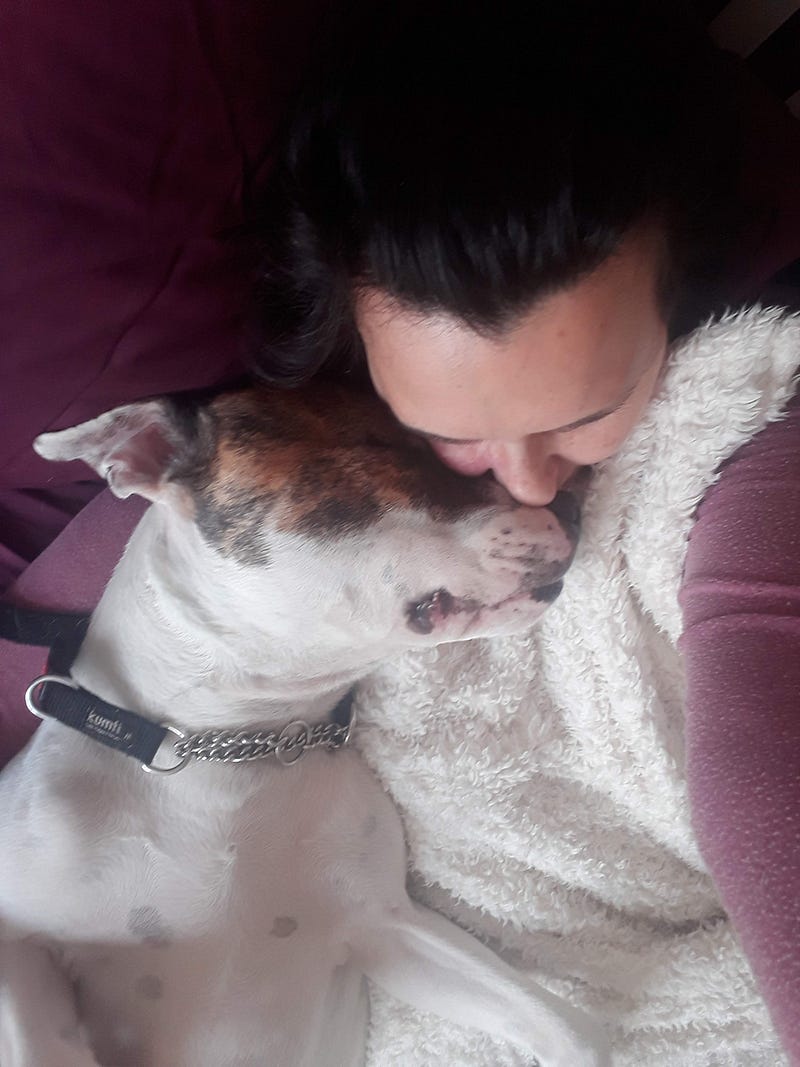
The love he gives me and the love I have for him, helps me overcome Tinnitus.
Today I am suffering. Writing about it, as I predicted, made me feel better. It made me remember how bad I was; how much I went through with Tinnitus. And how far I got.
Today is a bad day, but tomorrow it might change. I “just” need to relax, to let go of worries and disappointments. I am what matters the most.
I have to take care of myself, otherwise, Tinnitus will ruin my life again.
Living with Tinnitus is a living hell. You have to find your way to cope with it, accepting there will be bad phases but it will come back to normal — normal as “an acceptable volume of high pitch noise inside the brain.”
Tinnitus doesn’t rule my life anymore. I go out with friends, I go to the pub, even when it has bands playing live. I know the following day I will be almost def, that I will struggle to fall asleep. But I have to live my life, Tinnitus won’t steal it from me. It stole from me more than one year, it’s enough, I’m in command now.
I live with Tinnitus, not for Tinnitus.
Reading suggestions:


