
The A, B, and Cs of Me
Following the example of some others who have used the alphabet to describe who they are (or the advice they would give others), I decided that it might be a useful prompt to inspire me to write again. I’ve taken a break to write all the Republican Senators who accepted campaign donations from the NRA — and finally, there’s a nudge in the gun law in the right direction. This has nothing to do with the letter “A,” but it sort of a preamble and excuse why I haven’t been publishing anything lately. There are only so many hours (minutes, seconds) in a day, and I still have my day job (psychotherapist with a pretty full practice), social connections, dog to care for, exercise (which I forego as often as not), reading, medical appointments, eating sleeping and bathing . . . I mean! All of these things take time! Right?
So. Beginning with A:
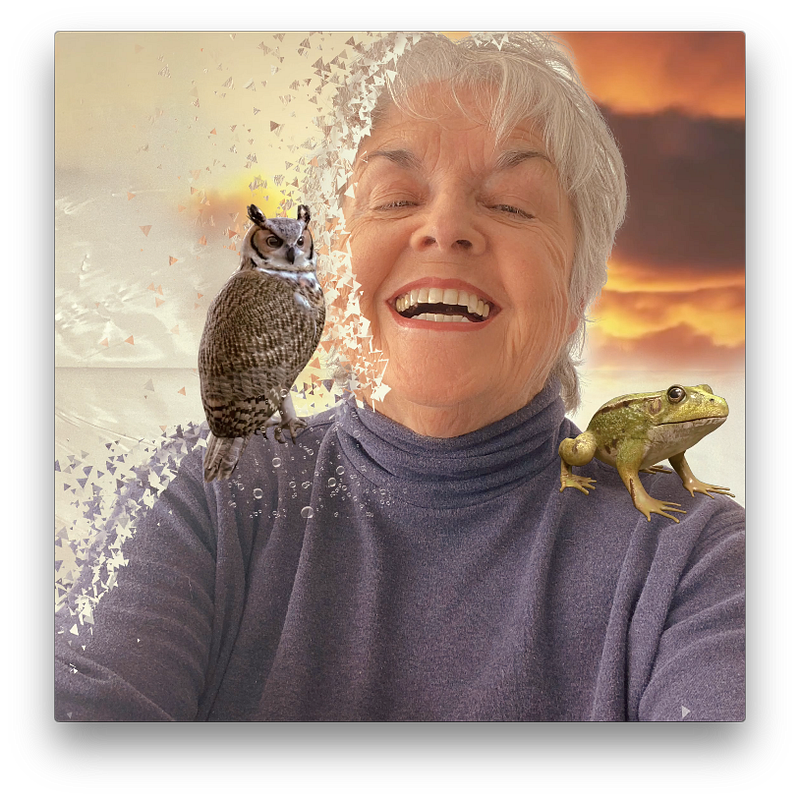
A. Adaptable. I guess that’s what the photo is about. The frog represents my adaptability. It can live in the water or on land. It adapts to its environment. When I was 10, my family up and moved lock stock, and barrel to Italy. (Now where did that saying come from? Just looked it up: it alludes to the three elements of a firearm — the lock or firing mechanism, the stock or handle, and the barrel or tube!) But I digress. The Owl can turn its head 360º and I identify . . . I can, most of the time, see all sides of an issue. It might be wise, and I might be wise on occasion after collecting 85 years of living. It’s possible to see how I’m evaporating also, which, at this age, is part of my experience. On the right side of the photo is a dark cloud which represents parts of my life, and the left side is the light into which I (hope) I’m evaporating.
My first experience of adapting was when I was very little. My father was a bipolar bigger-than-life opera singer (tenor). It took me years to think of his behavior as “abusive,” but it was. The primary emotion I recall from my early childhood was: terror. Fear of what would set him off, his disapproval, yelling, hitting. The story was proudly told by my mother of how, when I was an infant, he spanked me because I had kicked off the blankets in my sleep in my crib, and in his narcissistic twisted mind, I had done it on purpose to aggravate him (at maybe 10 months old?). I say my mother would recount this story “proudly” because she came up with the “solution:” large safety pins that would pin me in under said blankets. This has probably resulted in my tendency toward claustrophobia and inability to sleep “tucked in.”
On the other hand, he could be loving and devoted, and it was this state I constantly looked out for: what could I do to elicit his approval, his loving side? I became hyper-vigilant, looking for what I was doing that would set off his rage or what I was doing that would meet with his approval and love. I seldom got it right.
My mother was the “safe” one, but distant. She was the one who would smile benevolently and, when she was around, protect me, but I seldom felt connected to her. I idealized her, seeing her as all-good, somewhere else consulting with the gods in a rarefied atmosphere. She was a writer, a singer, a painter . . . a “creative.” She had met my father in Honolulu when he had come over from the mainland to sing Pinkerton in Madame Butterfly and she was in the chorus. She had been sent to Hawaii ostensibly to get over a love affair with her piano teacher whom her family (apparently, so I’ve been told, an “aristocratic” family with money) deemed as unsuitable. She lived there for a couple of years before meeting my father, and I can’t imagine that her family was much more thrilled with a tenor than they had been with the piano teacher.
Back to Italy. It was 1948. The war was over. My father’s dream was to sing at La Scala in Milan. So, lock stock and barrel off to Italy we went: 4 kids (I was the second) and my parents. For me the move was traumatic. Leaving 5th grade where I had just begun to make my social presence felt, everything familiar — neighbors, neighborhood, school, home — to go to a country that was still showing the scars of war (Milan was still very much bombed out). It was freezing cold. Lights were dim (metaphorically and actually . . . 25-watt lightbulbs). Everyone spoke a language I didn’t understand, smells were different, and food was different (I missed peanut butter, hamburgers, and Fritos!). When the head of La Scala told my father that no American would ever sing there, only Italians, we moved south to Rome: warmer, more intact because it had been spared from the war’s bombing out of respect for the Vatican (or so we were told), and more welcoming. Still, vastly different from our home in L.A.: I slept on a straw mattress. I was still cold most of the time in the winter. The aqueduct bringing water to Rome would break down regularly, and we would have to go to one of the ubiquitous street fountains which (I guess) were fed by a different aqueduct where the maid would fill buckets and bring them back to the apartment . . . having a “maid” because everyone did. They were inexpensive, and my mother welcomed the relief from housework and shopping and cooking after years of doing it in the U.S. After a disastrous try at an Italian school in which my sense of not belonging was intensified by the curiosity of the well-meaning Italian children who regarded me as a curiosity, like a cute animal in a zoo, my mother located a Catholic International school run by American and Irish nuns, Marymount. It was there that I spent 5th grade through high school, the school where I met lifelong friends, where I felt welcomed and protected while indoctrinated into the teachings of the Church which took me years to shed and come to my own understanding of the divine without dogma.
Family life was chaotic. My father had a heart attack the second year we were there, survived but never sang at the Rome opera. He got acting parts in the post-war movie “Boom,” and to this day I will occasionally see him late at night in an old Italian movie directed by Vittorio De Sica or some other well-known Italian director. My parents were not getting along. There was lots of yelling and conflict, and my impression was that the primary way of communicating, between me and my siblings and parents, was to see how badly you could make the other feel. My parents both attempted suicide, and I was the one responsible for getting the help that saved their lives. They separated when I was 17, and my father came back to the U.S. I was desperately unhappy and in retrospect, feel that I was not only supported by my friends but saved by them.
I suppose I could continue with the ways in which I have had to adapt here, but I think that I’ll find ways to use the other letters of the alphabet to describe additional aspects of my life and the elements that have helped make me who I am that will link this early part to successive periods, all of which have required a certain amount of adaptation. So “A” is for Adaptable.