
The 91st Academy Awards was the Worst Possible Outcome in Nearly Every Way
The show may have been short, but it was passionless and predictable up until a shocking Best Actress upset and the single worst Best Picture winner of modern times (if not all time).
Well, the strangest year in Oscar history is now mercifully over. The precursors were marked by an unprecedented divergence of opinion, which led to wide open field. Meanwhile, the Academy proposed a series of shakeups to the telecast that they quickly rescinded after industry outcry. The result was a painfully dull ceremony and a set of winners that veered toward the spectacularly undeserving.
My Take on the Winners
- Let’s get this out of the way first. I have seen nearly every Best Picture winner of the past half century and I can say unequivocally that Green Book was the worst. As I wrote in a previous post, “If you’re going to release a film in 2018 that includes scenes in which a white man teaches a black man how to eat fried chicken so he can be more authentic and a queer man begs forgiveness from a straight man after being arrested for consensual gay sex, you better have a compelling reason for doing so. This film does not. It is a clunky throwback to the old days in every way — its tone, its pacing, its ideology, and its characterizations. And even worse than being un-woke and out-dated it is woefully boring and riddled with cliches.” It failed to move me in its dramatic scenes or amuse me in its lighter ones. And the only thoughts that were provoked after I finished seeing it were how it got so far in awards season in the first place. Its win for Best Picture and Best Original Screenplay will likely go down as someof the worst (if not the worst) in the history of both categories.
- Almost as bad as the Green Book wins was Bohemian Rhapsody going 4-for-5. Although it was more entertaining than Green Book, the Freddie Mercury biopic was a by-the-numbers film that was highly problemaatic in how it portrayed its subject’s sexuality and racial background. It should have been nowhere near the Oscar race. (And critics agreed; its Metacritic score of 49/100 is the second lowest for a Best Picture nominee since the inception of the metric.) The only bright spot was that Rami Malek gave a very touching speech and the sexual predator (Bryan Singer) that directed the film was not nominated.
- Although I did not like Green Book, I cannot begrudge the gifted Mahershala Ali his win for Best Supporting Actor. He was the only element of Green Book that was watchable and — even though I would have preferred the brilliant Richard E. Grant win for Can You Ever Forgive Me? — Ali will not be remembered as an undeserving winner.
- Regina King managed to overcome shocking BAFTA and SAG snubs and the weak reception of her film (If Beale Street Could Talk) by the Academy and get a richly deserved Oscar. Her deeply moving speech shows why she is so well-liked in the industry and gives even those unfamiliar with her a taste of the soul that she brings to her performances.
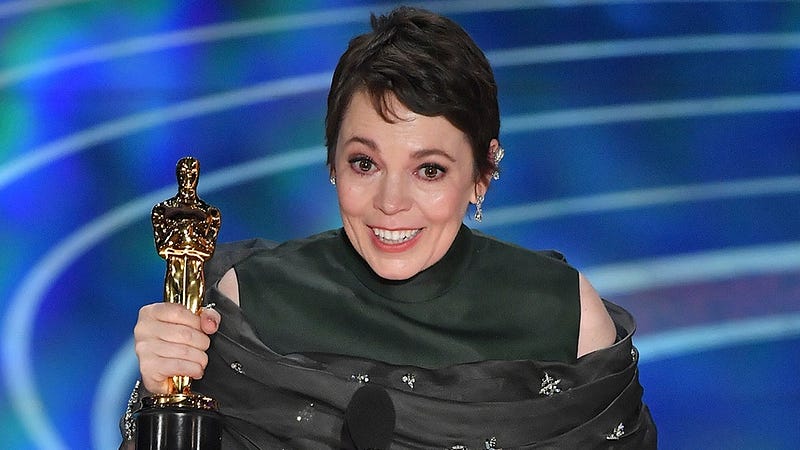
- Olivia Colman was also very worthy, despite the fact that her win came at the expense of a long-overdue win for Glenn Close (more on that below). It was a genuinely jaw-dropping moment and it provided a great showcase for Colman’s off-beat humor. Also, it stopped The Favourite from being the only Best Picture nominee to go home without a win.
- Despite the fact that Roma did not win Best Picture, Alfonso Cuaron had a great night as he added 3 more trophies (Best Director, Best Foreign Language Film, and Best Cinematography) to the Best Director statue that he won for Gravity.
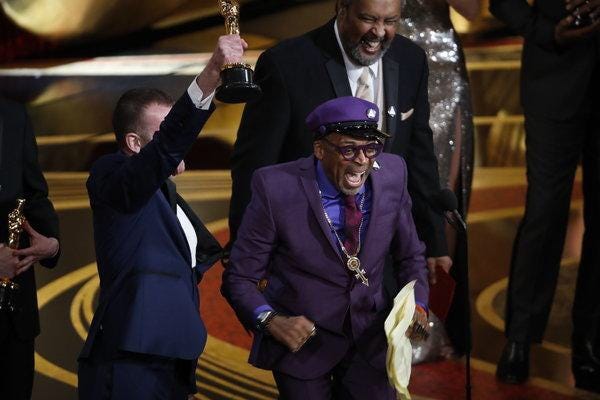
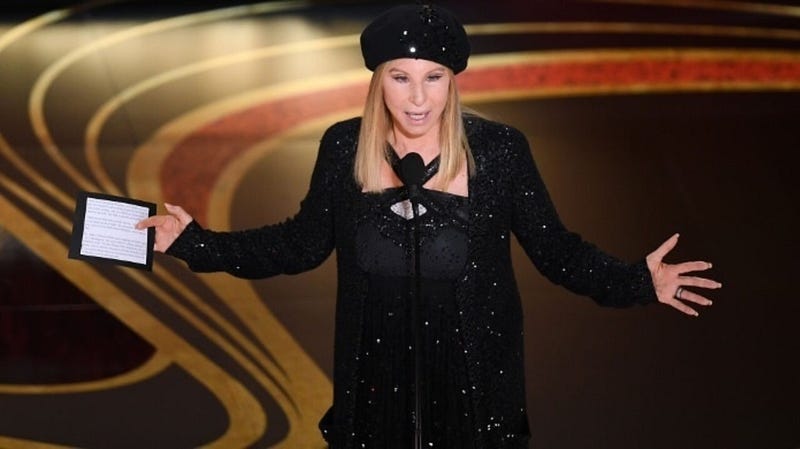
- Spike Lee finally has a competitive Oscar! After having been famously snubbed many times in the past and eventually awarded an honorary Oscar, Lee came roaring back with a Best Adapted Screenplay win (and a long overdue Best Director nomination) for BlacKkKlansman. His impassioned speech was a highlight of the night as were the endlessly meme-able reaction shots, most notably his deadpan response to Awkwafina and John Mulaney’s banter, his whooping when Barbra Streisand mentioned they were both from Brooklyn, and his clearly annoyed reaction that he lost Best Director to Alfonso Cuaron.
- She may have lost Best Actress, but Lady Gaga now has an Oscar (for writing “Shallow” from A Star is Born.)
- Most of the technical and specialty film categories went to the expected winners. Highlights were Black Panther beating more traditional nominees for Best Production Design, Best Costume Design, and Best Original Score and the unfairly overlooked First Man getting a win for Best Visual Effects. The low point was definitely the wins for Bohemian Rhapsody in Best Film Editing, Best Sound Mixing, and Best Sound Editing. Its win of the latter two awards is particularly baffling given that it utilized pre-recorded music and broke no new ground sound-wise (in sharp contrast to fellow nominees Roma, A Star is Born, and First Man.)
- I successfully predicted 17 of the 24 categories. Although this was not my best performance, it was not bad considering what a strange year this was.
Facts and Figures about the Winners
- Green Book became only the 5th movie in history to win Best Picture without a nomination for directing (it last happened in 2012 when Ben Affleck was snubbed for Argo.) It also became only the 3rd movie since the inception of SAG to win Best Picture without a SAG nomination for Best Ensemble Cast (it last happened just last year with The Shape of Water). It became the first film to win Best Picture without either a Best Director nomination or a SAG nomination since the inception of SAG.
- Alfonso Cuaron became the 19th director to score 2 wins in the category. (As mentioned above, he previously won for Gravity).
- Astonishingly, Cuaron’s win means that 5 out of the last 6 years the Oscar went to Mexican directors (Cuaron won in 2013 for Gravity, Alfonso Gonzalez Innaritu won in 2014 for Birdman and in 2015 for The Revenant, and Guillermo Del Toro won in 2017 for The Shape of Water). No Latino director had ever won prior to 2013. Even before they started sweeping the Oscars, Cuaron, Innaritu and Del Toro were known as “The Three Amigos.”
- Cuaron’s Best Director win is the first time a streaming service has won a major Oscar (Roma was released by Netflix).
- Rami Malek is the first winner of Egyptian descent. He also joins the list of actors who have won an Oscar and an Emmy for a regular role on a television series. (He won Outstanding Lead Actor in a Drama Series for Mr. Robot in 2016.)
- Glenn Close extends her record for most acting nominations without a win among all living actors. She is now 0-for-7. Close behind her is Amy Adams who has never won and lost her sixth nomination this year for her role in Vice. And speaking of painful losing streaks, Diane Warren now has been unsuccessfully nominated for Best Original Song 10 times.
- Mahershala Ali’s win for Best Supporting Actor makes him only the second black actor in history to win more than one Oscar (Denzel Washington is the other.)
- All eight of the Best Picture nominees won at least one award and no film won more than four awards. There is a definite trend toward “spreading the wealth.”
A Review of the Telecast
The Academy did not quite keep their promise of getting the show down to under 3 hours, but it was still far shorter than any ceremony in recent memory. But the cost was that everything felt rushed and absolutely nothing unexpected happened (save a couple of surprise winners and inspired speeches, which are elements outside of the control of the show’s producers).
Many will surely applaud the lack of the unnecessary clip packages, musical tributes, skits, and other filler that pad most Oscar ceremonies. But it turns out that when the fat is trimmed, things become exceedingly workmanlike. Exhausting and uninspired. The show presented all 24 awards, had a little presenter banter, a few musical numbers, and in the In Memoriam segment. That’s it. Not a lot of room for fun or spontaneous things to happen.
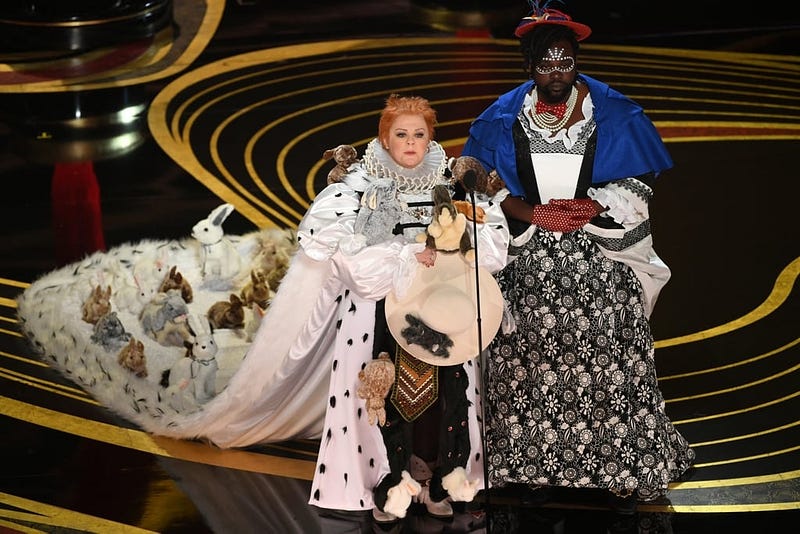
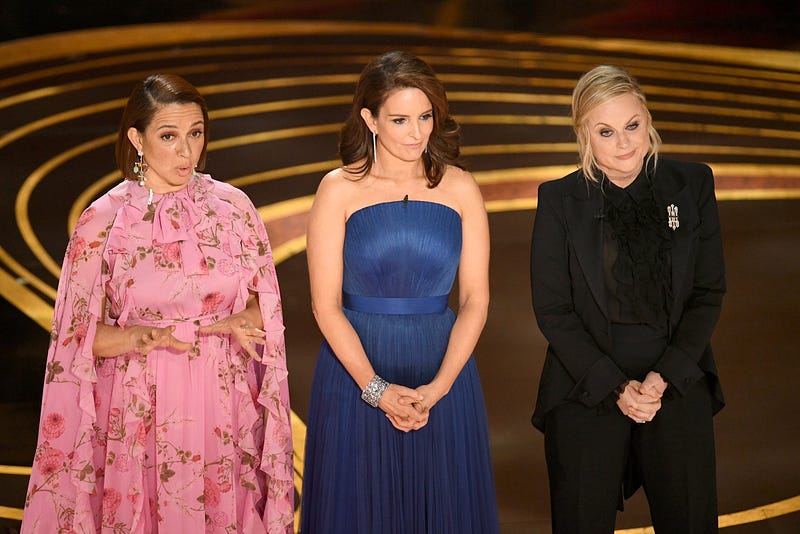
The show made a few smart choices with regard to on-air talent, including the selection of the legendary Barbra Streisand and Julia Roberts to take the stage during key moments late in the show and giving extended presenter bits to Tina Fey, Amy Poehler, and Maya Rudolph (who essentially served as a 3 minute hosting monologue) and Melissa McCarthy and Bryan Tyree Henry (whose Costume Design shtick was a real highlight).
But the rest of the presenter selection was a mess. The use of famous people without obvious ties to the film industry was perhaps interesting on paper but it failed in execution. As gifted as they are in their respective crafts, I don’t particularly care what Rage Against the Machine’s Tom Morello, tennis superstar Serena Williams, or Chef Jose Andres have to say about this year’s Best Picture nominees. (One exception was Civil Rights leader/Congressman John Lewis…I did care what he had to say.) And the remaining presenters were either randomly paired (e.g., Dame Helen Mirren and Jason Mamoa, Pharell Williams and Michelle Yeoh) or obvious attempts at appealing to young viewers (e.g., the fact that at least 10 of the presenters are key players in the Marvel Cinematic Universe). What’s wrong with having actual A-list film industry legends in the film industry on stage? Is it that they are invited, but won’t accept? Or are they just not hot and fresh enough to get good ratings?
The telecast had 6 musical performances, all of which were fine. Queen (with Adam Lambert in the role of lead vocalist) opened the show with a medley that should have set us up for a big night for Bohemian Rhapsody. It was a solid performance, but the shots of the crowd rocking along looked very forced and I don’t like it when the Academy singles out a single Best Picture nominee for excessive attention. Gustavo Dudamel and the LA Philharmonic did a lovely job with the “In Memoriam” segment and it was nice not to have the distraction of a singer belting a melancholic song during it.
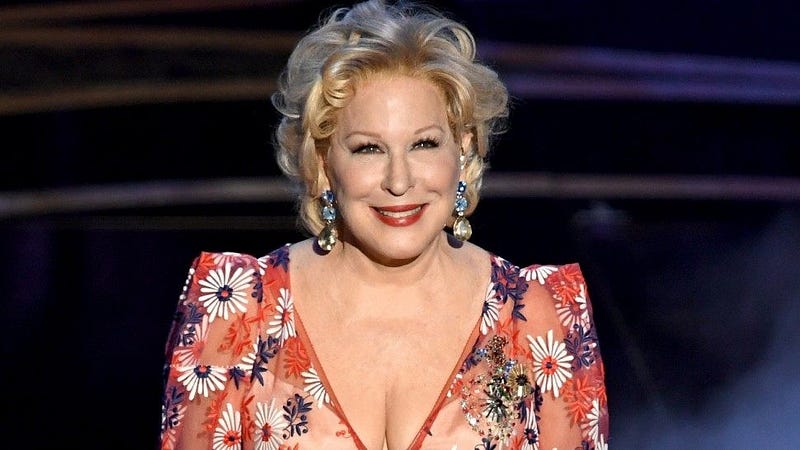
Four of the five nominated songs were performed. (Kendrick Lamar declined his invitation to perform “All the Stars” from Black Panther.) Jennifer Hudson showed off her impressive set of pipes with “I’ll Fight” from RBG. Gillian Welch and Dan Rawlins did a nice job with the folksy “When a Cowboy Trades His Spurs for Wings” from The Ballad of Buster Scruggs. The legendary Bette Midler stepped in for Emily Blunt with a gorgeous performance of “The Place Where Lost Things Go” from Mary Poppins Returns. (And she looks and sounds absolutely wonderful for 73.) Then there was Lady Gaga and Bradley Cooper’s beautiful rendition of “Shallow.” In sharp contrast to her performance of the song at the Grammys a few weeks ago, it was toned down, tender, and beautiful. It was also cleverly staged as the instruments were brought out without introduction and Gaga and Cooper silently walked to the stage from their seats to perform. It was one of the night’s few highlights.
Perhaps next year, the show’s producers can stop trying so hard to make things appealing to young viewers and can focus on celebrating the art of movie-making with actual film industry stars and inspired tributes to film history.
Oh, and if the voters could not give half of the awards to a trio of dumpster fires (Green Book, Bohemian Rhapsody, and Vice) that would a big help as well.
The Winners (in order of presentation):
Best Supporting Actress: Regina King, If Beale Street Could Talk
Best Documentary Feature: Free Solo
Best Makeup and Hairstyling: Vice
Best Costume Design: Black Panther
Best Production Design: Black Panther
Best Cinematography: Roma
Best Sound Editing: Bohemian Rhapsody
Best Sound Mixing: Bohemian Rhapsody
Best Foreign Language Film: Roma
Best Film Editing: Bohemian Rhapsody
Best Supporting Actor: Mahershala Ali, Green Book
Best Animated Feature: Spider-Man: Into the Spider-Verse
Best Animated Short: Bao
Best Documentary Short Subject: Period. End of Sentence
Best Visual Effects: First Man
Best Live Action Short: Skin
Best Original Screenplay: Green Book
Best Adapted Screenplay: BlacKkKlansman
Best Original Score: Black Panther
Best Original Song: “Shallow,” A Star is Born
Best Actor: Rami Malek, Bohemian Rhapsody
Best Actress: Olivia Colman, The Favourite
Best Director: Alfonso Cuaron, Roma
Best Picture: Green Book
To read my detailed analysis of the nominees in the Top 8 categories, take a look at my two part article: Part I and Part II.
Click here to read my take on how LGBTQ issues were represented in this year’s Oscar nominees.
Consider following me on Medium and/or Twitter for more commentary on Hollywood happenings.
Check out my other awards show articles on the Golden Globes, Screen Actors Guild Awards, Primetime Emmys, and Grammys.
Check out my articles about the following nominees: BlacKkKlansman, Black Panther, and A Star is Born.


