
Your Boring Office Job Might Actually Be Perfect for You
Without a Community, You Won’t Succeed
It happened last Thursday in a Paris metro station as I strutted down the connection between the metro lines 1 and 9. A spasm through both cheeks: what was going on? I reached up and touched the sides of my face, trying to get a beat on what was happening.
I was smiling!
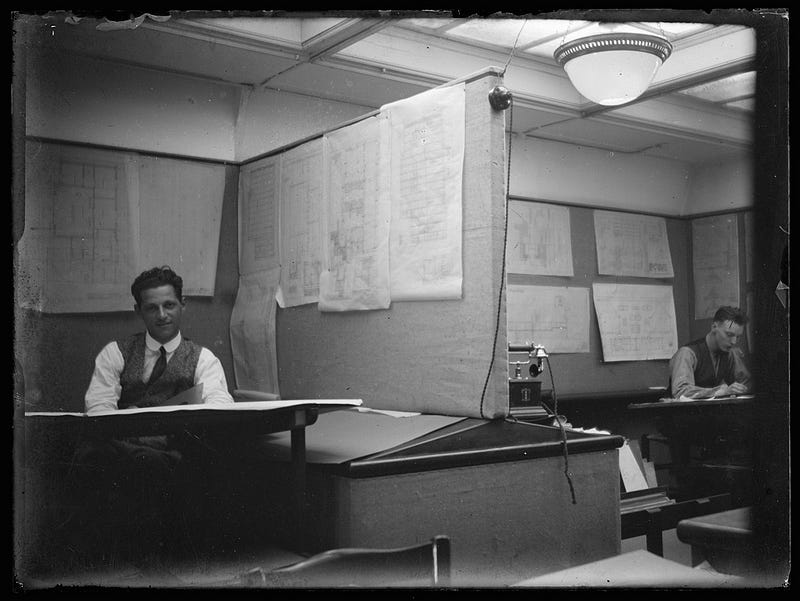
For the last 8 weekdays, I’ve been on assignment in Paris, France. Each of those mornings, I climbed into a train packed with bodies, took a 38-minute commute to the office, and worked from precisely 8:50–5:30.
Despite this, I had a grin plastered all over my face.
I thought an actual commute would be murder: wrong. I thought being back in an office environment would be miserable: wrong. I thought sitting in the same physical space as coworkers would be pointless: wrong. Instead of suffocating, my new routine feels comfortable and warm.
This feels traitorous. What self-respecting millennial could possibly admit to loving an office? After another week of self-reflection, I came up with these things.
1) It’s a not a workspace. It’s a Work Space
Working from home, the ideal day typically goes like this:
- 5:30 am: wake up and walking the dog (well, he walks me)
- 6:30 am: drink my water, and reading or writing
- 8:00 am: eat breakfast with my wife Kate
- 9:00 am: tackle the most important task for my “real job”
- 10:30 am: take a break for some laundry, dishes, or other household work
- 11:30 am: lunch
- 12:00 pm: back to computer to work some more
- 2:00 pm: run some errands around town
- 3:00 pm: finish any lingering work, send any emails which need to be sent before the next day
- 6:00 pm: eat dinner
Sounds reasonable, right? But in reality, maybe one out of every ten days goes exactly as planned. The rest often look like this:
- 6:37 am: the dog spots a cat across the street and loses his mind whining and barking
- 8:30 am: breakfast turns into doing dishes which turns into straightening the kitchen which turns into a family budget meeting
- 11:30 am: oops the dog allegedly needs to go outside again
- 11:45 am: a family member calls to see if we want lunch. It’s been a while since we caught up so Kate and I go. I think “I’ll finish that later”
- 2:00 pm: there is traffic in town, Walmart didn’t have the thing I needed, and Kate and I stop for a snack before getting back home
- 5:00 pm: I’m hungry and a little bored, so I call it a day and help with dinner
None of these unexpected interruptions are bad, per se. However, they are temptations, easy escapes for me when I don’t want to finish whatever task I have at the moment. The punishment for this procrastination is deferred work. The deference, of course, builds up until it reaches a fever pitch. Usually there’s a mad panic on Friday when, driven mad with stress and guilt, I lock myself in the office and rush through sub-par work.
With my Parisian office, there are no surprise errands, no dogs, and no family. My brain says: “Oh, this is a Work Space. We work here.” The triggers in my environment tell me what to do and I do it. No questions asked.
2) Insider information
At home, Kate and I eat lunch together most days. We often have meaningful conversation about the broader vision and impact of our lives. Thanks to my flexible schedule, we don’t have to work these important conversations in at the end of the day when both of us are tired and would rather watch TV.
In Paris, though, something else is happening.
I’ll chew on a mouthful of quinoa and hear: “Oh yes, she’s leaving the company.” I swallow my chicken and a colleague says: “That business unit isn’t doing very well.” After dessert: “Todd, are you finished? Let’s go upstairs. I can introduce you to…”
In the past, I would have written all this off as meaningless office gossip. Maybe there’s more to it.
I battled hard over five years to arrange my work-from-home-all-the-time schedule. I wanted nothing more. Now, in the center of the company’s information hub, I realize every new piece of information leads to a problem. The better I understand the company’s problems, the better positioned I am to solve them.
The more problems I solve, the more valuable I become.
3) Instant solutions
Computer is broken? No need to fix it yourself. Walk down to the 5th floor and talk to Guillaume the IT guy.
Waiting on approval? Don’t leave 16 messages on an answering machine. Take the elevator up to the 11th floor and visit Julien in Human Resources.
Out of toilet paper? There’s no need to go to the store. Slide the lever on the dispenser and grab another roll. Alternatively, go find one of the other 53 stalls in the building.
Need to collaborate? Forget about finding a slot which works for everyone. Instead, tap Christine on the shoulder and ask if she has 8 minutes to chat with you and Alexis over a coffee.
Speaking of coffee, do you need some? It’s all over the place. It’s unlimited. It’s in different flavors. It’s free.
Trash full? It’ll be empty when you return from lunch.
Internet down? No it isn’t.
4) Built-in friends
There is a French word — “copain” — which means close friend. (You probably immediately made the jump to “companion,” right?).
The word literally means “co — to share,” and “Pain — bread.”
Today, it’s a little outdated to make friends based on your geographic location. Why do that when you can hand-select people who have already professed to share your hobbies, social class, and political opinions? However, in a world where the political and social divides are larger than ever, I’m starting to wonder if the only thing we’ve managed to build with our social technologies is one large echo chamber.
In the office we all have different backgrounds and baggage. Despite this, civility happens. I find myself longing for simple companionship, skin deep and convenience-based as it may be. I can’t wait for lunch, even if I don’t understand 90% of the words spoken.
During my time in Paris, I’ve been required to make the daily trek to an office. But also, I’ve been more plugged in to information which will help me do my job, I’m building better relationships, and (get this) I’m actually happy.
So, should all of us trade in the safe confines of our homes for an office? Probably not. Doing so may not even be possible for you. But the resurrection of Office Todd reminded me of this: even if you don’t have an office, you must have a community.
Turns out the place I once called a prison cell had one waiting for me.


