
The 9 Different Types of Product Management Interview Questions and How to Answer Them

Preparing for a Product Management Interview? You’ll probably find my post on “The One Thing I Look For” helpful too!
Over the course of my career at Vistaprint, Upside Business Travel, ICX Media, and Kin Insurance, I’ve interviewed close to 100 Product Management candidates and helped hire dozens.
Typically, Product Management interviews include questions covering these key topics:
🎨 Design 💻 Product 📝 Strategy 👨👩 Behavioral 📊 Analytical 🧠 Mental Math 🤖 Technical 💼 Company Specific 🔀 Miscellaneous
The Product Management career has become more competitive than ever in recent years, so I created a list of 100+ of my favorite Product interview questions, answer strategies, and video walkthroughs to help aspiring PMs.
Learn more here: https://gum.co/JsUqia
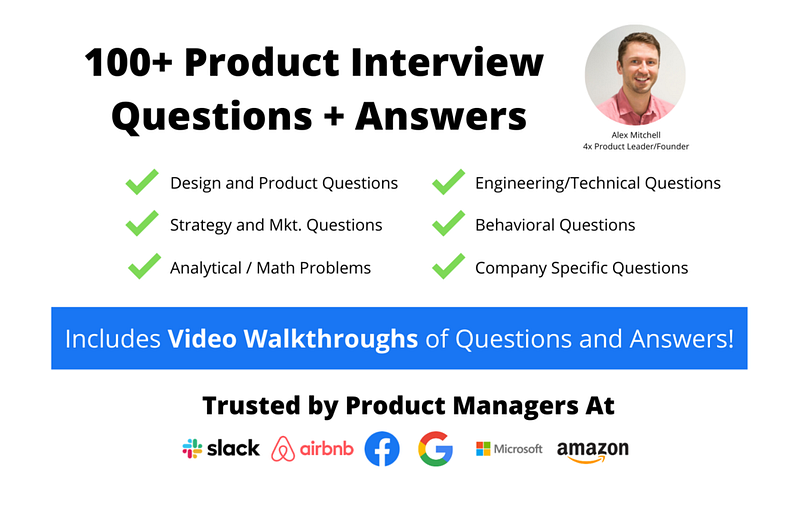
In this blog post, I want to share a preview of that Product Management Interview prep content and help you with high-level strategies to attack each type of question you’ll encounter!
🎨 Design
The One Thing to Remember: You need to be able to articulate why design is important and share examples of well-designed and poorly-designed products, while also articulating the impact design has on overall product performance.
Other Key Recommendations:
- Get experience with wireframing software like Balsamiq
- Get experience with design and prototyping software like Figma
- Test your skills by giving yourself only 5 minutes to design a new product for a popular tech company (ex. What would a Google refrigerator look like? What features would it have? What would differentiate it?)
💻 Product
The One Thing to Remember: Think before your interview about how you would improve your favorite product? What features would you add/remove? What would you want to learn from data/customer feedback to make more informed product decisions about that product?
Other Key Recommendations:
- Think about what you’ve built in the past: How did it go from idea to release?
- Understand the key components of user stories and why they are important and the costs of not writing good stories
- How do you/would you integrate user research into your Product roadmap?
Walkthrough Video on Product Questions
Purchase all 100+ answers and all section video walkthroughs (like this one!) for only $20: https://gum.co/JsUqia
📝 Strategy
The One Thing to Remember: You need to be able to articulate how you evaluate and size a market opportunity (often with help from other teams including Marketing, Growth, Business Development) and the potential Product solutions to solve those market needs/problems.
Other Key Recommendations:
- Understand Product-Market fit and how you know when you do or don’t have it
- Be able to share stories about how you have worked with key stakeholders to develop a Product Strategy (Leadership, Marketing, Business Development, Growth, Engineering, etc.)
- Be up-to-date on news in tech, especially in the sector you’re interviewing in, including recent mergers, acquisitions, IPOs, as you may get strategic questions regarding those events
Thanks for reading so far! If you’re enjoying this post, I know you will enjoy the great content at The Modern Product Manager.

If you prefer books, I think you’d also enjoy Disrupting Yourself (How to Succeed in the New Economy) and Building Digital Products (Handbook for Product Managers).
👨👩 Behavioral
The One Thing to Remember: Reflect on your past failures and areas of improvement. Be open about what you’ve learned and how those experiences made you better.
Other Key Recommendations:
- How do you motivate others to action? Think of several stories where you’ve motivated both non-technical stakeholders and technical team members.
- Prepare for questions like: How do you work with engineers? What about when they disagree with you, how do you manage that?
- Think of 1–2 examples where you’ve translated technical details for a non-technical person. This can be in school, on a project, or at a prior company. So much of Product is about communication, so this is an essential one!
📊 Analytical
The One Thing to Remember: Data and clearly defined key metrics are incredibly valuable and should be a part of every Product release, BUT they don’t provide 100% of the answer.
Other Key Recommendations:
- Think about several prominent tech companies and specific products they offer. What do you think would be valuable KPIs (Key Performance Indicators) for them?
- Read Measure What Matters to learn about OKRs (Objectives and Key Results)
- Articulate how you use data to inform your decision making and cite 1 or 2 specific examples where data you pulled was surprising or counter-intuitive
🧠 Mental Math
The One Thing to Remember: Don’t memorize “common” mental math questions that Amazon, Facebook, Google, Microsoft, and Netflix ask. Even if they ask you the same question, they’ll see right through your “rehearsed” answer!
Other Key Recommendations:
- Talk out loud! This may be a little uncomfortable at first, but it really helps the interviewer “see inside” your brain
- Ask clarifying questions (1 or 2 upfront) before jumping into an answer
- Aim for an order of magnitude of accuracy (“get in the ballpark”)
- At the end, include how you would validate your answer with more time
- It’s ok to bring in outside information or knowledge that you have (reference population statistics, related numbers you do know, etc.)
🤖 Technical
The One Thing to Remember: You are NOT a developer. Unless you actually were a developer before 🙂 → Don’t try to “fake it!”
Other Key Recommendations:
- Start by learning the basics about HTML, CSS, JS, Python (if the company is data-heavy). This is a great course: Coursera HTML/CSS/JS for Web Devs. For Python: Python Specialization Coursera
- Learn about the technical stack of your past/current company and the one of the company you’re applying to. What advantages does it provide? What weaknesses does it have?
- How would you rate your own technical understanding? How are you working to improve it?
💼 Company Specific
The One Thing to Remember: Devote serious time (3–4 hours) to studying the company and its key products. Your preparation and homework will show!
Other Key Recommendations:
- Check Crunchbase/G2 for Competitors
- Sign up for the product yourself (if you can), do a sales demo (if you can)
- Review the support materials and available screenshots of the products if you can’t test the product yourself
- It’s ok to ask the recruiter/interviewer for an account to access the product! Even if they say no, the fact that you asked is a great signal
- Audit all of the features (for a smaller startup) or key features (for a bigger tech company), see what people are saying about the product/company on social media sites and review sites
🔀 Miscellaneous
The One Thing to Remember: Be ready to answer questions about your past job, why you’re looking for a new role, and what excites you about the company you’re interviewing with. Be yourself!
Other Key Recommendations:
- Be ready to talk about your motivations in life and what you hope to learn and achieve with this new role
- Think about things outside of work (side hustles, charity, etc.) that you’re excited about and can tell a story about
- Prepare 2–3 insightful questions to ask if there is time at the end. But, you should be asking questions throughout the interview. Don’t wait until the end!
What Product Interview Tips Did I Miss?
Let me know in the comments or on Twitter at @amitch5903!
More from Alex Mitchell on Medium
Disclosure: Some of the links in this post are affiliate links, meaning that at no additional cost to you, I earn a commission if you click them and purchase a product.
Originally published at https://themodernproductmanager.com on July 26, 2020.
This post has been published on www.productschool.com communities.


