avatarBrett Berry

Free AI web copilot to create summaries, insights and extended knowledge, download it at here

1118

Abstract

figure out how to use the remaining 8, 3 and 3 to obtain 1/3. A much simpler task.</i></p><h1 id="1c79">Answer</h1><figure id="d6d2"><img src="https://cdn-images-1.readmedium.com/v2/resize:fit:800/1*hg-CLtRdGu9V7rLZXJ2PGg.png"><figcaption></figcaption></figure><p id="bcfe">Begin by rewriting 3 as 3/1 and then make a common denominator.</p><figure id="8f9c"><img src="https://cdn-images-1.readmedium.com/v2/resize:fit:800/1*ukmvbqhnMlIB3ZhAAOQimQ.png"><figcaption></figcaption></figure><p id="f658">The common denominator will be 3. So multiply 3/1 by 3/3 to obtain 9/3.</p><figure id="6ff8"><img src="https://cdn-images-1.readmedium.com/v2/resize:fit:800/1*frOyS2K4Hu2BPgxp-ox01Q.png"><figcaption>Note 9/3 is an equivalent fraction to 3/1 because 9 ÷ 3 = 3</figcaption></figure><p id="4644">Now we may subtract the two fractions.</p><figure id="d312"><img src="https://cdn-images-1.readmedium.com/v2/resize:fit:800/1*-wppjhuZzGlMCt2BD16gtg.png"><figcaption></figcaption></figure><p id="0cff">Finally, divide 8 by 1/3. To do so multiply by the reciprocal of 1/3.</p><figure id="00d9"><img src="https://cdn-images-1.re

Options

admedium.com/v2/resize:fit:800/1*0ePmgQpu74YU2c__D2rcGg.png"><figcaption></figcaption></figure><p id="7d6f">Lastly multiply straight across to yield 24.</p><figure id="3052"><img src="https://cdn-images-1.readmedium.com/v2/resize:fit:800/1*aI-yQG5guYFtHmfeFxbYFw.png"><figcaption></figcaption></figure><p id="da83"><i>Next Lesson: <a href="https://readmedium.com/the-euclidean-algorithm-631d7ddf2382#.wmg5xay6y">The Euclidean Algorithm</a></i></p><div id="2055" class="link-block"> <a href="https://www.youtube.com/channel/UC1IUdHJjVZfXIkpSXB6iRXw"> <div> <div> <h2>Subscribe Now!! Math Hacks is on YouTube!</h2> <div><h3>Join me as we tackle math together one problem at a time. Spreading math love + self-empowerment. Subscribe for new…</h3></div> <div><p>www.youtube.com</p></div> </div> <div> <div style="background-image: url(https://miro.readmedium.com/v2/resize:fit:320/0*Wl2Bn7Nr8HSZNFT0)"></div> </div> </div> </a> </div></article></body>

The 8, 8, 3, 3 Puzzle Solution

How’d it go? Did you solve it?

You are given the numbers 8, 8, 3 and 3. With only the operations of addition, subtraction, multiplication and division use the above numbers to yield 24

The trickiest part of this problem was getting around using parentheses. The clever way to do this is to implement division as a fraction bar which implies grouping, thus no need for parenthesis. You probably haven’t worked with that format for a while. It’s something you see in elementary school and not much afterwards which is what makes this problem so tricky.

If you had to resort to solving the puzzle using parentheses around 3–8/3, that’s okay. I would still give you a thumbs up because it was a tricky problem and you came a long way. Although with just one more tweak, you would have had it…just sayin’.

What helped me the most in solving this problem was realizing that 8 divided by 1/3 equaled 24. Then all I needed was to figure out how to use the remaining 8, 3 and 3 to obtain 1/3. A much simpler task.

Answer
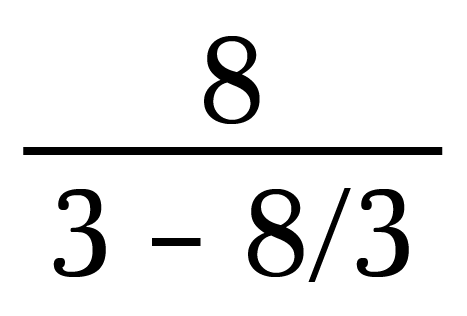
Begin by rewriting 3 as 3/1 and then make a common denominator.
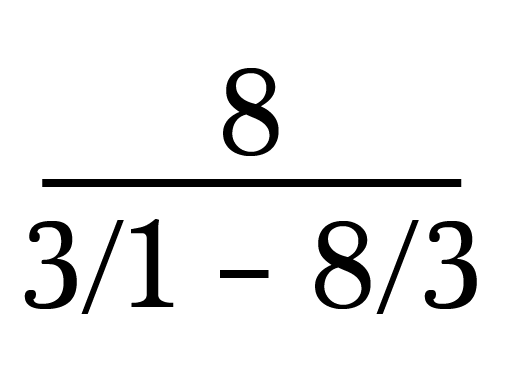
The common denominator will be 3. So multiply 3/1 by 3/3 to obtain 9/3.
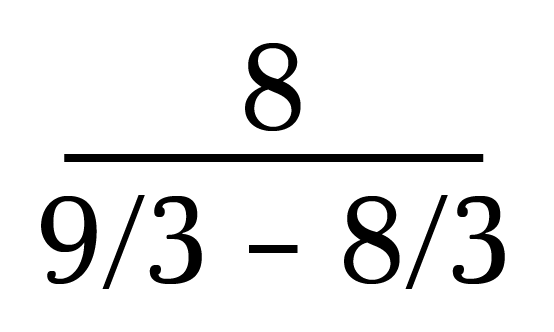
Note 9/3 is an equivalent fraction to 3/1 because 9 ÷ 3 = 3

Now we may subtract the two fractions.
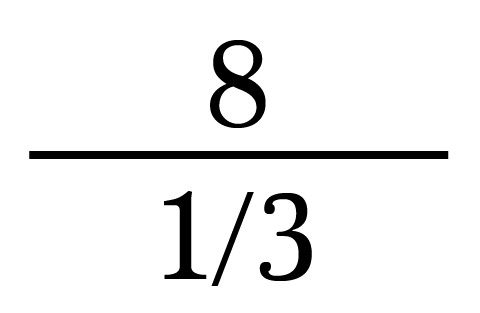
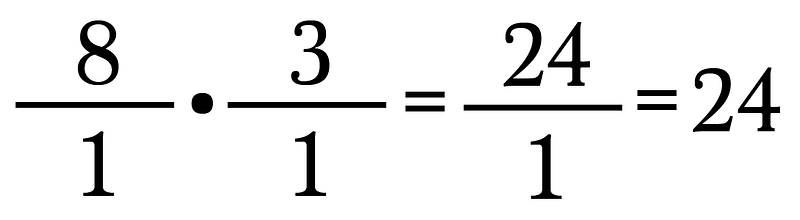
Finally, divide 8 by 1/3. To do so multiply by the reciprocal of 1/3.
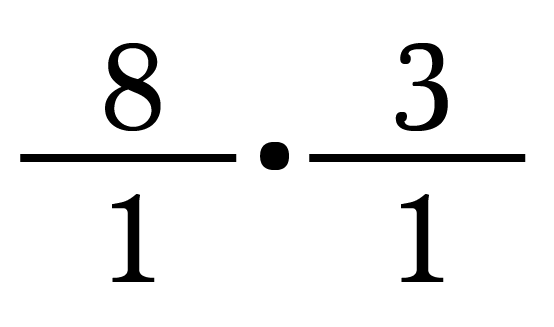
Lastly multiply straight across to yield 24.
Next Lesson: The Euclidean Algorithm

Mathematics
Math
Puzzle
Riddles
Recommended from ReadMedium