
The 7th Guest VR: Haunted By A Ghastly Ending
The original 7th Guest is an icon of early 90’s PC CD-ROM gaming, and alongside Myst it helped to usher in the era of the modern “immersive” point and click adventure. With the magic of 700 megabytes of optical storage, gamers could enter full 3D worlds complete with live action characters and many inscrutable puzzles to solve. Where Myst was ethereal and beautiful, The 7th Guest was more of a horror experience, with a dark creepy mansion and a central murder mystery to uncover.
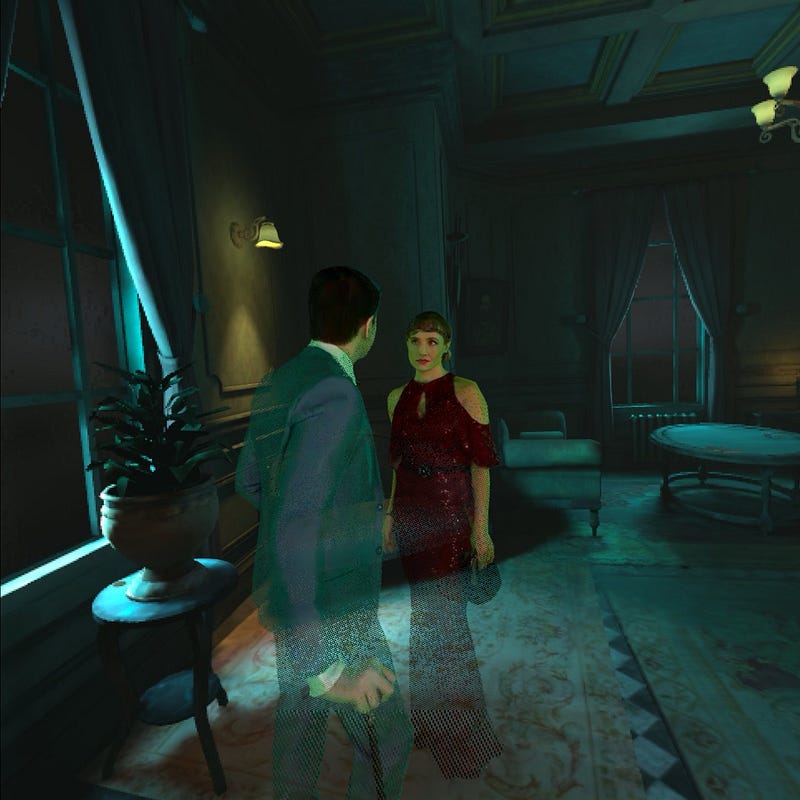
Last Halloween, Vertigo Games released The 7th Guest VR. Unlike the earlier Myst VR, this isn’t simply a port of the original game into a new format, but rather an entirely new title. The script, puzzle designs, and cast are all brand new, and the result is a modern gaming experience that still evokes the themes from the original. Just as the original pushed CR-ROM tech forward, this new VR version has an incredible implementation of live actors in a 3D space that I hope will inspire other games in the future.
If only it could have stuck the landing.
This article doesn’t spoil this game’s story, but it does contain my opinions on the design aspects of the last few puzzles and their context within the overall game. I wasn’t asked or paid by the game’s publisher to write this, and I bought the game myself from the Meta Quest store.
The 7th Guest VR is available across all modern VR platforms, including the Quest, PSVR2, and SteamVR. It’s thirty bucks, and should take you around five hours to play through once. It has bonus collectibles hidden about its mansion that unlock some achievements, but no other significant replay mechanics and only one ending.
Just as in the original, the game is set inside a creepy mansion built by an evil toymaker named Henry Stauf. After years of being a weird recluse, he invites six people to his mansion and then they’re never heard from again. You play as a mysterious ethereal figure who has arrived at the rundown mansion many years later, and you have to explore its rooms and chambers to figure out just what happened inside.
The story and mechanics here are both far more elaborate than in the 90’s original. Right near the beginning, you are granted a magical lantern. When you shine the lantern on different objects, it shows you a vision of how they existed when the mansion first opened its doors. Dead flowers spring back to life, worn carpets become new, and paintings reveal dark secrets, all thanks to the light of your lantern beam. It’s super cool and one of many ways the game integrates fun and tactile VR control mechanics. The lantern is regularly used to dispense hints about puzzles, and is one of the more enjoyable VR mechanics I’ve encountered so far.
Early on, you’ll witness your first fully 3D live actors. Cutscenes in this game play out all around you, and while they’re running you can move around them in real-time. A brand new cast of accomplished acting talent plays the mansion’s guests, and they’ve all been rewritten to have proper backstories and well-developed motivations. Each is a dignified person from the nearby town of Harley, and they all have their own connections to Henry Stauf. The actors aren’t simply flat video files pasted into the world, but rather they were spatially mocapped and filmed in a 360 degree studio, then mapped onto 3D models inside the game world. The result is live actors that you can walk seamlessly around and stand next to during cutscenes. It’s a truly remarkable integration of live performances quite unlike anything since LA Noire. As someone who loved old FMV games, it impressed me every time.
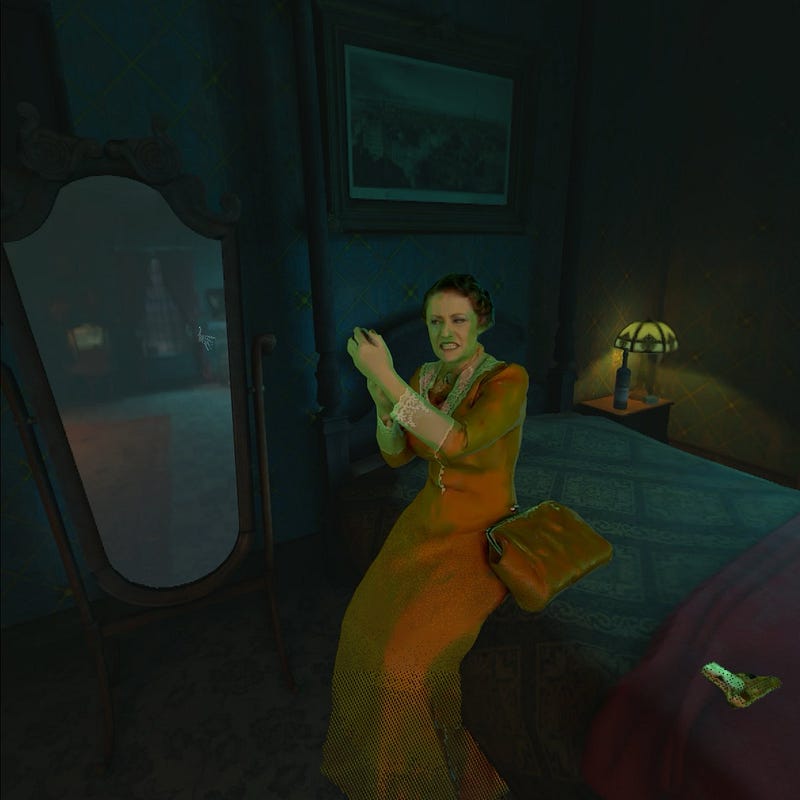
The live actor technology alone makes the game intriguing enough to play, and the environment and puzzles also mostly deliver a wonderful time. You can fully explore this four story mansion now, poking around in every corner with your physics-enhanced hands. You’ll open cupboards, manipulate keys, and reach your hand into terrifying voids during your adventure. Every puzzle here is new, and they’re all self-contained to the rooms they’re located in, so they don’t have the elaborate nightmare sprawl of some other adventure game head-scratchers.
For most of the game, the puzzles have a toy-like quality, which makes since as they’re supposed to be creations of the evil mind of Stauf. You’ll operate elaborate and beautiful wooden puzzle boxes, look for hidden levers behind various panels, and even encounter a creepy doll or two. The puzzles are well-integrated into the world of the mysterious house, and don’t feel too outlandish or “video gamey,” instead using the physical presence and spatial awareness of VR to make you feel like you’re really there.
That all falls apart in the last thirty minutes of the game. The puzzles become more bizarre, without enough story explanation to back this up. The context of the creepy mansion melts away, revealing challenges that a person couldn’t possibly have set up on their own. A number of times I found myself thinking “there’s no way Henry could have known this would still function a hundred years later.” There’s a bit of a magical element to the new storyline, but it’s still stretched to its limit near the end, with the final encounter taking place in a whole different location that doesn’t live up to the atmosphere or quality of the rest of the game.
The final area also blows it on the puzzle design front, introducing an element of random number generation that doesn’t appear anywhere else. You might be forced to play the last room of the game a number of times if the dice don’t roll in your favor. That’s a huge bummer after the largely cohesive and enjoyable spooky mansion adventure that the rest of the game presents. The ending challenge is strangely out of place, to the point where I almost wish they had just handed me a laser gun and asked me to blast zombies or something.
The actual narrative is much less cringey and poorly aged than the original 7th Guest games, and absolutely crushes the story from its old sequel The 11th Hour — a game which has unfortunate content that probably wouldn’t fly at all in the modern era. This new game tells a great self-contained tale that doesn’t require you to have played any of the older games, but it does work in several references to lines and puzzles from the original that fans might appreciate.
Music-wise, the soundtrack is awesome, with involvement from original composer George Sanger who goes by “The Fat Man” professionally. The tunes are modern orchestrations, but they weave in all of the standard-setting themes from the original game, and they’re wonderful to listen to. The atmospheric sound is the most unsettling and scary thing about the game…at least until the more violent horror moments start to play out in the final few chapters. This isn’t nearly as scary as something like Resident Evil 4 VR. 7th Guest steeps you in an unsettling environment rather than hitting you with several prominent scares, and it all works so well until the weird ending rips apart the atmosphere.
Both the VR and general accessibility options are pretty good. There are a variety of movement and comfort options to tweak, but as I’m a weirdo that’s not really impacted by VR motion I played with full motion enabled. If you’ve struggled with other puzzle or adventure games, there’s a well-integrated hint system here, with two levels of hints for every puzzle and a map that shows you exactly where the next challenge is. You can even spend the collectible coins you can find to auto solve any puzzle you’re stuck on. I didn’t have to do that myself, but I did have to use the hint system to figure out what the heck was going on with some of the more esoteric and baffling designs in the back half of the game.
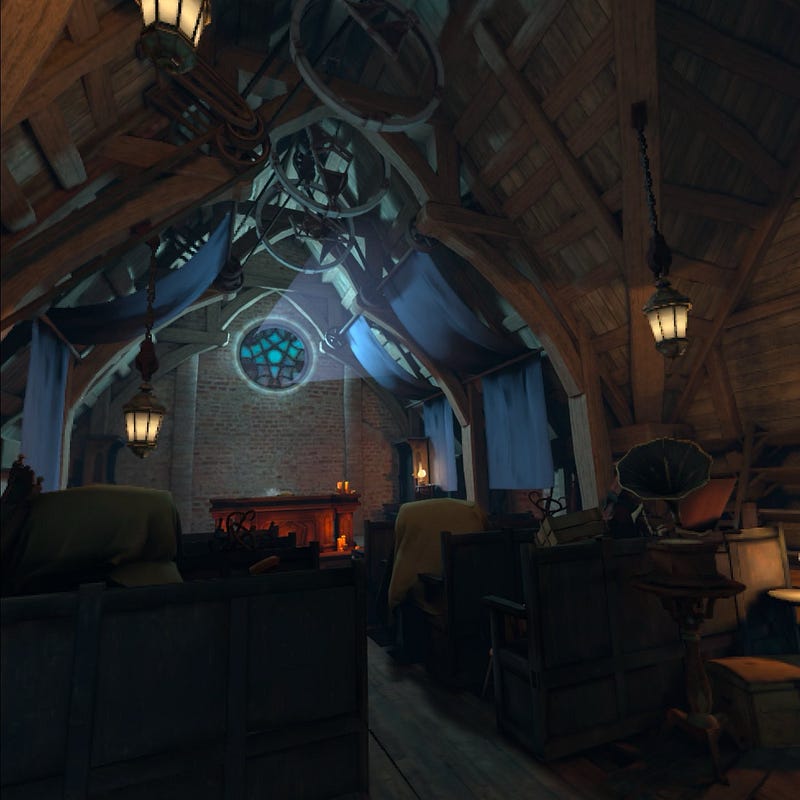
I played the game on a Quest 2, and it runs shockingly well, so it shouldn’t have performance issues on any of the other headsets it’s available on. It’s one of the better-looking games you can get on the Quest platform, with gorgeous environments full of layered textures and effects work. The framerate stayed high throughout, and the controls perform quite well.
If the last few puzzles had managed to live up to the rest of the game, I’d be trying to cram The 7th Guest VR into my game of the year list from last year. Even with the clunky and disappointing ending, it’s still a wonderful adventure game that greatly exceeds the previous entries in the series and it’s more than worth the thirty dollar price. The live actor integration is so cool and remarkable that I’ll probably boot it up again just to rewatch the cutscenes.