
The 7 Simple Habits That Help Me Maintain A Low Body Fat While Traveling
How to maintain your fitness progress while enjoying your vacations

First things first: This post isn’t about losing fat while traveling. Unless you’re a professional athlete or preparing for a fitness competition, dieting shouldn’t even be on your radar while on vacation. Enjoy your vacay!
That said, for those working hard to achieve or maintain a lean physique, gaining lots of weight on their time away isn’t ideal either. Raise your hand if you’ve ever been frustrated because you’ve undone three months’ work in two weeks.
*Raises hand*
Everything changed for me, though, when I implemented habits that allowed me to maintain my fitness progress while traveling.
The keyword: Maintain.
This is what I’ve been doing on my recent trips. Now that borders have reopened and I’ve been able to save some money, I’ve let my inner travel enthusiast free. This year I’ve been fortunate to do a two-week trip in late March and a three-week trip in late May.
The best part?
Though I’ve been traveling for 5 weeks in just 6 months, I’ve maintained the athletic physique I’ve nurtured for the past four years.
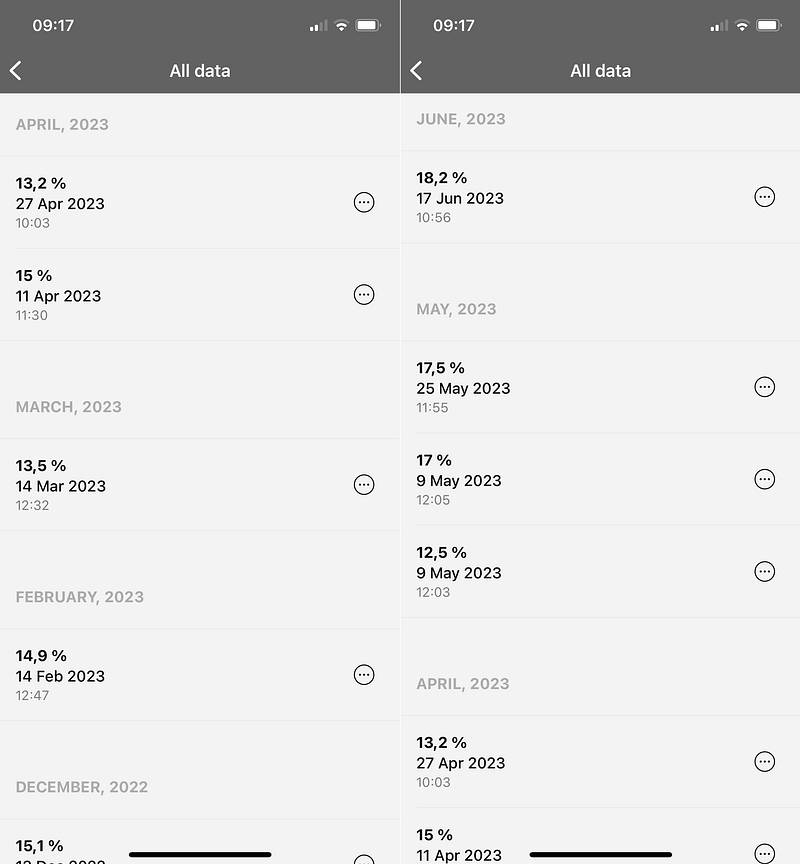
The pictures above show my fat percentage from December 2022 to my last measurement in June 2023, after returning from my previous trip. Three things are important to note:
- From “Athletic” to “Standard.” The fat percentage from May 9th onwards has considerably increased because I asked my gym’s staff to change how they measured my data, from the “Athletic” to the “Standard” setting. As you can see, I have two measurements on May 9th. They show that the gap between the two settings is around 4,5%, even though I weighed and looked the same. I asked for this change because seeing such a low-fat percentage felt weird.
- First trip. My first trip was from March 24th until April 9th. The data points around those dates show that, though there was some fluctuation just after the trip, my fat loss percentage remained stable.
- Second trip. On May 27th, I went away for three weeks. I returned on June 15th. As you can see, the measurements before and after this trip fluctuated very little. It’ll likely return to its pre-trip value once I’m through with the water retention I’m experiencing.
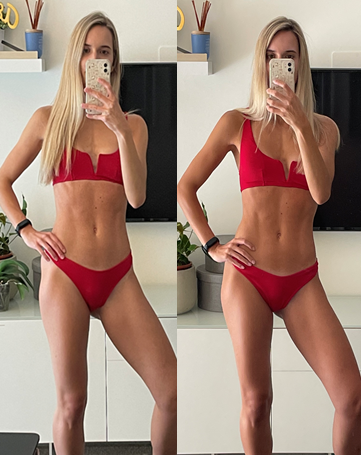
On my two trips this year, I haven’t tracked calories, gone to the gym, or stopped myself from trying whatever new dish I craved.
So how have I maintained my fitness progress?
Simple. I’ve followed these 7 Habits:
#1. Follow this Plate Composition Rule
Tracking calories while traveling is a no-go for most people, including me. This is why instead, I rely on a simple plate composition rule to ensure I’m getting all the nutrients I need while not going overboard with calories.
The rule is simple: Half your plate should consist of veggies, a quarter of whatever carbohydrate you want, and the last quarter of protein-rich foods.
And what about fats?
Don’t worry. As you’ll be eating out most of the time, even the healthiest veggie will likely have some oil or butter added.
This is why at breakfast, for instance, I will head to the buffet table, grab a plate, fill half with fresh tomatoes, fruit, or sauteed vegetables; a quarter with scrambled eggs, turkey, or sausage; and the last quarter with pancakes, toasts or whatever carb I want.
This keeps me satiated as I’ve had plenty of fiber, protein, and fat, while not being that calorically excessive.
However, you may be thinking: What if you go to a restaurant with no buffet?
Good question.
In this case, I ensure I order a veggie starter and then a main dish with protein and carbs. For instance, on one of the nights of my last trip, I ordered a delicious tomato salad and a seafood pasta platter.
That said, please remember that every circumstance is unique. Sometimes you go out for ice cream because that’s the plan, and that’s all there is.
If you follow this rule about 80–85% of the time, you’ll likely get all the nutrients you need to be happily satiated while avoiding an insane calorie surplus.
#2. Get Your Breakfast Right
Though this second habit is similar to the first, it requires a spot because of how much it can help you maintain your fitness progress while on vacation.
When you get your breakfast right — when you follow the “plate composition rule” at this crucial moment — eating well the rest of the day becomes easier.
This is a tip my nutritionist gave me to help me with my sugar cravings.
She said: “Having a savory breakfast with enough protein, fiber, and healthy fats is a surefire way to curb your appetite and cravings throughout the day.”
Sure enough, when I have pancakes or french toast with syrup, I always have more sugar cravings and a larger appetite than when I start my day with eggs, avocado, and wholewheat toast.
So if you want to minimize the odds of having intense sugar cravings while traveling, get your breakfast right.
#3. Go “Wild” Once per Day
I WILL TRY IT ALL when I’m traveling, especially in a gastronomically-famous destination. Period.
Who goes to Italy, Japan, or Mexico and doesn’t indulge in any of their delicacies?
A crazy person. That’s who.
However, if you go “wild” on every meal for the entirety of your vacation, you’ll likely experience a substantial setback in your fitness goal. The calorie surplus will be insanely high.
That’s why I try to only go wild once per day.
On my last trip, for instance, as we had a wedding, I followed the plate composition rule on the other meals that day. Then, I gave myself absolute freedom to enjoy the event (made easier by me also following habit #7).
The same was true for the rest of the trip (at least 90% of the days). If we went to a famous and delicious restaurant in the evening, I kept my breakfast and lunch “tame.” If we were going out for brunch, then my dinner was a healthier choice.
With this, I got to try everything my destinations had to offer without losing my fitness progress.
One last helpful tip: If you’re staying at an Airbnb, why not cook two meals and only go out once? You’ll save both money and calories.
#4. Listen to Your Body
I don’t know about you, but when I travel, I sometimes find myself “obligated” to eat when I’m no longer hungry.
Going to an all-inclusive resort means there’s delicious food available all the time. Traveling to a place like Japan means there’s always something weird yet enticing right around the corner.
It’s hard to say no — even when you’re bursting to the seams.
That was a problem I had in the past. My job was to eat as much as possible in an exotic destination.
The result?
Weight gain. Duh. But also many days of feeling sick. I ate to the point I became ill.
Not listening to your body — not stopping when you’re satiated — will almost certainly derail your fitness journey while making some of your vacation days nightmarish.
Now, though, I try to respect my hunger cues. It’s still a work in progress, but on my last two trips, I could say no to dessert or even a meal when I was already full from a previous meal.
I’m happy to say that this allowed me to never get sick on any of this year’s trips — not to mention it made keeping my fitness progress easier.
The body is wise.
#5. Prioritize This Macronutrient in Most Meals
Though all macronutrients are essential to help maintain our fitness progress while traveling, there’s one that is king when it comes to keeping our muscles strong: protein.
Many years ago, when I had only a few months of resistance training, I went on a two-week vacation that completely wrecked the results I’d gotten until then.
Though I didn’t gain weight as I was moving a lot, I ignored how much protein I was consuming and ended up losing three pounds of muscle while gaining three pounds of fat. As I wasn’t stimulating my muscles (something we’ll discuss in habit #6) and my low protein intake, my body traded muscle for fat.
Though I weighed the same, I looked different. It took me around 4 months to return to where I was before my trip.
Yikes.
But not anymore. Now I always prioritize protein in each of my meals. I even made sure I got enough protein at the wedding I attended on my last trip.
And sure enough… my muscles are still here.
Yes, I lost some (around 0,6 pounds), but that’s nothing. And that’s to be expected when you step away from heavy resistance training for almost a month.
But I’m not worried.
I know that in a couple of weeks at the gym, I’ll be back to where I was.
#6. Take a Resistance Band With You
As I mentioned in habit #5, resistance training is another factor that weighs heavily on whether you’ll maintain your muscle mass while traveling.
If you’re eating enough protein, you’ll do your muscles a major favor. Combine that with some resistance training, and you’ll lose almost nothing.
This is why I now take a resistance band with me.
It weighs nothing, and though it won’t provide the same stimulus as lifting heavy, it’ll at least be something. Something that tells my brain it shouldn’t get rid of my muscle because it’s still being used.
Better yet, why visit a hotel with a gym if you’re staying at a hotel? It doesn’t have to be long. You’re not actively trying to build muscle while traveling. Hell no. But any form of resistance training, even if just 5 minutes, will help you maintain your fitness progress.
Many trips have dead moments — waiting for someone to get ready, waiting for someone to wake up, waiting for a scheduled tour time. Why not seize the moment and challenge your muscles?
#7. Increase Your Output
If you only adopt one habit from this list, let it be this: Increase your energy output. Move.
Walk around whatever city you’re visiting or along the beach. Explore that all-inclusive resort. Dance at nightclubs or weddings. Swim in the ocean. Try kayaking, paddle surfing, or whatever feels interesting.
For instance, this is how many steps I did per day on the first week of my March-April trip:
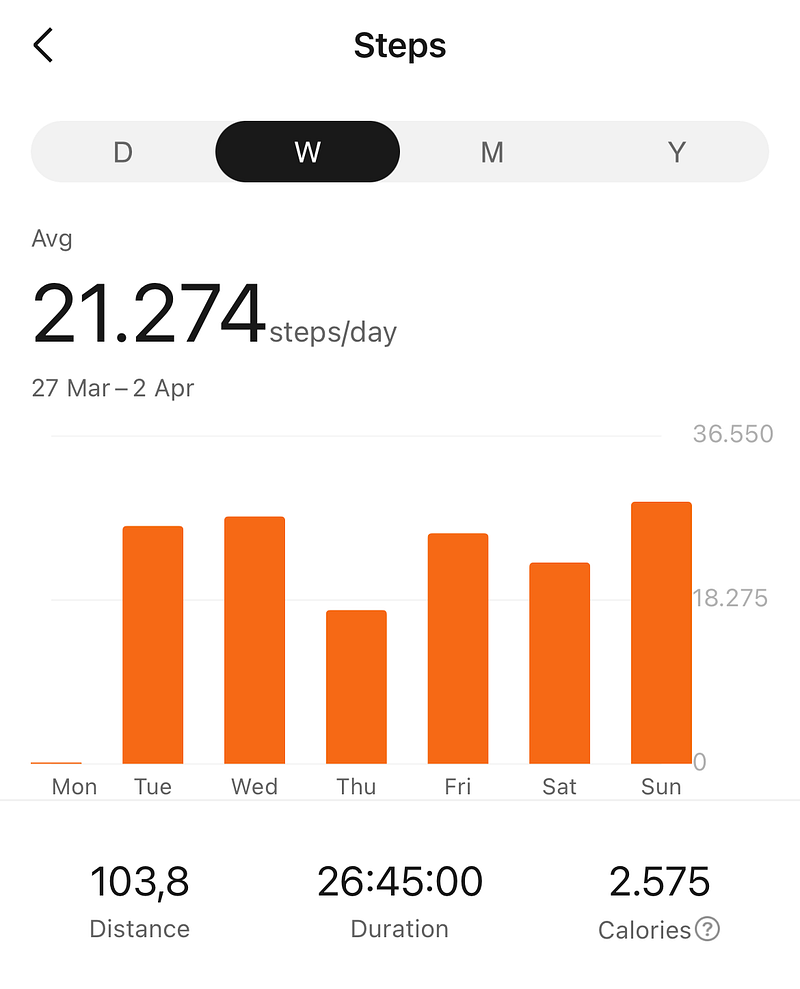
As you can see, I walked a lot. Some days more than others (on Monday, I wasn’t wearing my band), but I did an average of more than 20k steps per day.
No wonder I didn’t gain a single pound.
That’s why moving is the most important habit that can help you with your fitness goals while traveling.
Move as much as possible; I promise your weight gain will be minimal or nonexistent. Combined with the other habits, this will become an infallible approach.
The Caveat: Ignore These Habits if This Is True for You
This post aims to help you maintain your current physical state so that when you return from your trips, you can continue where you left off.
However, if following these habits feels restrictive, if it completely ruins what a vacation means to you, forget about this.
The phrase “Life is too short” is a cliche for a reason.
Ten years from now, you won’t remember your number on the scale. You won’t remember how much muscle you had. But you will remember walking along the gorgeous streets of Kyoto or having that delicious ceviche by the beach.
These are the things that are most important in life. No fitness goal should interfere with that.
And remember: Fitness is a lifestyle. One week, two, or even two months off will never be the end all be all.
Living in healthy balance and moderation is the key.


