
“The 7 Habits of Highly Effective People” Summarized in 7 Minutes
by Stephan Covey

When it comes to self-improvement, hundreds of articles, books, and mentors could be found. Every year people spend millions of dollars to find out about tips and tricks that highly successful people use. Since there is a lot of different sources, it can be hard to find the right one. By many people, one of the best books ever published for self-improvement is “7 Habits of Highly Effective People, by Stephen Covey”. The book focuses on character-based qualities rather than personality-based. Stephan researched the last 200 years of the success literature and found something quite interesting; In the last 50 years, most of the books about success focused on personality ethics like public image, social interactions, appearance, and general skills and technic to get people to behave in certain ways.
These books focus on how to appear rather than how to actually be.
The “7 habits of highly effective people” takes an inside-out approach. It focuses on character ethics since it’s the character that shapes the personality and without the character, personality looks weak and fake.
The character ethics teach that there are basic principles of effective living and people can only experience true success and enduring happiness as they integrate these principles into their basic character or simply greatness starts from the inside.
Be proactive

Every situation provides you an opportunity to make a brand new choice in your life. You are the one in charge, not your situation. when facing a challenge people divide into two groups:
Reactive people are the ones that are really affected by situations. They keep complaining about the issues that are out of their control rather than trying to deliver the best result. Basically, their environment and outside forces affect their performance and their mood. Hence, they usually nag instead of taking action.
On the other hand, proactive people believe that their decisions determine their future and not their conditions. They don’t complain about the things that they can’t control. Instead, they try their best to change what they can change by taking action. Taking action and doing is their number one priority. By choosing to be proactive you choose to be responsible for your success and failure at the same time.
Action is the foundational key for all success. — Pablo Picasso
Begin with the end in mind
The second habit is all about becoming you want to be by thinking deeply about how other people think of you. When you die, how would the people at your funeral describe you? Don’t you want to be remembered as a person who added value to society?
Think about the end of your most important decisions and see if that involves your priorities and it is based on meaningful qualities of life. Not just fame and wealth. By having a goal and deciding every move of your life accordingly, you are already ahead of the vast majority of people who run through their life aimlessly.
Stephan Covey explains that everything in the world is created twice. Once in the mind and once in the real world.
A lot of things only get created in mind and not in the physical world. Because we tell ourselves I can’t do it. Most of the problems only exist in your mind. This brings us back to the first point. Take actions according to your goal and purpose in your life and not your conditions and temporary situation.
Put first things first
As we learned in the first and second habits, everyone is the programmer of their life due to their goals and actions. But not everyone is good at programming. Habit 3 defines the rule of priorities in life and how we mostly put them aside and waste our time on useless time killers. This is where you examine your daily routine and habits. Do they get you a step closer to your goals or further? Do you stay up late and wake up with a bad mood which is going to affect your work performance? Don’t BE ASHAMED OF IT. JUST CHANGE IT. A lot of people suggest using calendars or daily planners. However, they may not appear as functional as what Stephen calls: “ Categorizing by urgency and importance”. Stephan invented a quad chart for this.
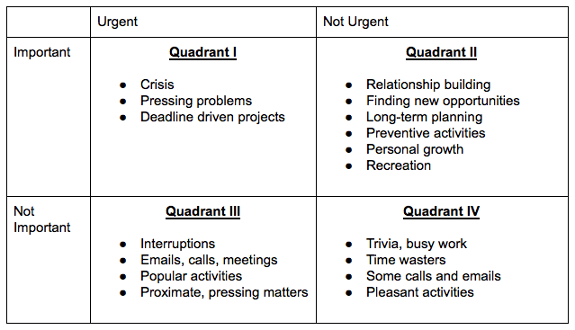
- Quadrant one is urgent and important. This is putting out fire emergencies. It is about daily fire-fighting and being Quick to delegate. These are the things that must be managed well.
- Quadrant two is not urgent but important. These are things like your health, relationship, and family. These are often neglected activities and this is where success in balance and growth is found. These activities are the ones that make us truly happy so our biggest focus must be on them.
- Quadrant three is not important but urgent. stuff like interruptions, some meetings, some phone calls, and other people’s emergencies. These are the activities that should be limited to have more time and productivity
- Quadrant four is neither important nor urgent. The place where most of our daily activities might take part in. Stuff like scrolling around social media. These are a waste of time and must be limited as possible.

The first three habits lead to independence. The next three habits help you become interdependent, which is the highest level of what Stephan Covey calls: The maturity continuum. Habit one to three is about self-mastery while habits four to six help you deal with people, teach you how to read the needs of others and cooperate with people.
Think win-win
When it comes to social or business-wise relationships. We have all kinds of deals. It could end up as a lose-lose, win-lose, win-win, and no deal at all. A common mistake some new entrepreneurs make is thinking of win-lose as their target. This mistake results in not having a deal which brings no progress. We want to look for win-win relationships. We want to search for mutual benefit. We have to develop a mindset to understand that we could share knowledge, we can give and we can profit together. Life isn’t a zero-sum game so look at every situation with a win-win mentality. I end this part with a quote from the book:
Win-win is a belief in the Third Alternative. It’s not your way or my way; it’s a better way, a higher way.
Seek first to understand then to be understood

We often get mad at people because they don’t think the way we think. We all see the world differently through our own opinions based on our lifetime experiences, values, memories, and beliefs. We can’t understand others unless we listen to them and try to understand their perspective. This is called “ Emphatic listening”. The highest level of listening.
We mostly don’t listen to understand. We listen to reply before the other person even finishes his talk.
Before you judge, before you take action, before you contribute just listen.
synergy
Habit 6 is synergy. The idea behind this is that different people bring different perspectives, opinions, strengths, and thought to the table. Instead of tolerating or accepting these differences, we should celebrate them. This is what any good CEO does. They get their different subject matter experts and get their input to come up with the best solution.
With synergy one plus one can equal three, ten or a hundred
Think of how individual units can work together to create something even bigger.
sharpen the saw
Let’s say you see a guy cutting down a tree with a dull saw. You will say: why don’t you sharpen your tool? It’s going to take 6 hours at this rate. He will say: I don’t have time for that! I have to cut this tree down as soon as possible.
If the guy spends an hour to sharpen the saw it may only take him 3 hours to cut the tree. doesn’t it make sense?
This example can widely apply to our lives. We are the instruments and we have to regularly sharpen four areas. These areas fall into quadrant 2 activities mentioned in the second habit. You can either spend a few minutes to exercise every day or pay for it in thirty years with all kinds of physical ailments that you could have avoided. Try to sharpen your body by spending regular time paying attention to your physical, spiritual, cognitive, and social health. The best way to unleash your future potential is by investing in yourself. Strive for continuous learning and improvement doing so renews each of the other habits as well.
In my opinion, this habit stands out as the most important one since this last habit keeps you fresh so you can handle the other 6 habits.
Hopefully, by this point, you are done reading the article. The point is that none of these habits are going to work unless you establish them as a part of your life. Don’t just attempt to understand them intellectually. Try to live them. Apply these habits and teach them to others because the best way to learn is by teaching to someone else. This is a lifelong process and requires patience. Keep pushing yourself and you will hit new heights and levels you have never taught of before. Hope you all enjoyed reading this article and I wish these tips come in handy and useful for you.