
The 6 Stages of Processing Life with Invisible Chronic Pain
How to emotionally navigate invisible illnesses
A storm of terror
We were at the University of Oklahoma Center of Meteorology watching live footage of tornadoes. My elementary school class ooohed and awed at the natural weather wonder as high winds blew and cars and bodies got sucked into the storm. In my body, I felt people being sucked into the tornado as if I was there with them.
At my desk, I froze and felt utterly trapped. My mind began a repeating movie reel of the footage and would not stop. It ate into my brain during my sleeping hours for months to come. My body housed this new terror at a cellular (somatic) level. My body was storing the trauma. Recently, I learned about Peter Levine’s teachings of the somatic approach to recovering from flight-fight-freeze states, which I will dive into in a separate article.
Invisible illness
Depression, anxiety, and intrusive thoughts (a form of OCD) have woven throughout the tapestry of my life since I was a young child. I remember the hair on the back of my neck standing on end, shear panic consuming my body during this elementary school field trip. Looking back now, I realize this was the first time I had a panic attack. Why was I having this visceral reaction?
I’m an intuitive empath. I’m a highly sensitive person. Along with the positive qualities these bring (care, empathy, sympathy, understanding), come qualities that are more difficult to navigate (emotional attachment, extreme feelings, the tendency for mental illnesses), especially as a young child, who hasn’t learned to set in place emotional boundaries.
Today, I can articulate this. As a child, teenager, and young woman, I did not know how to put these feelings into words. And, I didn’t understand that woven with the threads of anxiety and depression I was also experiencing real physical pain in my life.
The 5 (6) stages of grief — a reckoning
In her book On Death and Dying Elizabeth Kübler-Ross lists 5 main stages of Grief: Denial, Anger, Bargaining, Depression, and Acceptance. Later, with Kübler-Ross’s permission, David Kessler added to this list what he believes is a “key ingredient” in processing grief — finding Meaning. In 2020 I went through these 6 stages of grief as I came to terms with a new clinical mental illness diagnosis of OCD and new chronic pain diagnoses.
Let’s get physical (here comes the pain again)
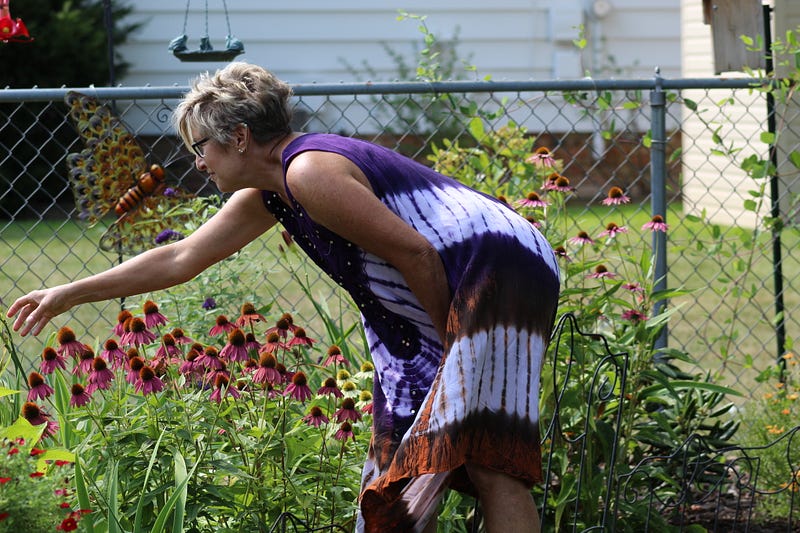
I began work in May of 2017 as a part-time gardener at my local botanic garden. It was a dream job. Flexible hours, good people, and I was paid to be immersed in nature. I was 38 years old. I learned how to weed whack, operate a backpack blower, climb tall ladders to elevated garden beds, and even how to wrap tall trees with Christmas lights for an annual holiday display. There was a lot of digging, planting, weed pulling, lifting heavy buckets of mulch, and a cacophony of other duties. The variety was a perfect match. I can get bored easily. But, at this job, I was constantly learning new skills and information.
These tasks were done in all kinds of weather. This was manual labor. It was hard. We exerted ourselves every day. To perform well in this job, you had to be tough and have good endurance. It felt amazing to use my body this way. It took me out of my usual state of inertia into a state of actively doing. It helped me un-freeze. My biceps grew. My confidence grew. My knowledge grew. Work friendships grew.
For many years, I thought the pain was in my head or other people experienced pain like mine and they were tougher than me, therefore it didn’t bother them.
Physical pain also grew. And, I wouldn’t admit the intensity of my pain to anyone, including myself. At work, we all laughed about days that were extra hard on our bodies, and then we moved on. I left work and popped Ibuprophen in my car on the way to pick up the kids from school. By the time we got home, all I was ready to do was crawl into my bed and let my body begin an attempt at recovering. I often laid in bed until the next morning when it was time to go to work again. I began eating meals in bed. Nachos became my new favorite meal. They were quick and tasty.
For many years, I thought the pain was in my head or other people experienced pain like mine and they were tougher than me, therefore it didn’t bother them. Looking back, I realize I was in major denial of my circumstances. I was not imagining the pain.
I felt justified in my lazy behavior because I was hurting and I was angry about it. I had finally found a job I loved, but it was hurting me. I was experiencing a mix of both denial and anger at this point. But, it was on a bit of a subconscious level. I’m hurting, but I’ll be ok. Just leave me alone and things will get back to normal. This isn’t fair! I was also beginning to incorporate bargaining into the equation.
My husband, David, did not like this. He was worried about me. And, he was frustrated with me. More than once, he encouraged me to look for a job better suited to my age and physical condition. To which I got defensive and angry. I had no idea where I’d go to work. I had never found my “work-niche” and after having kids, had stayed at home for 9 years. Despite 2 degrees in English, my confidence for a writing job never arrived. I felt stuck. Depression set in.
I did the bare minimum outside of work because my body needed all my non-work hours to recover the best it could. My muscles and joints were in constant excruciating pain. Driving hurt, sitting hurt, laying down hurt. Everything hurt. In the winter of 2018, I had discovered Glucosamine and it helped with my joint pain. I think it bought me one more year at work. I told myself the relief it provided was enough. I even aimed for promotion to a full-time horticulturist.
At the end of 2019, I was offered that promotion and accepted it. That’s when my denial truly began to drop away. How would I manage 40 hours of manual labor while dealing with all this pain? On top of the muscle and joint pain (I had trouble getting my fingers to cooperate in pulling weeds sometimes) I was also having terrible stomach and heart pain. I didn’t tell anyone about that either. Not even my family. I thought I could imagine or will away all these issues. I was back in the bargaining stage.
I’m sure you won’t be surprised when I tell you that did not work out.
Around Christmas of 2019, I had a holiday break. I knew in my heart that this promotion wasn’t going to work out. I was depressed and angry. With myself. With the world. I still didn’t know how to talk about what was going on with me. I was still pushing a lot down. I began having suicidal ideation. I hadn’t experienced that in many years.
I was also battling with something I rarely talked about — OCD. I had never been diagnosed with it, but as my depression and anxiety increased so did my hand washing and fear of contamination. I had a fear of hurting others with my (perceived) filth. I washed the soap containers in the shower. For the first time in my life, bathing became stressful. These feelings escalated. My hands grew red and raw.
Emotional earthquake
As I approached a full-on breaking point I think the first 5 stages of grief melded and I found myself sobbing in my bedroom, wondering how I would go into work that afternoon. I was past denial…I had to admit there was a problem as it was becoming more and more obvious to everyone around me.
Even back at Thanksgiving, I had frozen at a family function, terrified of contaminating furniture should I sit down on it. I was feeling angry that I couldn’t get my emotions under control. I had already been putting in work with counseling for decades. Decades! And, I had been taking my medication faithfully. Medication that had been helping me for the past ten years! Why was everything falling apart now?! It wasn’t fair. I was angry.
I had worked hard to get this promotion. Surely, I could make myself do it. And, my manager was a great advocate for caring for your health, including mental health. I didn’t want to let anyone down. I didn’t want my friendships that had been forged at work to fall apart. My body and my brain told me to leave but my heart didn’t want to go.
Ultimately, I accepted that my body was in intense pain, my mental health was compromised, and I required new kinds of care. I emailed my letter of resignation. I was terrified. My depression remained. My counselor of almost a decade had retired at the end of December. I found someone new. I went to my PCP. I was assigned a psychiatrist. I started a new kind of medicine. My mom came to stay with us and take care of me.
As I started being real with myself I realized I hadn’t been making up my physical pain. I had been working hard to deny it and will it away, but then the breaking point came. This was the point that I genuinely accepted my situation and accepted outside help. I realized I couldn’t will myself into getting better.
On March 6, 2020, I posted on Facebook:
I saw my PCP for my annual visit today. I’ve been seeing her often as we try to puzzle through my pain, etc this year. I explained how frustrated I felt after getting the diagnosis from the rheumatologist. My doctor understood my frustration. When I explained how frustrated I’ve been to be told basically by the rheumatologist that she believes I have pain but she doesn’t have a diagnosis for me, my doctor sat & listened to me & then gave me 2 diagnoses: fibromyalgia (pain between the joints) and polyarthralgia (pain of the joints). She has been doing OMM (Osteo Muscular Manipulation) on me for over a year now- this is how she can tell about the fibromyalgia, specifically. The old tapping test is now outdated. I’ve suspected I had fibromyalgia for several years & saw a different doctor many years ago who also relied on the point test for diagnosis.
I’m really glad we’ve ruled out anything super scary. Fibromyalgia is often associated with depression & anxiety
I also am advised against running & heavy lifting due to a small prolapse of my uterus- yep going to that female stuff. It’s about time folks felt comfortable talking about it, dammit.
And, my gut issues seem to have stemmed from acid reflux, gastritis & a small hiatal hernia — who knew?
Now that I’m healing from the reflux, I realize I used to have a constant uncomfortable pressure on my breast bone, my IBS issues are almost gone, my post nasal drip is gone!, my chest pains that I never told people about are gone, my shortness of breath is gone. So much is gone & I am feeling much better. As much as I was annoyed with my dental hygienist for starting me down the path to an endoscopy, I am so grateful, because it ended up explaining so much.”
Why did I omit OCD? Well, it feels that although anxiety and depression are more widely destigmatized these days, OCD is not. There’s also the issue of people flippantly saying they have OCD when they don’t understand at all what a clinical OCD diagnosis looks like. I wasn’t ready for those conversations then.
I believe that we go through the 6 Stages of grief when processing something new and potentially painful about our identities, including mental illnesses and physical illnesses. Looking back over the past several months, I can see that I was working through these stages. Sometimes they overlap or are simultaneous.
Navigating old territory with new meaning
From this year’s experience with invisible illnesses and chronic pain, my memoir was born. It is currently being reviewed by a publisher. Writing this book was a healing practice. I hope it helps others with healing as well. When I accepted that I could no longer perform manual labor without hurting my body, I began writing again.
I began grant writing, blog writing, book writing, poem writing, all kinds of writing. I began getting paid for my writing. I joined a virtual writing group. I found healing communities I had no idea I would find. This breakdown led to many amazing breakthroughs. And, that, my friends, is where I find the meaning that makes this grief thing bearable.
So many of us have invisible illnesses. Chronic pain, anxiety, depression, and OCD are the ones I deal with. I am committed to being part of the group that brings to light these illnesses and takes away the stigma. The more we write and talk the more we realize the company we are in. We can learn from each other. We can support each other. We are powerful. Let’s acknowledge this and move forward into a more empathetic, understanding frame of mind towards chronic pain and invisible illness. Let’s do this! Together.
References Very Well Mind on Mental Illness CDC on Mental Illness
If you or anyone you know is experiencing Suicidal Ideation or Suicidal Thinking this a reference of international helpline numbers. Please reach out for help. You are worth it.


