
6 Easy Yet Incredibly Effective Time Management Strategies
And how to put them into practice in your daily life.

In general, our society’s understanding of work is a pretty paradox.
Isn’t it weird that we believe everyone’s job would be done in 8 hours per day? Maybe we don’t even believe that anymore, but most people are working a 9-to-schedule, which indicates that they have 8 hours of work to do.
You can’t really manage time. You can not take 1,5 hours out of 1 hour or influence the flow of time by any other means.
However, you can manage your productivity.
You can make sure to get as much as possible done during the timeframe that you have at disposal.
For me, becoming more productive starts with a good schedule and includes making use of a few time management methods to get more work done while even increasing the quality of your work.
Time management methods make your life easier.
To help you, I have put together the most valuable time management strategies I’ve learned and tried out over the past few years. If practiced correctly, these strategies can help you to boost your self-organization and productivity enormously.
But before we dive into it, let’s get clear on the ultimate goal of his article:
Making sure that you find the one (or max. two) time management strategy that best suits you, your projects, and your way of working.
Self-organization and time-management are never-ending processes.
You are changing, and your work is changing, thus also your self-management will have to change regularly.
However, it is essential to have a few strategies that work well for you in general.
Having clear strategies that you stick with will allow you to complete your tasks faster, minimize stress, increase your productivity, and be more relaxed.
1.) The Eisenhower Principle
The Eisenhower principle (also called Eisenhower Matrix) is an excellent tool for task management and setting clear priorities. It is used to categorize tasks into one of four Eisenhower quadrants.
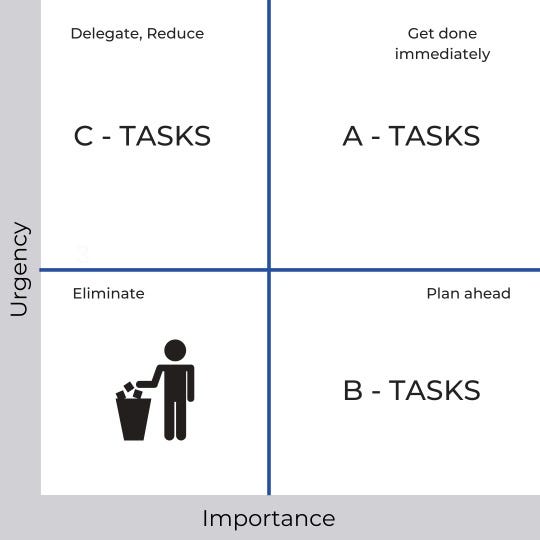
According to the Eisenhower principle, all activities can be divided into four categories (one also says “Eisenhower quadrants”, because the whole can be represented well as table or matrix).
In this matrix, each task is classified according to its urgency and importance.
Once you have classified all your tasks according to these two criteria, you will know what to do first, what to delegate, and which jobs to eliminate.
I.) A-Tasks
A-tasks are urgent and important. These are the things that you want to get done as soon as possible. Crisis, critical problems, and quickly approaching deadlines are just a few examples of possible A-tasks.
Once you know which ones are your A’s, you need to get them done as quickly as possible — these are your absolute priorities
II.) B-Tasks
The second quadrant represents the so-called B-tasks. These are important, but not urgent.
One of the most common mistakes in self-management is that people ignore B-tasks and instead do C-tasks.
What’s crucial is to get done the important tasks, not the urgent ones.
What most people also overlook are things like personal education, health, family, and recreation. These things might not be urgent, but they are essential. Thus, it is necessary to plan ahead and put them into your schedule as well.
III.) C-Tasks
The third quadrant contains tasks that are not important but urgent.
These might be things like sending e-mails, making calls or arranging appointments. Of course, these are also important to a certain extent, but B-tasks always have priority over C-tasks.
If you consider the long-term effects of the tasks from the second quadrant (B-Tasks), it quickly becomes apparent that they are of much higher value for your personality and your life goals.
In short: Try to reduce the tasks that are placed in the third quadrant.
If you can’t reduce them, make sure to delegate as many C-tasks as possible to other people.
IV.) D-Tasks or: ELIMINATE
The fourth quadrant consists of activities that are neither important nor urgent. You already suspect it: These tasks have no relevance for your life at all and should be avoided.
You should always give preference to tasks from other quadrants when planning your time.
2.) The Pareto Principle
The Pareto principle belongs to the abstract time management methods and helps you to set your priorities by asking yourself the following question: Is this one of the 20% tasks that will give me 80% of my desired result?
Effective and successful time management is almost impossible without taking care of the Pareto Principle, also known as the 80/20 rule.
This rule can be summarized very briefly:
For many events, roughly 80% of the effects come from 20% of the causes.
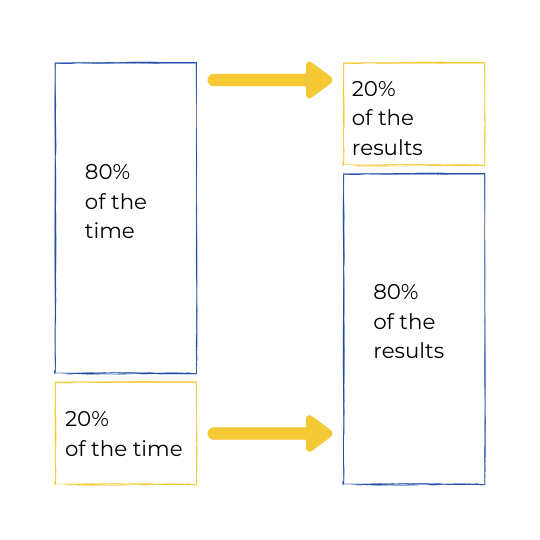
In terms of time management, this means that with 20% of your time expenditure, you can achieve 80% of your desired results. The remaining 80% of your time is used to only reach the missing 20% of the result.
Meaning that if you succeed in identifying the 20% (which are responsible for 80% of the result), you will save a lot of time and can optimize your entire time flow based on this knowledge.
On the other hand, the Pareto principle warns against perfectionism. Frequently, 80% of the result is sufficient, and trying to reach 100% percent takes five times longer than reaching 80%.
(Of course, in some fields following this rule might be irrational: A surgeon, for example, can not quit his job at 80%, but in most cases, our jobs are not as detail-oriented.)
Often it is not directly visible which 20% will take you the furthest. However, asking that question can be incredibly useful for self-reflection and task evaluation.
Question yourself regularly: Is what I am doing or what I am planning to do goal-oriented at all? (Do I achieve 80% of the result with the tasks that I am trying to complete?) Or am I perfecting something that is no longer making a difference?
3.) The ABC Method
The ABC method is an effective time management method that is especially helpful for daily planning. Due to its simplicity and quick applicability, you can use it every morning (with very little time expenditure) to roughly structure your tasks for the day and set priorities.
If you are struggling in setting priorities and the Eisenhower Matrix feels too complicated, you will love the ABC method.
This time management method is super simple and yet extremely effective.
The ABC method helps you to set your priorities through distinguishing between A (very important), B (important), and C (less important) tasks.
A — Tasks: These tasks are usually not delegable. Therefore you can often only do them yourself. Since they have a high value, you should plan about 60% of your working time for them.
B — Tasks: These tasks are on average important and sometimes well delegable. You can plan about 25% of your working time for them.
C — Tasks: These tasks have the lowest added value. Mostly they devour or even waste your time (for example phone calls). You should dedicate a maximum of 15% of your working day to them.
In summary, the ABC method is an excellent beginning for setting priorities and scheduling your day according to essential tasks.
4.) Eat the Frog
This is one of my absolutely favourite time management methods, because it is super simple and yet has a massive leverage effect on your productivity: ALWAYS start your working day with the hardest and most difficult task, which however delivers the greatest added value or progress.

It is scientifically proven that we only have a certain amount of willpower per day. Usually, we experience the highest amount in the morning and a decrease throughout our day.
Thus, it is obvious why we should start our day with difficult tasks: The probability of getting them done effectively is much higher.
Our motivation is usually highest in the morning after breakfast. One of the reasons is a good blood sugar level.
Win the morning and you win the whole day.
So let’s briefly capture the essence of this time management method:
Always start the day with the most difficult task!
Your concentration, your energy, your willpower, and your motivation are the highest in the morning. Getting important things done right in the morning will additionally create a sense of achievement and give you a great feeling, which in return drives your productivity for the rest of the day.
5.) 10–10–10 Method
The 10–10–10 method is not an ordinary time management method. It is more of a universal tool you should use for all of the decisions that you make in your life: What are the consequences of this decision in 10 minutes, 10 months and 10 years?
Similar to the ABC method, the 10–10–10 approach helps you to make faster and better decisions.
Decisionmaking is not only very important when creating your schedule, but it is also vital for managing your free time and being able to relax and recover fully.
Winners do not prolong decisions unnecessarily.
The 10–10–10 method is about asking yourself the following question immediately every time you are faced with a decision:
What are the consequences of my choice?
… in 10 minutes? …in 10 months? …in 10 years?
This direct comparison helps your brain to get distanced and a better perspective for the decision.
Under this new, more objective consideration, it will be easier for you to sort out unimportant tasks and decisions.
Like the Pareto principle, the 10–10–10 method can and should help you with your self-reflection. Observe yourself. Always question your actions. If this becomes a habit, it is much easier for you to classify activities such as surfing the Internet as unimportant and stop them.
6.) The Pomodoro-Technique
The Pomodoro technique is a great way for higher productivity, especially for smaller projects that can easily be broken down into much shorter tasks. It’s easy: 25 minutes of focused work, 5 minutes break. Repeat the whole thing 3 times and then take a longer break.

The Pomodoro technique was named after a small kitchen clock, which takes the shape of a tomato and is another very effective method for time management, with a focus on work methodology.
The Pomodoro technique can be broken down into 5 steps:
1. Write down all the tasks that you want to get done
2. Set the alarm to 25 minutes
3. 25 minutes of concentrated work, until the alarm clock rings. (No phone, push-notifications, or other distraction!)
4. Take a 5-minute break (Fill up your water bottle, go to the bathroom, stretch..)
5. After 4 Pomodoro units, take a more extended break of 20–30 minutes.
This time management method is based on the principle of incorporating many short breaks at more frequent intervals to maintain high mental performance.
Therefore it is crucial to interrupt your work after 25 minutes and take a break.
Even if it may be challenging to interrupt the task. I love to work with this technique myself. I prefer to move around during breaks, have a drink, or go out for a short break in the fresh air.
Different time intervals Of course, you are free to choose other time intervals (e.g. 45–5 and longer breaks after three long sessions), which fit better to you and your way of working.
The Pomodoro technique, in particular, is ideal for beginners who want to get more productive. This method is straightforward in the core but at the same time highly effective and doable for everyone. Also, it is easier to reflect on a working day, as you have divided the entire work into 25-minute blocks.
Grab your free Productivity Ebook here: http://bit.ly/ebook181210


