
THE JOB SEARCH
The 50-Year-Old Idea About Work that Still Works
Change Careers, Not Just Jobs

My Daughter, the Newly Minted Nurse
Jen graduated nursing school in June — a remarkable accomplishment on many levels but more so at age 52. Her three sons were 10, 14, and 16 when she enrolled. A month ago, after her eldest started college, she started her new job as a case manager for home hospice.
My daughter’s latest career follows a long line of interesting and worthwhile work. She earned a masters in health promotion and, before becoming a mom, worked in several jobs designing and administering fitness, nutrition, and stress-reduction programs. She went back to school to become an EMT in 2014 when her youngest was five. And who knows? Nursing might not be her last career.
I tell you this not because I’m extremely proud of my daughter — although I am — but because Jen’s trajectory is proof of a theory first put forth in What Color Is Your Parachute?, a ground-breaking 1972 book by Richard Bolles.
At a time when “success” was measured in the number of years you stayed at the same company, Bolles’ message was counterintuitive: switching jobs and careers makes for a rich and rewarding life.
Bolles died at 90 in 2017, but his book is still in print, updated regularly. The 2021 edition was edited by Katherine Brooks, EdD, the Evans Family Executive Director of the Career Center at Vanderbilt University.
How Bolles Conceived His Theory
Richard Bolles, a Harvard grad, an Episcopal priest, and an activist who came up in the era of gold watches and job security, was fired in 1969 because of budget cuts and philosophical differences with the church elders. He had been a priest for 18 years. Now what?
After a six-month search, Bolles finally landed a job with the United Ministries in Higher Education, an interdenominational church organization that recruited and supported college chaplains across the country. As he pondered his own transition out of the clergy and began counseling laid-off chaplains, showing them how to apply their skills to secular jobs and step into new careers, the idea for a book began to percolate.
When he died in 2017, the New York Times obituary explained why Bolles chose the title:
…[it] came from an oft-repeated discussion he had in the 1960s with parishioners who were unhappy in their jobs. They would say they were thinking of bailing out. “And I always thought of an airplane when I heard that phrase,” he said. “So I would respond, ‘What color is your parachute?’ ”
Bolles lived his own philosophy. He found a new passion, believed in himself, and went for it. He realized that while the clergy represented a unique segment of the population, many other careers were disappearing or in flux. He was determined to shape the photocopied sheets he’d shared with transitioning chaplains into a book for the general public.
I met Bolles in 1977, researching “How To Get Out of Your Job Rut” for New York. My assignment was to sample and report on a variety of career counseling centers in Manhattan. What Color Is Your Parachute? and was positioned as a do-it-yourself alternative.
Bolles, then a rising star, was warm and affable, a generous man, and a great thinker. When I confessed to him that this was my first magazine piece, he was kind enough to cheer me on.
Bolles knew from personal experience that there are no shortcuts. Before he found a publisher for Parachute, he confided that he sat in his Walnut Creek, California office, “sometimes, for days — waiting for someone to buy a copy, so I could buy groceries.”
An Unusual and Arduous Method
The strategies and suggestions in Parachute were inspired by Bolles’ helping laid-off chaplains apply their skills and knowledge in new ways. But the book is clearly for everyone.
Be warned: It asks a lot of the reader.
You’re not just hunting for a job, Bolles maintains; you’re in search of work that matches your competencies and interests. In the earlier editions, the first challenge you encounter is the “inventory.” The goal is to reveal your strengths, weaknesses, and what kind of work makes you happy. This excerpt from my piece shows some of the issues the book asks you to ponder.
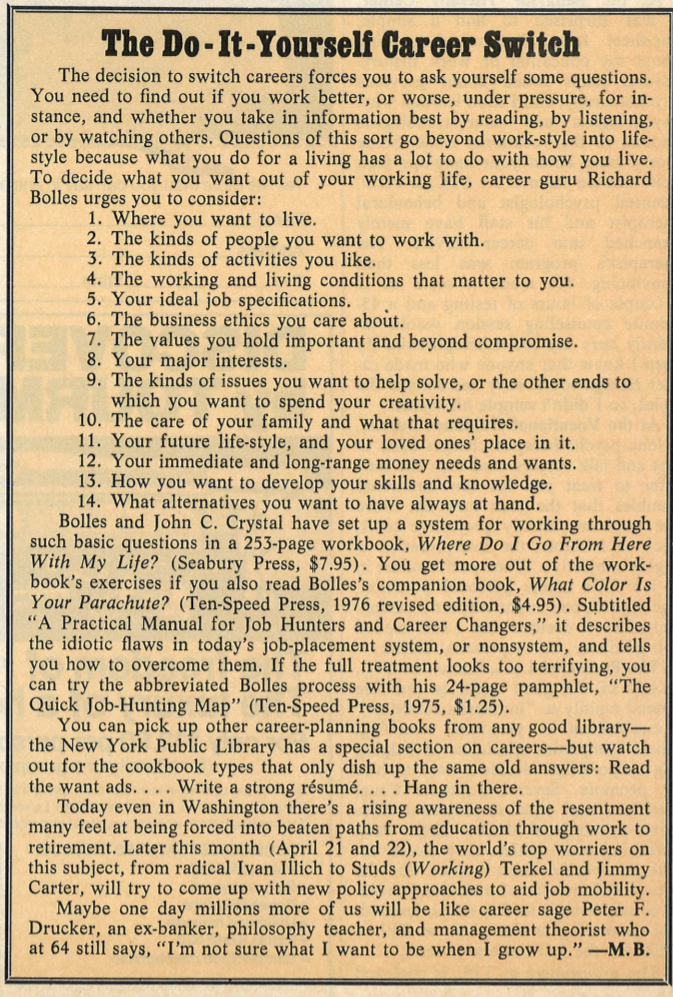
Parachute was conceived long before Google (its founders were born a year after the book came out!) and LinkedIn (launched in 2003). These modern tools of job-hunting are included and analyzed at the beginning of newer editions. The inventory appears in Chapter 6, “What to Do When Your Job-Hunt Isn’t Working,” perhaps not to scare readers off!
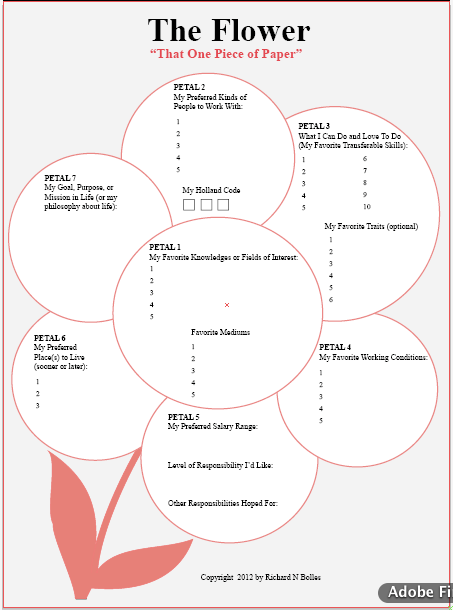
In 2012, Bolles simplified the process by creating a “flower” for you to fill out.
Using the Flower Exercise: Look at your past, break that experience down into its most basic “atoms” (namely, skills), then build a new career for the future from your favorite “atoms,” retracing your steps from the bottom up, in the exact opposite direction.
As these highlights from the 2017 edition suggest, Bowles stresses that, however you do it, self-analysis should be the engine that drives your search:
With the second way to hunt for work — let’s call it The Parachute Way (everybody does, except me) — you begin with yourself instead of the job-market.
Looking for employers’ job-postings on the Internet…works on average just 4% of the time.
If you’re a union member, particularly in the trades or construction, and you have access to a union hiring hall, this method will find you work, up to 22% of the time.
Asking for job-leads. This method works 33% of the time.
Knocking on the door of any employer, office, or manufacturing plant…works 47% of the time.
Using the Yellow Pages. This method works 65% of the time… You call them, set up an appointment, go visit them, and explore whether or not they are hiring for the kind of work you do, or the position you are looking for.
The Parachute Approach. This method, faithfully followed, step by step, works 86% of the time… It begins by your doing an inventory of what you love to do.
Parachute is filled with plentiful and often surprising suggestions:
• Go after any organization that interests you, whether or not they are known to have a vacancy.
• Now, many employers prefer a cover letter instead of your resume. That brief cover letter can summarize all that a longer resume might have covered. Another alternative to a classic resume is a Job or Career Portfolio.
• Job-hunting is all about human nature, and in its essence is most like another human activity that we call dating. Both shake down to: “Do you like me?” and “Do I like you?
• If it was you who asked for the interview, not them, remove their dread of this visit by specifying how much time you are asking of them.
• In an interview for hire, talk half the time, let the employer talk half the time… Let the length of your answer to an employer’s questions be between 20 seconds and 2 minutes at most.
• How do you tell whether the figure the employer first offers you is only their starting bid, or is their final offer? The answer is: by doing some research on the field and that organization, before you ever go in for an interview.
• Keep in mind that the interview may not be face to face: 63% of companies now report that they sometimes do video interviews.
• Have a plan B, laid out, before you start, as to what you will do if it doesn’t work out; i.e., know where you are going to go, next…Write it out, now: This is what I’m going to do, if this doesn’t work out.
Parachuting Today
I stayed in touch with Richard Bolles for decades after we met on the phone. Our paths crossed once in person. I always felt like I was in the presence of a humble genius.
I hadn’t thought about him for years, until my daughter’s deep dive into a new career. But his message and his methods in this post-pandemic era are more useful and vital than ever — especially his stress on doing the work:
In today’s world, he or she who gets hired is not necessarily the one who can do that job best; but, the one who knows the most about how to get hired.
What Color Is Your Parachute? was launched at a time of transition, when many people were out of work and, most significantly, when the world of work was changing. The book has sold more than ten million copies and has been translated into 20 languages. It’s right up there with the Bible and is arguably still the best single resource for job hunters.
Work — how we define it and where we do it — continues to evolve. Jobs and whole industries are disappearing or retooling (including publishing). Absent a crystal ball, we can’t know what’s ahead. Could we ever have imagined so many people working from home?
Ironically, the “maybe” I suggested fifty years ago in “How To Get Out of Your Job Rut” — after months of researching professional advice and dealing with my own career switch — has come to pass:
Maybe one day millions more of us will be like career sage Peter F. Drucker, an ex-banker, philosophy teacher, and management theorist who at 64 still says, “I’m not sure what I want to be when I grow up.”
If you like what you’ve read, by all means:
- Subscribe to my Medium articles — you’ll get an email when I publish.
- Subscribe to my blog. (I won’t charge you or share your information.)
- Subscribe to Medium using this link, and I will earn half of your membership fee: $5/month, or $50/year — a small price to pay to support a favorite writer and for unlimited access to a world of great thinking and writing.
- Follow me on social media via LinkTree