
The 5 Essential Components of Viral Content
How to create contagious ideas

You carefully craft content for your social media account. You write the copy and select the images.
You are excited to publish your masterpiece and see how your follower base will grow. What a well-crafted plan, right? But what happens next?
You hit the “Publish” button and then nothing, silence. No one likes your post, comments on it, or shares it. You sit down, demotivated, and start thinking about what went wrong. A true story of my life.
You might think that those who have thousands of followers will always get good content traction. Well, partially, yes, because followers will see posts in their feed.
However, content virality is never granted to anyone. There is a science behind what makes content contagious.
I’m sharing five principles of stickiness described by Chip and Dan Heath in their famous book, Made to Stick: Why Some Ideas Survive and Others Die.
These principles will help you revamp your content strategy and craft powerful content that will resonate with your target audience across all social media platforms.
1. Simple
The idea behind this principle is simple: less is actually more. Tell people ten facts and they might remember just one. We cannot remember that many things at once.
Do not overcomplicate your posts or ads with too many details that you believe are important.
Some users might not even notice them. Instead, narrow down your message to 1–2 key factors that can present your product or service in the best way.
How “simple” works in practice
This is a MacBook Air ad by Apple that represents the concept of “simple” in the best way. The ad doesn’t say anything about the display size, memory, storage, processor, or any other technical parameter to outline that it is a good laptop.
Instead, Apple created a powerful ad that communicates just one message — the MacBook is the thinnest laptop ever. It is as thin as an envelope.
The MacBook Air envelope ad is a perfect example of a simple message that sticks.
Since we all know how thin an envelope is, we can easily get the feeling of how thin the laptop is. Apple wanted to communicate just one message — MacBook is the thinnest laptop in the world — and they did it perfectly.
I honestly can’t stop watching this ad, even the music is contagious.
2. Unexpected
To make your ideas stick in users’ minds, simplicity alone is not enough. Your content should be surprising, and unexpected.
Turn the common facts upside down and let your ad have an unexpected ending where people will be anxiously waiting to see what will happen next.
This Coca-Cola Happiness Machine ad went viral online when a regular day at college went differently, and no one expected it.
Coca-Cola installed a sort of regular machine at a college to make students’ lives a bit more fun.
This ad is simple, unexpected, it triggers emotions, and it makes me want to share it with my friends to make their day happier too.
3. Concrete
Have you ever heard the following phrases during business presentations: “strategic cost-based vision”, “customer-focused empowering values” or something like “right-sizing, restructuring, empowerment shifts”?
They all sound great and professional, right? I agree. So, what’s the problem here?
If you ask someone to repeat what has been mentioned, they might not even remember it.
Why is that so? These statements are not concrete. In fact, they are too abstract to remember. We, humans, cannot visualize “customer-focused empowering values,” thus such bold statements usually come and go quickly.
What could you do differently to make your message sound concrete and stick in people’s minds?
Here is one very funny yet concrete ad for ski helmets by the Boeri brand. Instead of saying that the helmets are capable of resisting tons of snow and high pressure, they showed how strong their helmets are.

All the chickens have been successfully turned into the packed meat, but this one wearing a helmet survived. What would be the logical conclusion from this ad? It must be a strong helmet, then.
This is the power of concrete messages. Show more, tell less, make viewers feel what you want to communicate.
4. Credible
The fourth essential step to making your content viral is to add credibility. Others should believe in what you’re saying, otherwise, your messages will not resonate.
You can back up your words with a lot of numbers and research data. That’s one way of convincing people, but numbers are not that memorable.
If you want to make your ideas stick, add context to your words. Referring back to the MacBook Air ad shown above, Apple didn’t just say they produce the thinnest laptops in the world, they showed it. The act of adding context to their statement made others believe that the MacBook is indeed the thinnest if it can be kept in an envelope.
What if I say that a Coca-Cola classic is not healthy, because 1 liter of Coke contains 108 grams of sugar. How would you react? Someone could say “so what?” How much are 108 grams? It is less than 200, but more than 100. So, what does it tell me?
If anyone wants to communicate the side effects of Coca-Cola, they could say something like this: “1 liter of Coca-Cola contains even more sugar than Red Bull, iced tea, Minute Maid orange juice, or 20 Oreo cookies.”
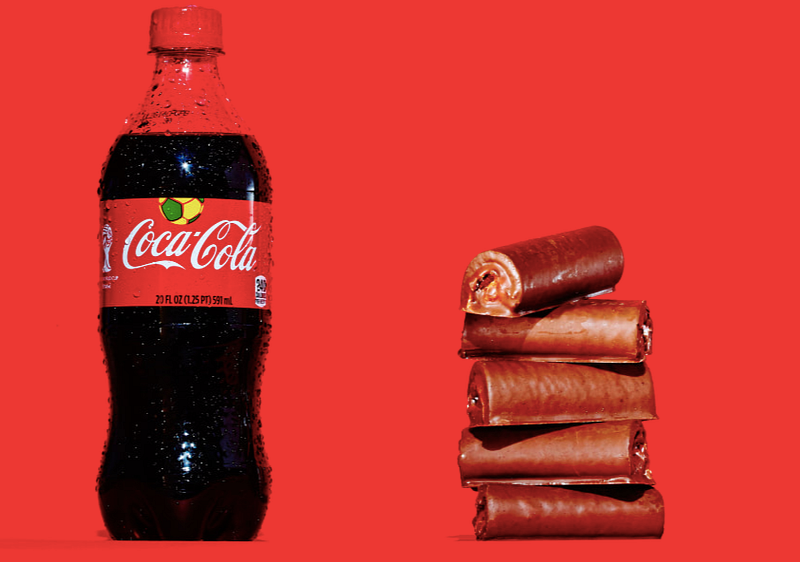
Even though I am not here to talk about nutrition and I have a neutral attitude to Coca-Cola, you could feel how powerful the message was when I added a comparison.
Rather than convincing people to choose your brand, emphasize your unique selling proposition, add context to your numbers, say that you serve clients on five continents, and show actual concrete reviews. I bet this would work much better than buzz words.
5. Emotional Stories
If your ad can make someone care and trigger emotions, it is very likely your message will resonate with others and will get exposure online.
The more we care, the more we relate to the story, and the more we are likely to remember it.
I’ll give you a short personal example of how emotional triggers can make someone share and like social media content.
I am a true cat lover. I like and share posts with cats on Facebook. Guess what? Facebook started to show me even more posts with cats. Cats were everywhere, in videos, in ads, on images, etc.
The Facebook algorithm detected what triggers my emotions and makes me react. This is why I, just like a lot of other people, keep seeing cats everywhere.
Here is another adorable example of an emotional story that increased brand sales by 1000% percent.
Have you ever tried Holy Crap? No, I am not joking. This is an existing brand of cereals in the U.S. and Canada.

The brand shares an emotional and funny story about its naming. The founders are a couple from the U.S. that launched the brand in 2009.
They say that the actual brand name was different, but one of the first customers shared their feedback about the product by saying, “Holy crap … it is amazing!”
After this, the owners promptly changed the brand name and observed a boost in sales from 10 to over 100 orders per day.
While writing these words, I’ve got a thought that I want to buy a pack of Holy Crap for myself too. It really works!
Build an emotional story for your brand that will make others get attached to it. This might become your best and free ad that people will most likely remember.
I’ve just covered five essentials of contagious content using the SUCCESS framework:
- Simple
- Unexpected
- Concrete
- Credible
- Emotional
- Stories
Each component helps us understand why some messages and ads stick in our heads, while others don’t. Behind the viral content, there is a concrete model that led to its success.
Take a closer look at these five principles and start applying them while creating your content. Make it simple, add context, pour in a bit of surprise, evoke emotions, and make people care.
This is a short recipe to create contagious content that sticks.
You can get full access to every story on Medium for just $5/month by signing up through this link.
Your membership fee will directly support me and other writers on Medium to keep creating helpful content for you. :)