
The 4 Times the CIA almost Killed Me
With a title like this, you think you are settling into a spy thriller.
I am sorry to say, but this is about the original CIA.
The Culinary Institute of America.
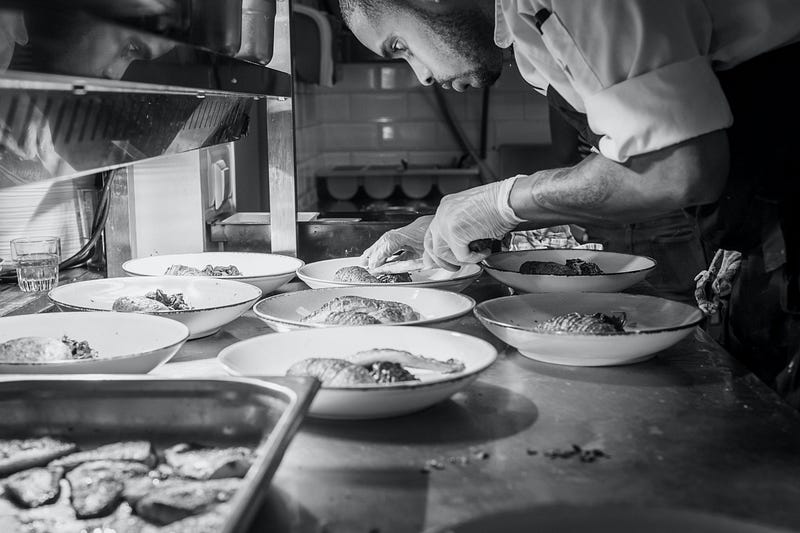
Who has laid claim to the acronym for 7 years prior to big brother’s co-opting of it. So, to remove any confusion from the start, this is a story about my 4 most intense experiences at the world premier culinary school in the Hudson Valley.
Buffet of Madness
My dumbass always volunteers to take on more than I should. I was assigned team leader of my class after volunteering to do so; the class voted and I was picked. After completing the fundamentals class, we moved on to a class called banquets. The Chef of banquets is a stoic hard-ass who loves to scare the pants off students. The fundamentals class does not prepare food for other classes. So Banquets is the first class other students are allowed to come eat at.
To understand what I mean, you need to understand the way the CIA operates. Every student and faculty receive an ID card. It has three swipes a day. You are allowed to go to any one of the production kitchens and swipe your ID and receive the meal they are preparing that day. It is consistently the best food you will eat every day for 2 years.
Back to banquets class.
The first day was the day that almost broke me. We all showed up to class except one student. He overslept. Great, now I am tasked with making sure his food is prepared by lunchtime. The chef immediately tells the class that they all have their assignments and if he needs anything, he will address me only. At this point, he says, “Team Leader,” and I drop everything I am doing and run over to him.
There is no time for pleasantries. As soon as I walk up to him with a small notepad and pen in hand, he starts spouting off instructions and walking around the kitchen. “This is the main protein, you will need to have a cutting board, heat lamp, carving knife, carving fork, three towels, 25 small plates, 25 gravy bowls, and 20 ramekins at this station…”
He pauses and looks at me, frantically trying to make a list of the things he is saying.
“What are you doing?”
I replied sheepishly,
“I am making a list so that I don’t forget.”
“Don’t you look like an amateur.”
He proceeded to list off at least 200 more items with random quantities for the entire buffet line. Once he was finished listing off all the different plates and utensils I needed to gather, he looked at me and said,
“What are you doing? Go get them.”
I didn’t know where they were. I asked him. He said,
“Find them.”
So I wandered around the campus until I found the storage room that contained the plates.
Halfway through the morning, it was obvious that the soup station had burnt the raft of the consommé before it lifted off the bottom of the pot.
He looks over at me and whispers,
“I hope you can cook better than your class.”
Monger Mania
Fish Class is the fourth class you take at the CIA. It is in the basement of the main building and it is a giant refrigerator. Turns out if you keep fish at exactly 34 degrees Fahrenheit, they decompose at a much slower rate than just a few degrees above that. A few below and they freeze. Fish class was always 34 degrees.
Every day, every class at the school puts in an order for what they need from the different “shops.” Fish class, Butcher class, and Storeroom class are all tasked with supplying the different ingredients needed for the food production classes. You go through these three classes right after the Culinary Fundamentals, and the Buffet production class.
As the team leader, I was given a stack of order guides from all 16 classes on campus. Each one had varying orders. Salmon drawn, scaled, skin on. Salmon drawn whole, Cockles purged, Shrimp peeled deveined, Skate fillets, Bronzino whole, Bronzino fillet skin on, these are just a few of the variations and order types I needed to wade through in this frozen tundra.
“I love my class, It’s like a day at the beach… In Alaska,”
Chef Gerard Viverito
My job was to sort through the different orders, write down the totals and all variations necessary to produce for the day, divide the workload amongst my class, and then organize, retrieve and ensure the orders are completed in the 2 hours we had for production.
The fish are buried in ice to preserve them. Once the orders are divided up, we need to dig them out of the ice and get to work.
One of the most amazing things I observed was that the lazy classmates who always avoided the dishpit in our previous classes were now very quick to volunteer to wash the dishes. Perhaps a change of heart, a new found work ethic, or maybe it was the warm water.
The stress of this responsibility never waned; this is one of the only times in my adult life that I broke down in tears from the sheer intensity of the cold, pressure, and stress.
I managed to hold my composure throughout the class but walking to my car, I held my head very low so that no one would notice as I sobbed uncontrollably.
Hollandaise in Blaze
Halfway through the program, we take our Midterm Practical. One day a week before the practical, while preparing for lunch service, our instructor decided to throw us a curve.
It was 10:30, we were all behind preparing for the day. Lunch was served promptly at 11. With 50 minutes of work left to do, and 30 minutes to do it, scrambling is an understatement.
All of a sudden, our chef says,
“put down your tools and come here.”
We all drop what we are doing and go over to the front of the class. He says,
“You all have 10 minutes to prepare and bring me a 2 egg hollandaise.”
What? We don’t even have clarified butter. That alone takes 20 minutes. The class erupts into a frenzy. All of us scrambled to make the sauce. I was the second to get it in front of him with 2 minutes to spare. A few classmates did not make it in time. Once everyone was back at the front of the class with their respective sauces, he said,
“Now you have 5 minutes to break it, fix it, and return it.”
What? I’ve never intentionally broken a hollandaise. I broke tons of them accidentally but never intentionally. The frenzy turned into a madhouse.
Back to the heat my sauce went, I managed to break it just in time for the instructor to inspect and then back to the stove to try and salvage it. I had never fixed a broken hollandaise before.
Honestly, at this point in my career, it was a blind spot in my culinary abilities that I had just avoided by carefully babying my sauces with heat and time.
Hollandaise breaks because it is what’s called a temporary emulsion. It’s fat infused with fat that have different densities. They do not want to stay together. The small amount of water in the mix is what serves as the binder. We are not allowed to use mustard which helps strengthen the bond.
The key to fixing a broken hollandaise is to get it back to the proper temperature and add just the right amount of water to re-emulsify the sauce. This process is virtually impossible in five minutes. I made it with seconds to spare.
The following week I drew Poached salmon with hollandaise sauce for my midterm practical. Everything was going smoothly. I had 3 minutes left to serve. My hollandaise was resting on a crock above the stove in my station.
I looked up to my horror, my classmate next to me had co-opted one of my burners to boil some water and guess what’s directly above it? My hollandaise.
I knew the moment I touched the crock that it was too hot. I lifted the lid and there it was broken, 1 minute left to serve.
I immediately began the recovery process. I presented my dish to the Chef with 10 seconds left on the clock. If you do not present your dish in the 1-minute window, you receive a zero.
For 50 seconds, he looked at me, tapping his watch. If my instructor had not put us through what he did a week prior, I would have failed my midterm practical and had to retake the class.
Bourdain’s Harbinger
Anthony Bourdain in Kitchen Confidential mentions his admiration for a chef named Giovanni Scappin. He also mentions that he was fired by him because he couldn’t handle the pressure.
I can see why. Here is my experience with Chef Scappin.
He liked to torture the class. Every morning he would sit us down in the classroom and waste 2 hours talking about nothing. He knew what he was doing. He was turning up the pressure, by wasting time.
The more time we sat in class, the less time we had to prepare for service. The pressure was intensified because this wasn’t a production kitchen. This was the actual restaurant on campus. People come from all over the world to experience the food served at this restaurant.
So one day, he keeps us in class until 10:15. It takes 10 minutes to get to class and turn everything on, and so 10:25 we start gathering ingredients. My station needs to have roasted, carved, and rested chickens as well as mashed potatoes.
The chickens take 30 minutes to cook and 15 to rest. Which leaves no time to carve. Prepping them for the oven takes a few minutes, so I had no time to spare. I raced to get my chickens in the oven. Now it’s 10:35, the birds are roasting.
Next, I have to shift my focus to the potatoes.
If it was rustic mashed, then it would be no problem. Just rinse and scrub the potatoes, chop them up and start cooking.
These aren’t ordinary mashed potatoes. These are peeled, blanched, parched, riced, whipped, and put in a piping bag with a star tip. This is not an easy process and it takes one hour from start to finish.
I do not know how I am going to get mashed potatoes ready in 30 minutes. I frantically peel the potatoes and then chop them up into smaller pieces. The theory was if they are smaller, they will cook faster.
Big mistake.
Around 10:50, Chef Scappin wanders into my section and sees the size of the potatoes in the pot and launches into me in a mixture of Italian and English. He throws them away and then decides to criticize everything about my station. I will never forget this one line,
“You are a senior at the Culinary Institute of America and you cannot cook mashed potatoes?”
I felt 1 inch tall. I had to start over and luckily no one ordered potatoes until 11:50.
The class was unique in that the class ahead of us served the restaurant, so my entire class as well as my upperclassmen all watched as Chef Scappin lit into me for 10 minutes.
He spared no one in my area. My classmate and coworker worked the sauté station next to me. Chef Scappin’s rage spilled over onto him and he belittled him for the next 10 minutes.
Later that day, we got into my car to go to work and my coworker said,
“I am going to make $10 an hour for the rest of my life.”
I felt it, defeated, small, stupid. That night I read everything I could about mashed potatoes. I read everything I could about starch molecules. I read everything I could about what makes a great mashed potato and what makes a bad one.
The CIA Almost Killed Me
Those are the 4 most intense moments I experienced through my culinary school training. In hindsight they were not that bad. They all had a profound effect on my abilities in the kitchen.
Buffet class taught me I could trust my mind to remember large quantities of information.
Fish class taught me I could handle extreme environments and still perform.
My practical taught me that if I am not careful I can set myself back and if I do not have a back up plan I will fail.
Chef Scappin taught me that cutting corners is never the right way.
What I am reading in Illumination:
Lashon Byrd writes a story about Justice. They carry us through time from Ancient Rome to the reconstruction era all the way to the Civil Rights movement. Its a poignant piece reminding us that being right is not enough.
“Justice, the most essential of the Stoic virtues, is not just about being right. It’s not just about having the moral high ground. You have to fight for it.”
Read the full Story here: