
The 4 Most Critical Differences between Rugby and American Football
A short, definitive guide for fans of all shapes and sizes
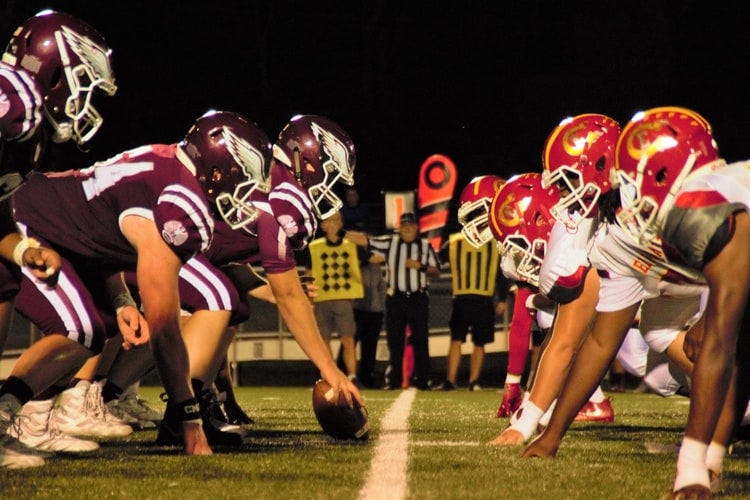
(*Note: The reference to “rugby” in this article is to the more popular and well-known version of rugby, which is rugby union and not rugby league.)
Both these sports have die-hard and consequently often irreverent fans around the world. The similarities between the two are plain to see on the face of it: big men, chasing oval balls around, tackling each other and trying to put points on the scoreboard in batches of seven. It therefore makes sense that people would try to compare them on their points of difference but I’ve found that often the argument is skewed one way or the other, depending on who’s making it.
So, first of all, let me just state that this is not going to be one of those articles that tells you that either sport is better than the other. As a former professional rugby player and an avid NFL fan for many years, I’ve come to appreciate the nuances in both that might not be obvious to the casual observer and since I’ve had the question asked a few times, I thought I might as well put my observations to paper. So, no, rugby fans, it’s not as simple as “American football players are sissies because they wear helmets and pads” and no, American Football fans, it’s not as simple as “American Football players would dominate on a rugby pitch.” Here are some high-level points of distinction that you may not usually hear that make these two games exciting in their own unique ways.
1. Collisions
The collisions in the two sports differ as football tackles can be much more violent without violating a rule. This is for two main reasons, one is obvious, the other much less so. The first and more apparent one is football players do wear heavy shoulder pads that can weigh 4–5 pounds, a polycarbonate helmet of similar weight and potentially additional padding in the pants. Naturally, much more is permissible, whereas with rugby, any contact with the neck or head is punishable by a penalty at the very least and a red card (which may or may not include a ban for a certain number of future games depending on the seriousness) for the most violent infractions. Rugby also prohibits tackles without wrapping the arms around the target (shoulder charging) and any contact with a player in the air (for example a player jumping to catch the ball).
The less obvious reason is simply the volume. Because rugby is much more continuous and the players are in constant motion, unlike the stop/start, play by play nature of American football, much more tackles are possible in rugby as a percentage of overall playing time. For context in the 2011 World Cup final, French captain Thierry Dusatoir made 38 tackles in that single game alone which is high, but not even the record at the professional level — that distinction goes to Jonny Gray who made 43 tackles in a professional club game for the Glasgow Warriors in 2019. By comparison, the single-game tackle record in the NFL is 17 which is jointly held by Patrick Willis and Michael Barrow. The frequency at which rugby players have to tackle may have the effect of reducing the overall force and velocity going into tackles as the game wears on and bodies begin to tire.
2. Cardio
I alluded to this in the earlier point when I said that American football is much more fragmented. In football, not only does each team have a separate offensive and defensive team, but the game pauses between snaps, between quarters and it even pauses for commercial (advert) breaks. Rugby, on the other hand, is played in two halves of 40 minutes each (making a game 80 minutes as opposed to a total of 60 minutes in football) and since every player is both offensive and defensive, everyone must be able to run for 80 minutes at the elite level. It therefore makes sense that in football, you regularly get Offensive Linemen who are in excess of 350lbs (about 159kgs), with the heaviest among them, like Trent Brown breaking the 380lbs mark.
Whilst rugby has seen its giants such as Ben Tameifuna, who usually weighs in at about 322lbs (146kg), this is rare and actually not preferred in rugby for the reasons outlined above. In this way, football is a game of extremes in that on the same offence you can have wide receivers as fast and athletic as Tyreek Hill or Stefon Diggs but also O-lineman that probably couldn’t run a mile if asked to. Rugby requires a high general level of cardiovascular fitness for everyone.
3. Specializations
Rugby has 15 distinct positions, each with their clearly defined roles and responsibilities, but the bare minimum is that everyone must be able to run, tackle, pass and carry the ball. In football, however, separate defences and offences mean that unless there has been a strip-sack, a fumble or an interception, generally speaking, defensive players will not have to attack and vice versa. The NFL is the elite level so, naturally, those errors leading to a turnover are relatively rare. In rugby, whilst an error can lead to a turnover (such as a knock-on, penalty or steal at a ruck), plays that are not errors and very deliberate can also turn over the ball (such as a box kick or kick for touch). Therefore, turnovers are a lot more frequent in rugby and as such, it is critical that a rugby player be able to switch from offence to defence in a second and do both well.
This means though that whilst rugby produces a much more well-rounded athlete in my opinion, football undoubtedly produces more elite specialists. If, for example, as a wide receiver, 95% of your training from Pop-Warner through to the pros is concerned with being faster from a standing start, running routes and catching, you will be elite at those things — more so than a rugby winger has to dedicate his time to practicing the same things but also has to develop defensive competence. Similarly, it makes sense that offensive linemen, whose primary utility in the game is to protect their quarterback, will put up freakish numbers on the bench press or squat rack. A prop in rugby may also reach elite lifting levels in the gym but this is rarer simply because all the cardio means they never reach the weight or even place the same emphasis on certain lifts to be able to bench 500lbs.
4. The relative importance of the primary playmaker
In football, the quarterback is the single most important player on the turf. In chess terms, he’s your queen and I don’t think anyone can dispute this. His role in executing the offence is indispensable and that’s why NFL team owners regularly break the bank for the best ones. The rugby equivalent is a flyhalf (no.10) and whilst a great flyhalf is preferred, I’ve seen teams at the elite level get by and win with a mediocre flyhalf. This is because the offensive decision making and execution can be delegated between the scrumhalf (no. 9), the inside centre (no. 12) and the fullback (no. 15). Simply put, the flyhalf is not necessarily the most important or valuable piece on the board in rugby.
To illustrate this point, it’s rare for a non-quarterback player to win the Heisman Award or the NFL MVP award (the awards for the most valuable player in college football and the NFL respectively). The last time a non-QB won the NFL MVP was in 2012 (Justin Peterson) and it has only happened 18 times in the 63 seasons since the award started being handed out in 1957. By comparison, in rugby, the World Rugby Player of the year award has been won by a flyhalf just 7 times since 2001 when the award started being handed out and it has gone to players of multiple positions including wings, flankers, a hooker, a lock, a scrumhalf and a number 8.
Regardless of which sport you prefer, what they do have in common is that they are both games that push the limits of both physicality and tactical intelligence and skill. Both are games for people of all shapes, sizes and walks of life and whilst different, this similarity is probably the most important thing for fans to remember.


