

The 3 Most Important Skills to Learn Now to Thrive in 2019
The faster you learn these, the faster you’ll thrive
*Are you worried about what to do during the pandemic? Please read this comprehensive guide:
Tired of your current situation?
Do you want to make 2019 better than 2018 and the years prior?
I was in that situation last year. Back in September of last year, I went to live in Cambodia to work remotely on my own startup. During that time, I grew the company from 4 people to 8.
But that’s not all.
In the course of the next 12 months, I also lived in Spain, India, Canada, and now I’m in Colombia. I started 3 businesses, wrote 2 books (with two bigger ones in process), wrote 300+ articles on productivity, learning, life lessons, etc, became a top writer in 16 categories on Medium.com (including top 1 in Travel and top 5 in Inspiration), became healthier, opened my own light coaching program, learned 36 new skills, etc.
Reading that, you may not guess that I’m actually a software engineer by trade, building video games for a living.
Needless to say, I did thrive in 2018, and that can happen to you too, to levels you may not even imagine possible (I certainly didn’t).
In fact, one of my first article on Medium.com was this one:
So, why am I writing this now? We’re just in October after all!
Truth is, to become who you really want to become, you’re going to need to change, and change doesn’t happen overnight. Two to three months from now though, that’s reasonable. I’ve been there and know other people who have also been there.
But trust me, it’s not easy. What I’m proposing in the following paragraphs is no shortcut to success. It’s a set of skills that, once learned and honed, can lead you to any success you may strive for.
Of all the skills that contributed to me thriving in 2018, I narrowed it down to the three most important in my opinion. This also comes from compiling and testing theories in some of the best self-help books in the world.
I ordered them from least to most important in my mind:

Skill #3: Learn to Get to Action
If there’s one thing I can say without any doubt it’s that I’m a pro at getting to action. I often surprise people with having done something less than 24 hours after we talked about it.
But this is also one of my big weakness. I tend to charge ahead, sometimes not thinking enough about if I even have the time to commit. This often led me to do too many things at once, not having the time to deliver quality results.
But I stand by this skill.
In this world, there are underthinkers and there are overthinkers, with hardly anyone in between. Underthinkers don’t think things through, and hardly follow through. Overthinkers spend so much time planning that they forget to act. You don’t want to be like that.
Getting to action is also not about not planning. It’s about planning just enough and carrying through within less than a week of planning.
If you don’t act, you don’t get. It’s that simple. Nothing meaningful comes to you for free.
How do I learn this skill?
Get into the habit of putting actions in your calendar. That’s the first step towards knowing where your time is spent and where you have actual free time. In your daily planning, always leave room for important but not urgent tasks. From 5am to 9:30am, I exclusively do things that are not considered my main job. I write, go to the gym and practice 3 skills.
Take notes. Your memory is not good enough to recall things you’ve heard or seen. When you can refer back to a thought you had, you’re statistically more likely to act on it. Take notes in class, while watching videos, while listening to podcasts, while talking to people, etc.
Do daily, weekly, and monthly planning. Every Friday or Saturday, I plan my activities for the next week. As mentioned above, that gives clarity on where my time is spent on my productive activities and hobbies. But everything is not set in stone. Every evening, after work, I review my priorities for the next day and move things around as needed. And every end of the month, I write down my goals, both professionally and personally, for the next month. I try to be as specific as possible. How much mass do I want to put on? How much money do I want to make? How many new followers do I want to have? When you have goals you firmly believe in and you review them at least once every week, you align your plans with your actions.
Journal your heart out. Sometimes there are too many decisions to take and that clouds our judgment on what we should act on, leaning us to more often than not work on urgent but not important tasks. Journaling is a great way to free your mind and be aware of all the decisions that are “required” from you. It also helps for your daily, weekly, and monthly planning.
Do things for others. That’s an easy but greatly overlooked trick. Aren’t we just so much more motivated to do things if it benefits other people? Or even out of obligation. It brings a sense of necessity. So whenever there’s something you want to do, think about what it brings to other people. I’m no people pleaser but it helps to think that way. Even for things you think only benefit you. I learned to rock climb to help fight my fear of heights. I seem to be the only benefactor in that, right? Not really. Now that I’m less afraid of heights, I can do more activities with other people involving heights. I have also a new activity I can practice with friends I meet around the world. If there’s something you procrastinate doing over and over again, think about the benefit it brings to others.
Do these things consistently over the next few weeks or months, and you’ll notice that not only you’ll act more, you’ll also act better. But remember the number one rule to action:
The main thing is to keep the main thing the main thing.
Skill #2: Learn to Adapt to Change
One of the most important quotes you need to understand is this one:
“It is not the strongest of species that survive; nor the most intelligent that survives. It is the most adaptable to change.” — Charles Darwin
It was true millions of years ago, it is just as true today. In fact, I’d argue that it’s even more important today because the world changes at the fastest speed it has ever changed. And it’s only going to change even faster. The good news is: it’s easier to learn to adapt to change than to become strong or intelligent.
I like to think that I’m a highly adaptable person. I traveled around the world — experiencing over 50 countries, I learn 36 new skills every year (more on that below), surround myself with people of different ethnicities and religions, etc. I’m a software engineer who writes fiction and non-fiction and takes photos semi-professionally. I have adapted to every environment the world has thrown at me, and that allowed me to thrive in the past few years, and especially this year.
Surely you’ve seen the need to adapt yourself. You lost your job, your partner, moved to a new city, etc. You had to adapt if only to not be miserable.
I recently wrote about the fact that it’s okay to not do what you went to school for:
It’s Okay if You Don’t Do What You Went to School For
People who realize what they studied isn’t for them and adapt to their new environment tend to thrive more than people who settle for their subpar lives.
Simply said: Comfort is opposite of thrive.
How do I learn this skill?
Be positive. Drop negativity. Try to drop negative words from your vocabulary: no, not, bad, etc. Here’s a full list: https://www.enchantedlearning.com/wordlist/negativewords.shtml. When you think and talk positively, you act positively. When you are in a positive mindset, you are more open to other perspectives. When you are more open to other perspectives, you are more receptive to change. It’s fundamental and not too hard if you practice this on a daily basis. If you catch yourself thinking or saying something negative, simply stop yourself and re-phrase.
Be genuinely curious. Ask questions. Curiosity is a skill a lot of high performers have. When you ask more questions than you give answers, that’s when you know you’re on your way to adaptability. In day to day conversations, how often do you inquire about other people? Do you listen to their answer? A practical thing you can do is, at the end of the day, try to recall your conversations and write down the questions you remember the answers to. When you’re in the curiosity mindset, you start to question things you’ve always taken for granted. And when that happens, you start to be more open to change.
Set time aside for important but not urgent tasks. Much like above, it’s important to set blocks of time daily (or close to that) where you can focus on yourself. A time where you focus on things you’ve always wanted to do but never do because “urgent” stuff takes all your time. Take that time to learn languages, other skills, read, journal, work out, explore your city, etc.
Travel. And I’m not talking about a place that looks like home to you. You are from America or Australia? Go to any parts of Africa, the Middle East, India, Mongolia, China, Japan. You’re from India? Come to Canada, especially in Winter. You’re from Europe? Go to Central and South America, East and West Africa, India, China, Japan. You’re from Asia? Go to Europe, Africa or America. You’re from Africa? Again, come to Canada (I’m so biased haha)! Travelling opens your mind to so many different experiences and makes you realize that what you know, well, it isn’t really a universal truth. Things are done differently abroad. Your method is no better than that of others. YOU are no better than others. This will kick your senses in the butt (senses have a butt, right?) and force you to adapt at speeds you never thought you ever could!
Spend time in multicultural cities. Co-living in the same city with people from all around the world is one of the best experiences of my life. When I moved to Toronto, I became way more open-minded, simply by being there and making friends of different ethnicities, backgrounds, religions, etc. If you have the chance, live, if only for a little while, in a city like that. Here’s a list: https://theculturetrip.com/north-america/usa/california/articles/the-10-most-multicultural-cities-in-the-world/
Host people from different countries. Failing to be able to travel to a different country or city, you can always host people from abroad. I’ve done it through Couchsurfing a few times. It’s safe, and frankly a lot of fun. Otherwise, you can host exchange students, expats, immigrants, etc. Having genuine exchanges with people will different perspectives broadens your opinion on things.
Do things out of your comfort zone at least once a week. A while back, I read an article, which I think was from Tim Denning, where he listed a number of things to do that are out of your comfort zone, like having lunch with a homeless person, jumping in the water fully clothed, laying down on the ground in a public place only to stand back up a minute after, pretending nothing happened (I think that was popularized by Tim Ferriss), and more. I tried a few things from his list and it was eye-opening. Try it out!
“I have no special talents. I am only passionately curious.” — Albert Einstein
Skill #1: Learn to Learn
Back in October of last year, I was doing research on how to learn faster. I was at a point in my life where I thought I wasn’t learning fast enough. That’s when I stumbled upon this video, by Josh Kaufman:
That video changed my life forever. The mental block I had that it took 10,000 hours to learn a skill was completely removed. It does take 10,000 hours to master a skill, but simply learning it? It can take less than 20 hours of “smart” practice. The idea is that you learn the 20% of the material that will yield 80% of the result.
But there’s more to it than that. Cram 20 hours of practice in 3 days and I guarantee you have haven’t learned anything. To learn anything in life, you have to work with your brain. You have to make your brain work for you. More on that below.
Common wisdom says that you need to focus on one thing to be successful. I challenge that thought. One of my favourite quotes is this one:
“The future belongs to those who learn more skills and combine them in creative ways.” — Robert Greene.
I’m not against focus. I’m also not necessarily against “the one thing”. But how do you know what that “one thing” is until you’ve even tried other things?
And that’s where learning to learn comes in.
We have limited time on this planet before we’re gone. The faster and better you learn, the more you’ll thrive. The problem is, we’re never really taught how to learn which, sadly, should have been our school’s job to do that.
If I thrived in 2018, it’s not because of luck. It’s not because I did the one thing. It’s because I will have deliberately learned 36 new skills. That made me more motivated, adaptable, relatable, versatile, interesting, etc.
Interested in knowing what some of these skills were to get inspired? Here’s my answer to Anastasia Shch:
I ranked this the top skill to learn because the more you learn, the more important qualities and habits you develop, and the better your qualities and habits, the more you thrive.
How do I learn this skill?
I could write a full-length book on the subject. In fact, I am, though it won’t be out this year. In the meantime, I hope these ideas will help you.
First things first, I’d strongly recommend following the Learning to Learn course on Coursera, by Barbara Oakley. It’s free and takes about a month to complete if you practice for 30 minutes a day. I did it in less than three weeks using this approach:
How I Instantly Doubled my Learning Speed Using this Most Simple Trick
And in case you’re wondering if I know what I’m talking about on the subject, here’s a tiny bit of a proof:
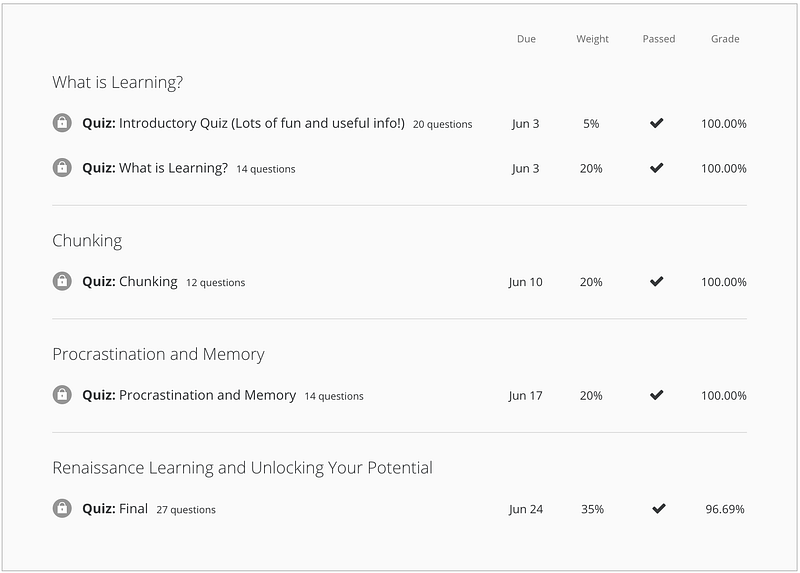
If you’ve followed the course, you’ll understand why deliberately learning 36 new skills in a year is important. When you learn new concepts, your brain creates mental chunks. Skills are an assemblage of chunks if you will. When you develop skills, you are in fact creating many different chunks in your brain. And what’s important to note here is that these chunks, even though developed by practicing a specific skill, are actually valuable to learning other skills. Even seemingly unrelated skills.
Knowing the scientific truth above, you can understand that there’s no hacking the process — you have to deliberately work to get your brain to create chunks. The course explains the concepts more in details, but here’s the not-so-surprising key:
You need focused periods of time where you deliberately practice a skill and repeat the process over a number of days, weeks or months.
How focused? How many days? What do I practice? When do I practice?
My approach is to learn 3 new skills every month. I practice 30 minutes each every morning for 30 days. I usually choose skills that work completely different areas of my brain. If we agree with Robert Greene’s quote from above, then we agree that becoming a polymath is a surefire way to thrive. Working skills across different areas of your brain will do just that.
I explain my full process here:
I learn 3 new skills a month, and so can you!
*If you sign up for the newsletter, you’ll get the exact same worksheet I’m using. So check it out!
What you’ll notice along your journey of learning to learn is that the more you learn, the faster and easier it becomes to learn other skills, again, thanks to the chunks you previously formed.
There are two other very important aspects of learning: Resting and Smart Repetition.
Resting
By resting, I don’t necessarily mean sleeping. I mean calming your mind to let your subconscious do its work. It has been proven that chunks are indeed getting formed while you rest your mind.
Without going into details, here are some ways to rest your mind:
- Cardiovascular activities (walking, jogging, biking, hiking, etc);
- Meditation;
- Journaling;
- Enjoying nature;
- Taking a shower or bath; and
- Quality sleep.
Smart Repetition
A great book recommendation I have is: How We Learn: The Surprising Truth About When, Where, and Why It Happens
Is practicing the same thing over and over a smart way to learn things?
Well, no. It turns out there’s science showing that there is an optimal time to revisit something you’re trying to learn. This seems to be especially true for non-motor skills.
Basically, you try to space out the repetitions. What you learn today, recall it tomorrow, then after 2 days, then after a week, then after a month, then after a year. Chances are that by then, the knowledge will stick to your brain.
The book goes into more details as to why that is.
Here’s a one-sentence “formula” to summarize how to best learn new skills:
Consistently do focused practice, rest your mind, and repeat in smart ways.
Runner-ups
Choosing 3 skills was insanely difficult. There are so many important factors to thriving that 3 just can’t cover everything. As such, and briefly, here are two I strongly considered putting on the list:
Become Truly Self-Aware
Check out Ryan Holiday’s book: Ego Is The Enemy
Develop Influence
Check out Brendon Burchard’s book: High Performance Habits
Conclusion
Ready to start your journey to make 2019 your best year yet?
I hope you learned something important here and that it’s going to push you to action. Too many people read articles and books, never acting on them. Don’t let this article just be another one of those. If you learn to get to action, adapt to change, and learn to learn, you’re equipped to thrive not only for 2019 but for the rest of your life. So start now before it’s too late.
You can do this!
Thanks for reading, sharing, and following! :)
Check out my deeply actionable Course on 10 Skills to Improve Your Learning in 10 days.



