
The 2 Reasons Populations Are Collapsing in Developed Countries Around the World
170 years ago, the average woman in the U.S. had at least 5 babies. Today that number is less than 2 and declining. What changed?
Related and recent articles
• Should It Be Up to Our Kids to Win the War Against Climate Change? • The Japanese Government Pushes People to Have More Babies — Smart Move Or Not? • 3 Things You Didn’t Know about Student Loan Debt and (Potential) Debt Cancellation • The Social Contract Broke in the U.S. Years Later Than in Japan • Has U.S. Healthcare Really Become a Mob Protection Racket? • The Rule of 72 — A Shortcut That Makes Anyone Look Like a Math Genius
(Subscribe to receive email notifications when I post new articles.)

Roadmap for this article
- Introduction. Japan as a cautionary tale.
- Total fertility rates are declining in other countries, too.
- WHY have birth rates been declining?
- The population collapse happening around the world is being driven by 2 main factors.
Part 1. Introduction. What happened in Japan?

Let’s go back in time to 1984 when the fertility rate in Japan was 1.81. This meant that the average Japanese woman was having 1.81 babies over the course of her life.
However, this was below the replacement rate for the population, which is around 2.10 births per woman.
By 1988, the fertility rate had dropped further to 1.66 births per woman. And this foreshadowed a substantial decrease in the Japanese population in the decades to come.
The Japanese government was in panic mode.
There were societal reasons, cultural reasons, governmental reasons, and tax revenue reasons why government officials felt Japan’s population needed to at least hold steady if not continue to grow.
So the Japanese government beginning trying in the early 1990s to increase the number of babies that Japanese women were having by expanding “family policies and programmes in three areas: (1) childcare services; (2) parental leave schemes; and (3) monetary assistance in the form of child allowances.”
Definition of Total Fertility Rate (TFR): “The total fertility rate in a specific year is defined as the total number of children that would be born to each woman if she were to live to the end of her child-bearing years and give birth to children in alignment with the prevailing age-specific fertility rates…. Assuming no net migration and unchanged mortality, a total fertility rate of 2.1 children per woman ensures a broadly stable population….”
Did these incentives work in Japan in the 1990s and 2000s to increase the Total Fertility Rate and push it back above 2.10?
Not even.
Instead of increasing Japan’s TFR back above 2.10 from 1.66 in 1988 or 1.50 in 1992, the TFR continued to decrease until it hit a bottom in 2005 at 1.26 births per woman. (Data from The World Bank)
Japanese TFR did increase some after 2005, but by 2019 and 2020 it had dropped back down to 1.36 and 1.34 respectively.
Part 2. Total fertility rates are declining in other countries, too.

This means that populations in these other countries will decline also, if they haven’t started to already.
South Korea’s TFR has outright plummeted to 0.81 in 2021 — a record low — according to the Korea Times.
No other developed country has as extremely low a TFR has South Korea does, but most of them do have TFRs low enough their populations are either shrinking or about to start shrinking.
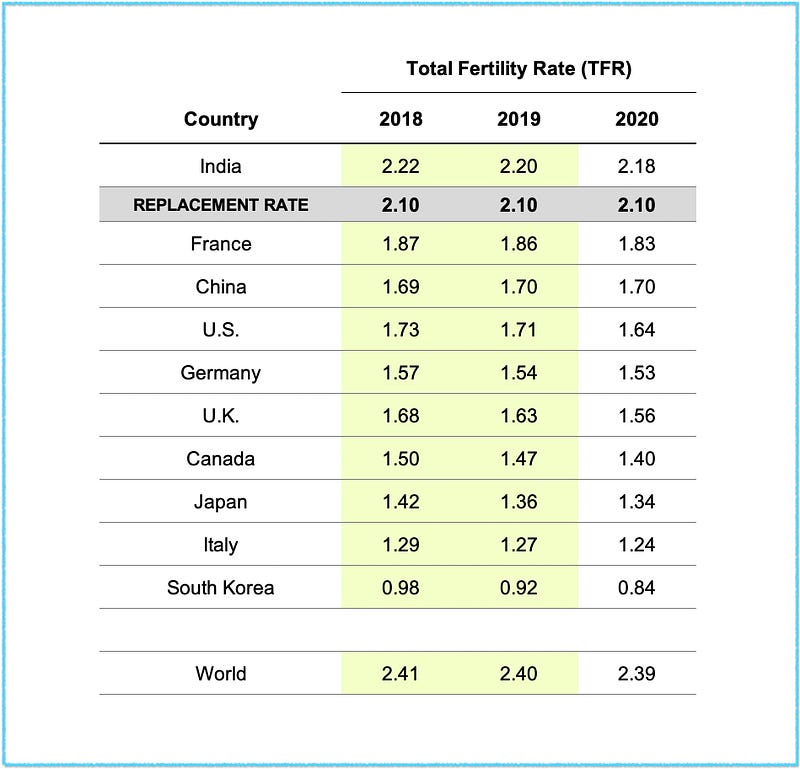
Governments are freaking out about this. Part of the reason is tax revenue, and that alone is probably enough for most governments to be in a state of moderate panic.
But the part that is keeping them awake at night and causing them to use these 4 magic words every time they order a drink — “make it a double” — is this apocalyptic realization:
Large parts of the developed world’s economic growth and economic well-being have been built not only on leverage, but on leverage funded by debt.
As long as GDP and population growth continues, they can keep kicking the can down the road to let the pyramid scheme work for a few more years.
But as soon as a country doesn’t have increasing numbers of consumers entering the pyramid scheme, it unravels.
And once it starts to unravel, economic systems can come undone at lightning speed as everyone races each other to get out the door before the other guy does.
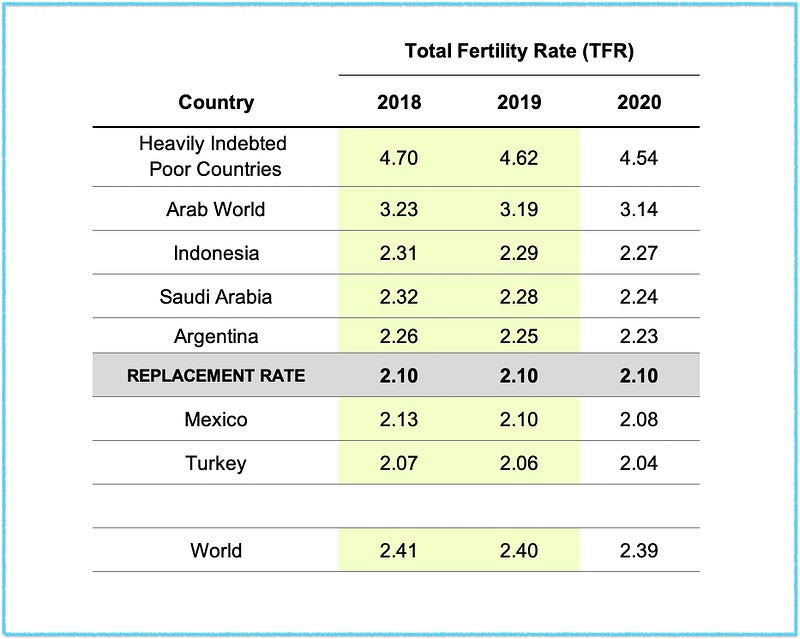
By the way, many countries are still doing OK in terms of birth rates, but even their birth rates are decreasing. It will take longer for them to get to the point where their populations peak and then decline, but it will probably happen for most of those countries also.
Part 3. WHY have birth rates been declining?

First let’s look at why birth rates began to explode UPWARDS from the mid-1800s until the late 1900s.
From Chapter 3 of “The Next 100 Years” by George Friedman, 2009:
“…There were two clear causes for the population explosion that were equally significant. First, there was a decline in infant mortality; second, there was an increase in life expectancies. Both were the result of modern medicine, the availability of more food, and the introduction of basic public health that began in the late 18th century.”
There are no really good statistics on fertility rates in 1800, but the best estimates fall between 6.5 and 8.0 children per woman on average. Women in Europe in 1800 were having the same number of babies as women in Bangladesh are having today, yet the population wasn’t growing [in Europe in 1800]. Most children born in 1800 didn’t live long enough to reproduce. Since the 2.1 rule [Replacement Rate level with regard to Total Fertility Rate] still held, out of eight children born, six died before puberty.
Medicine, food, and hygiene dramatically reduced the number of infant and childhood deaths, until by late in the 19th century, most children survived to have their own children. Even though infant mortality declined, family patterns did not shift. People were having the same number of babies as before.
It’s not hard to understand why. First, let’s face the fact that people like to have sex, and sex without birth control makes babies — and there was no birth control at the time. But people didn’t mind having a lot of children because children had become the basis of wealth. In an agricultural society, every pair of hands produces wealth; you don’t have to be able to read or program computers to weed, seed, or harvest. Children were also the basis for retirement, if someone lived long enough to have an old age. There was no Social Security, but you counted on your children to take care of you. Part of this was custom, but part of it was rational economic thinking. A father owned land or had the right to form it. His child needed to have access to the land to live, so the father could dictate policy….”
That last bolded sentence is key. In an agricultural society, every pair of hands from every child that you have is a revenue generator. And children were a fairly low-cost revenue generator.
Back then, if children received any formal education, it was only up until the time they were 10 or 12 years old. Other than that, they could be working in the fields and “generating revenue” for the family and parents.
As Friedman went on to describe, “as children brought families prosperity and retirement income, the major responsibility of women was to produce as many children as possible. If women had children, and if they both survived childbirth, the family as a whole was better off. This was a matter of luck but it was a chance worth taking from the standpoint of both families and the men who dominated them. Between lust and greed, there was a little reason not to bring more children into the world.”
Why have birth rates began to COLLAPSE over the past several decades?
Fast forward to the late 20th century and early 21st century.
Whoosh!
And the rewards and incentives have turned upside down for having more children!
- Today children generally do not generate any REVENUE for the family while they are young and growing up, it’s the opposite now.
But it’s far worse than just that.
- Children have become a massively large EXPENSE on the family income statement in modern times. Clothing, food, healthcare, child care, education, college, etc. Most of the expense items I’ve listed here did not exist to any significant degree for families with children on farms 170 years ago.
Bringing a child into the world and raising them to adulthood has become an increasingly large financial burden.
As Friedman so memorably put it:
“10 children in 18th century France might have been a godsend.
10 children in late 19th century France might have been a burden.
10 children in late 20th century France would be a catastrophe.”
There are many reasons why people decide to have children:
- There may be religious reasons.
- It may be part of a your own sense of what it means to be an adult.
- You might feel pressure to continue the family name.
- You might have kids because you’re pushed that way by your parents or the rest of society.
But “my kids are an amazing financial investment with crazy-large returns on investment!” is NO LONGER one of those reasons.
The financial side of the “why have kids?” equation has gone from (1) being something that made you want to have children 170 years ago to (2) today pushing you to NOT have children.
So the economics of having children NOW moves the needle away from (1) overdrive-mode where women were having 5 or 6 or 7 babies 170 years ago to (2) today where they are having fewer than 2 babies.
And if we’re talking about South Korea today, it’s less than 1 child on average!
Part 4. The population collapse happening around the world is being driven by 2 main factors

What is driving the ongoing collapse in population around the world and in the United States?
- Any revenues once associated with having children have disappeared for families in developed countries.
- The costs of raising a baby to adulthood have skyrocketed (1) in absolute terms and (2) in relative terms compared to the limited family financial resources that ALSO have to go toward caring for adults in the family and saving for the parents’ retirement.
With rapacious price increases happening everywhere in most countries — especially in the United States — the population collapse seems almost certain to continue indefinitely.
Related and recent articles
• Should It Be Up to Our Kids to Win the War Against Climate Change? • The Japanese Government Pushes People to Have More Babies — Smart Move Or Not? • 3 Things You Didn’t Know about Student Loan Debt and (Potential) Debt Cancellation • The Social Contract Broke in the U.S. Years Later Than in Japan • Has U.S. Healthcare Really Become a Mob Protection Racket? • The Rule of 72 — A Shortcut That Makes Anyone Look Like a Math Genius
(Subscribe to receive email notifications when I post new articles.)
Again, thank you for reading, subscribing, clapping, and sharing — your time and attention are deeply appreciated!