
The 2 Most Important Life Lessons I Learned From Schrodinger’s Cat Experiment
About Happiness and Fear
For everyone who is not familiar with the Schrodinger’s cat experiment here is a very brief explanation in the simplest of terms —
In 1935, Erwin Schrodinger in an attempt to criticize Copenhagen interpretation of quantum physics proposed an experiment where a cat is placed in a box with the sealed vial of poison that will break open at a random time since no one knows if and when the poison is released until the box is opened the cat can be thought of as both, alive and dead.
The point being the existence of the cat is both, alive and dead till the box is closed, it is only by opening the box that we can know which is which.
Now one would think what does this scientific experiment have anything to do with one’s state of mind, but I would disagree —
The connection between Schrodinger’s theory and Happiness —
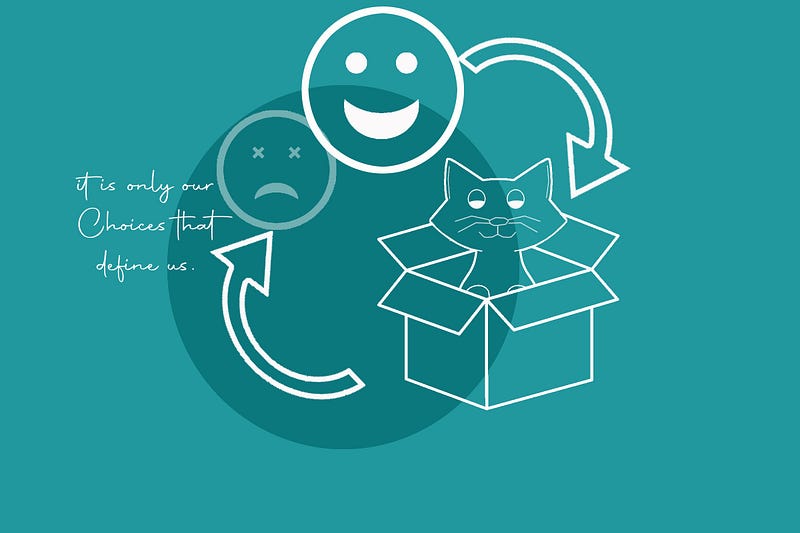
By analogy to the “thought experiment” let’s consider our emotions —
The experiment says that the cat can be in multiple states i.e. in superposition at the same time.
Similarly, as human beings, our mind is a battlefield for complicated emotions. We experience millions of emotions on day to day basis. We are sad, angry, tired, content, happy, all of it at the same time. All these emotions are in superposition in our minds, existing at the same time. For example —
EXPERIMENT SETTING:
When overbearing grief envelopes us or when one is in a stressful situation, we tend to focus on the crisis because our survival instincts tell us to concentrate on the bad, the severe. It’s only natural to do so. These are the times when one’s mental health takes a toll. These severe emotional traumas may lead to depression or emotional unavailability.
THE APPLICATION OF THE THEORY:
In such high-pressure situations, we tend to forget that all those other pleasant emotions are still buried deep inside in our conscious, those small wins are still lingering in the back, still in superposition; just seeking an appropriate access point.
So if we choose happiness, if we intentionally choose to focus on the good parts, the small wins. If we choose that our mind (the cat if you may) is, in fact, alive then by the extension of your choice all other states such as grief, regret, sadness, exhaustion collapse and you are left with the new possibility of hope.
Every day is a simple choice, you can choose to be happy, to be productive, to be more than what you were. So choose, and choose wisely.
“You can’t cross the sea merely by standing and staring at the water.”― Rabindranath Tagore
The connection between Schrodinger’s theory and Fear —
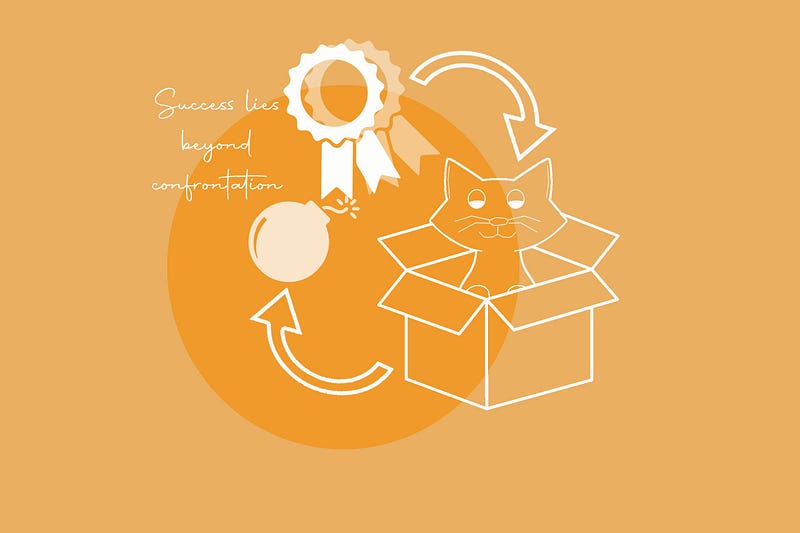
Now by analogy to the “thought experiment” let’s consider our fears —
The experiment states that the cat can be in either state before we open the box and only our decision or lack of it, forces the cat to be either dead or alive.
Similarly, we are constantly living in the fear of our choices; contemplating the what-ifs, deducing if that one particular decision that we are dreading will go in a positive way or negative. For example —
EXPERIMENT SETTING:
As humans, we are afraid to try something new because that something new forces us out of our comfort zone while threatening our well-established routine. The fear of change or fear of failure seems so tremendous that we don't even weigh on the possibility of success. We never make that decision to change the outcome of our life trajectory. And when no decision is made to inspect what you fear. There is no scope for success. It is the inspection that forces the probability of one state (success /failure)to collapse and forces the other to come to fruition.
THE APPLICATION OF THE THEORY:
But until we take the risk, until we take that leap into the faith, until we open the box; we will never know what lies across that finish line — Reward or disappointment.
The point is to try and make that decision. Because opening the box doesn’t make you reckless it makes you brave.
“One of the greatest discoveries a man makes, one of his great surprises, is to find he can do what he was afraid he couldn’t do.” — Henry Ford
WRAPPING UP
There are many theories in which science is reflected in the human psyche. And this simple yet complex experiment is an example of one of those theories. To believe in the science of physics or of emotions is an individual choice.
However the ultimate truth lies in our capacity to process knowledge and information, and to act on it. It’s irrelevant if it’s through the lens of quantum physics or human emotions.


