
The 19th-Century French Artists in Search of Truth and Beauty in Rural Life
The importance of the Barbizon School of painters
.jpg)
The emergence of the French Impressionist painters of the 1870s didn’t come from out of nowhere.
The Paris-based conjurors of light found a new mode of making paintings that constituted a break with the traditions of European painting, yet they owed many of their practices to an earlier school.
An important precursor and a cited influence on artists like Claude Monet and Pierre-Auguste Renoir was the circle of painters known as the Barbizon School.
In the middle of the 19th century, this group of French artists set up home in the village of Barbizon in the Fontainebleau forest, some forty miles southeast of Paris, and set about forging a new relationship with nature around them. They made paintings of landscape scenes and rural life, with especial attention given to naturalistic lighting effects.
The difference with the work of the Barbizon School was not of a new relationship with light as such — as the Impressionists would later forge — but a new desire to evoke in paint the first impression of a scene made upon the senses.
It was a push against the mannered styles of the academic tradition, in search of an art form that expressed a direct encounter with their subject, where the motif was stripped of any pre-established “rules” of painting.
Beginnings & Influences
The beginnings of the Barbizon School can be traced back to the 1824 Salon de Paris in which the English painter John Constable exhibited three paintings and was praised by several prominent French artists of the time, including Théodore Géricault and Eugène Delacroix.
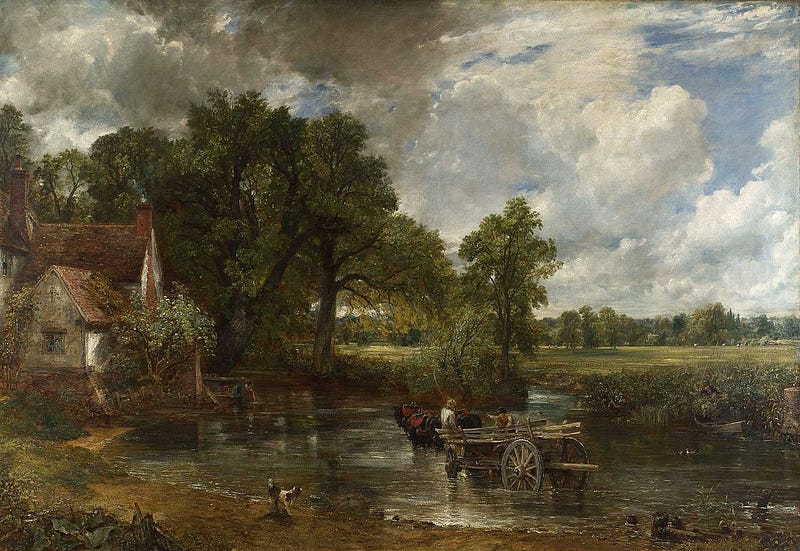

Constable was admired for his unique approach to making art, which turned away from the tradition of copying from old paintings and instead used unmediated studies of nature as his primary source.
The originality of Constable’s technique would have a pronounced influence on the course of French art, most notably among the members of the Barbizon school.
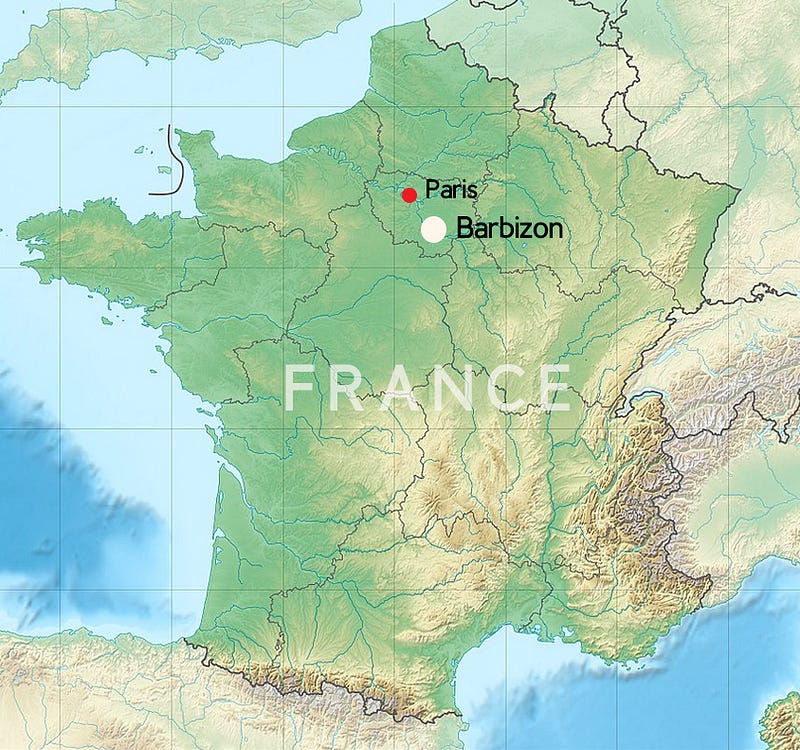
As early as 1829, Jean-Baptiste-Camille Corot travelled from Paris to Barbizon to paint in the Forest of Fontainebleau.
Corot had begun his adult life as an apprentice to a cloth merchant. Commercial life however — with its “tricks of business” — didn’t agree with the young artist, and at the age of 26, he persuaded his father to support a change of career.
“I told my father that business and I were simply incompatible, and that I was getting a divorce.”
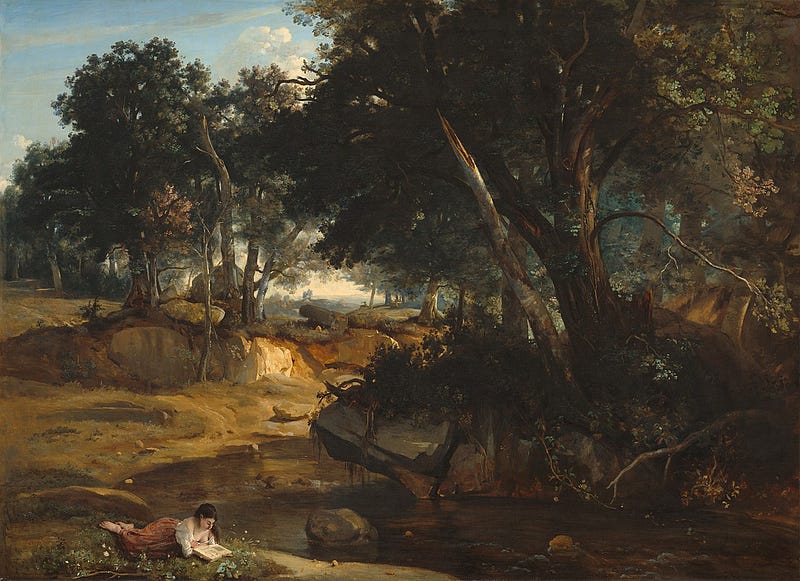

Corot had begun what would become an evermore common practice among Parisian artists of the time, of taking excursions beyond the suburbs of the capital into the countryside.
In the summer months, artists began to venture to the royal parks of Saint-Cloud and Versailles. Other artists went to the beach resorts on the Normandy coastline, whilst others went to the rural environs of Barbizon in search of their own authentic experience. John Constable’s influence would be crucial in this regard as a guiding light.
Building a Community
During the 1840s in Paris, several of the key members of the Barbizon School were beginning to befriend one another, including Jean-François Millet, Constant Troyon, Narcisse Diaz, Charles Jacque and Théodore Rousseau.
Several of these artists had experienced disappointment at the hands of the Salon. Some failed to gain entry. Others, like Millet, were the recipients of severe criticism. In 1848 he exhibited his ambitious work The Captivity of the Jews in Babylon, but the painting was condemned by art critics and the public alike.
In June of the following year, Millet settled in Barbizon with his wife and their children. Here he focused more concertedly on the scenes of rural life instead of grand history paintings, and consequently discovered the mode of painting that suited him best. As he wrote in a letter to a friend:
“But, to tell the truth, peasant-subjects suit my nature best, for I must confess, at the risk of your taking me to be a Socialist, that the human side is what touches me most in art, and that if I could only do what I like, or at least attempt to do it, I would paint nothing that was not the result of an impression directly received from Nature, whether in landscape or in figures.” (Jean-François Millet, letter, 1850)
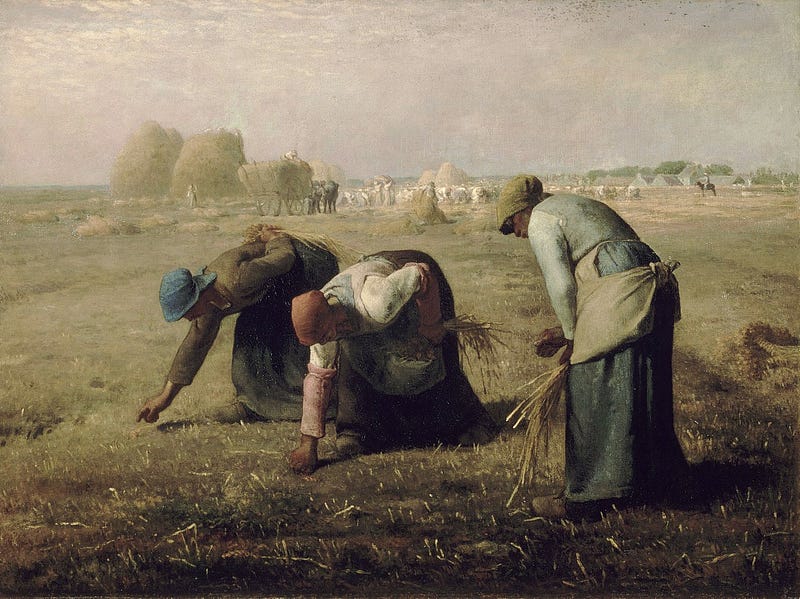

Millet’s painting The Gleaners, made in 1857, is a work that stands out as a paradigm for the Barbizon school. Its temperate colour scheme, the late afternoon dusk setting, along with the feathery brushwork, give the work a peaceable feeling and draws on the romantic idealisation of the countryside as a place of simple and earnest community.
Millet had a strong conviction that the feeling of unity within a painting was the key to its success. “Beauty is the result of harmony,” he wrote.
“I do not know whether in art one thing is more beautiful than another. Which is most beautiful, a straight or a crooked tree? — the one that fits the situation best. In the right place, a hunchback will be more beautiful than Apollo himself. However one looks at it, however one turns it around, and whatever one chooses to call it, order will always carry the day. Order and harmony are the same thing.” (Jean-François Millet, letter, 1858)
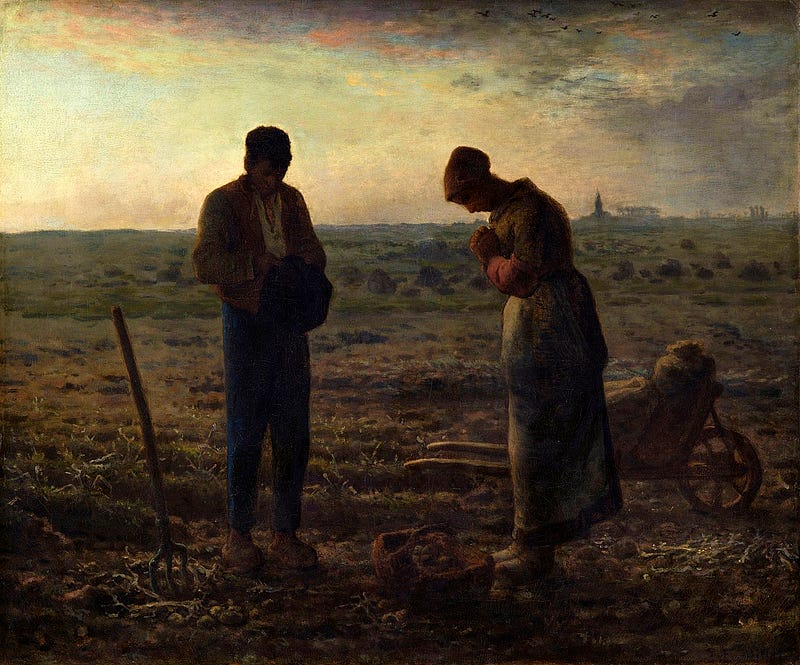
One of Millet’s best known works is The Angelus, painted between 1857 and 1859. The painting shows two peasants during the potato harvest in Barbizon, with a view of the church tower of Chailly-en-Bière.
Millet said of the work: “The idea for The Angelus came to me because I remembered that my grandmother, hearing the church bell ringing while we were working in the fields, always made us stop work to say the Angelus prayer for the poor departed.”
Le Grand Refusé
The painter Théodore Rousseau also struggled with the Salon de Paris. After initial success in submitting works to the exhibition in the early 1830s, he had eight of his works rejected between 1836 and 1841, gaining the comic nickname “le grand refusé”.
During this period, Rousseau began to spend time in the village of Barbizon, and in 1848 he took up permanent residence there. His works tend to carry an air of sweet melancholy, with the forms of trees and the play of light suggestive of the ineffability of life.
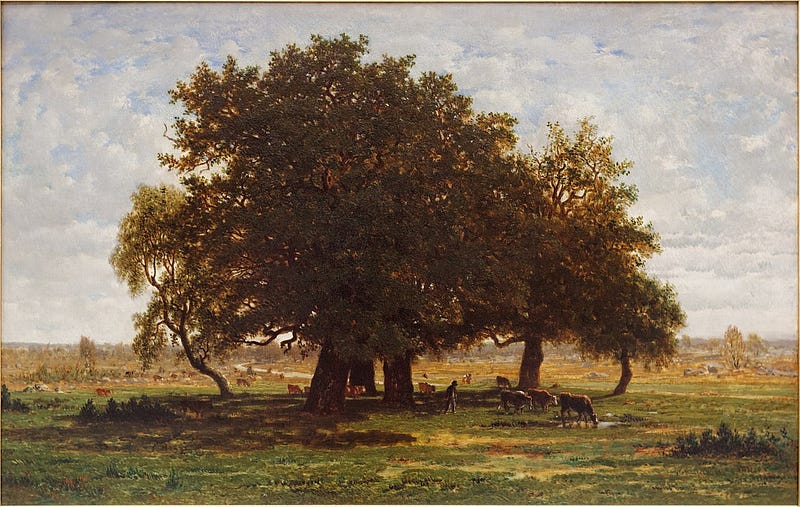

Unlike Millet, figures rarely appear in Rousseau’s paintings; when they do they are usually small, embedded in the landscapes as naturally as rocks or animals.
Importance of the Barbizon School
The Barbizon painters would have a significant influence on the course of French art in the 19th century.
Several younger artists — who would go on to become some of the most famous names in art history — visited the Fontainebleau Forest, including Monet, Renoir, Alfred Sisley and Charles-François Daubigny.
The new emphasis towards realistic detail and away from the Neo-classical tradition that sought to emulate classical antiquity, would be especially important to these Impressionist artists, who took the Barbizon practice of painting scenes outdoors as their model.
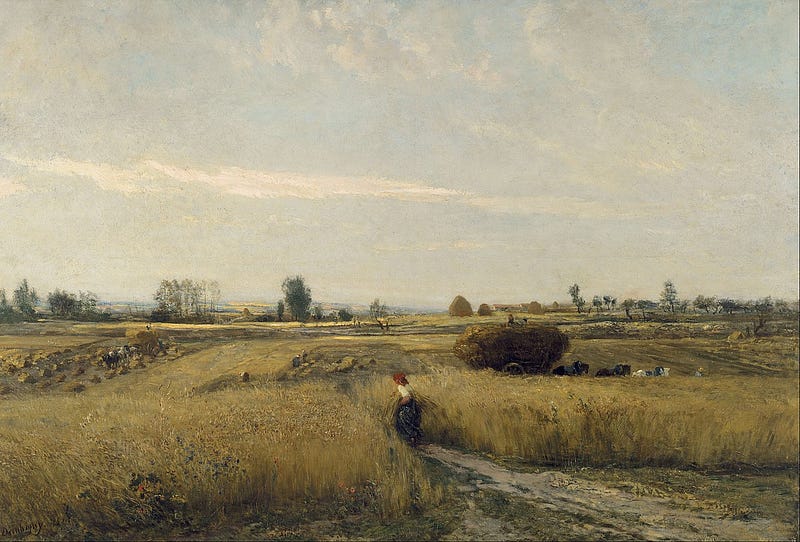

The artists of the Barbizon School were, in many respects, the first artists to appreciate the rapidly changing view of the countryside that the rise of urban living would instigate.
As Paris bloomed into a modern metropolis, they painted the trees, meadows, marshes and glades of the Forest of Fontainebleau, and in doing so offered an image of rural harmony that the urban psyche would find so invaluable in its pacifying effect.

If you liked this, you may also be interested in my book Great Paintings Explained, an examination of some of the most beautiful objects in art history.
Would you like to get…
A free guide to the Essential Styles in Western Art History? Download for free here.
Join me…
On Instagram for more great paintings on the go!