
The 12-Point Checklist for Poetry Editing
To polish your work and prepare (if for publishing)

If you are having trouble viewing this content here’s how to fix that.
Working as a freelance poetry editor, I see some of the same things over and over from poets who are pretty sure their work is completed. I say “pretty sure” because there’s something nagging at them about the work, hence the hiring of a poetry editor to look at their poems.
Often, when I am done working through the Google Doc, leaving dozens (sometimes hundreds) of comments on a body of work, the client is at first a bit overwhelmed, then ultimately empowered and grateful.
Easy Navigation GuideForm
∘ Grammar check — spelling
∘ Grammar check — tenses
∘ Form check
Style
∘ Remove all clichés
∘ Find areas that are “telling” instead of showing
∘ Imagery inclusion check
∘ Imagery parallelism / consistency check
∘ Remove superfluous words
∘ Word choice
Final checklist
∘ Analyze the meter / flow.
∘ Punctuation
∘ Read your poem out loud
More resources:
∘ Here’s a handy dandy graphic for you if you’d like to save it for future reference.I thought perhaps a quick checklist for poets would be of help, to all of us including me, so that we take those crucial moments between the first draft and deep editing work, to make a quick run down this list, which will help to determine the poem’s finality. What I hear most from clients is that they think the poems are finished, parents and friends love it, but they know there is more they can do for the poems to make them their best.
From the insecure or the “newbie” writer to the seasoned professional and accomplished poet, this list is here to help!
- (Handy dandy checklist graphic at the bottom.)
Form
Grammar check — spelling
It is difficult to depend on Grammarly for poetry, but it will at least catch your obvious misspellings. Nothing screams “amateur” quicker than misspellings or typos — so proofread thoroughly.
Grammar check — tenses
Check your verb tenses and while you are at it, the agreements. It is easy to shift halfway through a poem and not realize it — after all, you are busy chasing beautiful lines and inspiration. But now that your editing hat is on, check through your work for these common grammatical errors. Make sure it is clear what you mean and your sense of time is not fuddled by a mixture of tenses.
Form check
Take a look at your poem with a wider lens to make sure that as a whole it looks appealing. You don’t want one weird line that is three times longer than everything else. Make sure the line lengths and stanza breaks make sense.
Style
Remove all clichés
One of the most common errors I see when editing poetry is that people have an affinity for including clichés in their writing. If you want to publish or share your poetry, it is frowned upon to involve clichés. It is an element that will label your work as amateur, and frankly, lazy. It is ok to write them as you are writing out the thoughts of your poem, but please, double please, go back and take out the cliché and replace it with something more original and certainly poetic. Here’s an article on cliché.
Find areas that are “telling” instead of showing
You’ve heard this one before, right? It’s somewhere in “Writing Rules 101.” It is fairly easy to look at your writing and see “action” there because you are so close to the emotion of the poem. But if the entire poem is “explaining how you feel” and “explaining what is going through your head” then there is likely a whole lot of “telling” going on. (I call this stuff “thought-splaining”.) Make sure that there is more depth to your poem by including more active phrases. If the poem is particularly cerebral, just be sure your reader can relate to it — rather than your reader just being the “listener” to how you are feeling about something. Write the rough draft however you want, but do go back and work to shape the poem into a reader experience.
Imagery inclusion check
I tell my clients to imagine their poem is a string hanging from the beginning point of the poem to the end, like a clothesline. Each image you provide them is a snapshot, a picture, hanging along the string. If there aren’t any images or if the images are too vague to create a very good picture— your work is not done. Make sure you give the reader something to experience by including sensory imagery. Here’s something that will help.
Imagery parallelism / consistency check
This one gets tricky. In fact, I’ll probably dedicate an entire post to this topic alone. Imagery needs to be consistent throughout your poem. Poets love throwing in everything but the kitchen sink if it sounds pretty. I have given you in the previous example an image — a clothesline full of snapshots.
Now, go through your poem and each image you provide is a separate picture lined up along the line. If there are any outliers, it will be easier to see what images do not work in the poem by this visualization. Try to stick to a “theme” for your imagery throughout — all nature images and word choices, or all medical images and terms, but if you toggle back and forth or have images in all kinds of different categories then the reader is left with confusion. It doesn’t mean these are the TOPICS of your poems — but the theme of the images you provide. The topic of your poem could be an abusive experience and the theme of your imagery could be “dancing” or “musical” terms. When your reader closes your eyes — what do you want them to see/hear/smell etc.? THIS is your imagery.
Remove superfluous words
Get rid of all those useless fluff words. Consider your poem this: a series of descriptors / images / snippets of action — connected with as FEW words as possible. Get rid of the fluff and keep the juicy stuff. The weighted words are the words that matter.
Word choice
Keep your word choice parallel and consistent — just like your imagery (another topic that can use a post all its own). If you are writing about nature, for example, but all your descriptor words are abrasive and harsh — it will disrupt the peaceful scenery you are trying to build. Like saying the “iron moon” right in the middle of a nice, serene poem. Do you want abrasive? Man-made? Hard? Metal? If not then find a better way to describe that moon even if the word “iron” looks so pretty there.
Word choice is crucial. EVERY verb should be analyzed to make sure it is the correct verb to use. (Perfectly chosen verbs won’t need those pesky adverbs.) EVERY phrase — the correctly chosen words will do the most work in the fewest words.
Final checklist
Analyze the meter / flow.
If you are sticking to a meter, clap it out. Adjust so that you don’t have syllables that are off the meter. (This one could be a series of posts.) Basically, make sure (if you want a meter) that the poem sticks to something pleasing. If you read it out loud and stumble with the rhythm, adjust the words to keep the rhythm. A word on rhyming: forced rhymes do not add value to your poem.
Punctuation
Do you want the reader to take a quick pause? They won’t know without a comma. There are ways to tell your reader where to take a short pause (comma or line break), a full stop (a period or stanza break), or to linger with something (stanza with a stand-alone line or itallics etc.). Tell the reader to read quickly through to the next line with enjambment or to connect two phrases / images / thoughts (with a dash — or a rare semicolon). Read through your poem and add in the punctuation directives for your reader.
Read your poem out loud
Just do this. You can find all kinds of issues with meter, words that simply do not fit the narrative, or phrases that are too complex. If you stumble — your reader certainly will.
More resources:
Poetry Blogging Guide Creative Use of the Senses in Your Writing
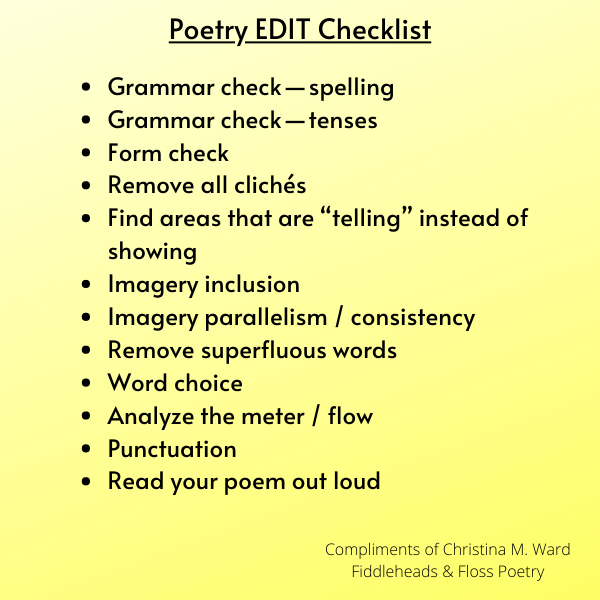
Here’s a handy dandy graphic for you if you’d like to save it for future reference.
Christina M. Ward is a poet, writer, author of the best selling poetry book organic, and novelist (now querying!). You can follow her work by joining her Author Newsletter.


