
The #1 Reason Why When I Leave America I’ll Never Come Back
Even if money was no object, there’s no changing this sad fact of life
You’ll never hear me make guarantees like the one I’m making now —
When my partner and I move to Spain — hopefully sooner rather than later — I will not return to the United States of America, except to visit.
Generally, I’m eager, positive, and enthusiastic at the same time as cautiously pessimistic. Due to a mix of anxiety and superstition, I tend to qualify most statements I make about the future, particularly as they relate to my health, work/money prospects and general life plans. I even did it there in my guarantee with hopefully sooner rather than later.
I know we’re going to move to Spain. That’s not the question. And I know once we get there, we’ll never look back. It’s the timeline I qualify as to not jinx myself. In addition to hopefully, there’s lots of knock on woods, if all goes wells and we’ll see what happens sprinkled in my vocabulary.
If you have a similar psychological composition, what I’m saying here might resonate with you. Maybe deeply.
If you know someone with a similar way of being, you might have an understanding of where I’m coming from.
It’s like if I say it’s absolutely, positively going to go well (whatever it is) — no question about it — I’m too cocky and confident. However, if I qualify my statements, I’m humbly leaving open the possibility that things won’t go well, somehow guarding myself against things going wrong.
Put another way, I overthink — too often — about unlikely obstacles and worst case scenarios.
This can be good, especially when there’s lots of planning involved in accomplishing something. Leave no stone unturned. Prepare for the worst, hope for the best.
But this approach can be bad, because, as Tom Petty wrote —
Most things I worry about never happen anyway.
(Knock on wood).
All of this said, I don’t get the least bit nervous, worried or anxious. Like not at all. When I say that once I leave the United States, I’ll remain in Spain for the rest of my life.
My partner and I had this conversation the other day. And we agree — for many of the same reasons.
The conversation sprung from a confluence of factors, including —
- Posts I’m reading in some Facebook groups about moving to Spain where people talk about their transitions. Some hesitated to completely close up shop in the US (i.e., sell the house) to make sure they would like Spain. Most ended up loving it. A few couldn’t get with the new culture and came home.
- Thoughts I have been having lately about getting older. Specifically, the idea that as you get older you develop a stronger and more certain sense of what you want and you freak out much less over going for it.
- Related to getting older, I turn 48 on July 18th. So I’m headed into — if all goes well — the second half (the second act) of my life. And I want it to be as fresh, exciting and full of experiences as the first half. In fact, I want it to be better. And I expect it to be better because I have a stronger and more certain sense of what I want and I freak out much less over going for it. We’ll see what happens.
Take all of this together and add it to something I wrote on Medium the other day —
Turns out I knew within 13 seconds of setting foot on Spanish soil that isn’t an airport that I’d love living there. In fact, we’re going back in February.
The above probably has a lot to do with my move to San Francisco in 1999 and subsequent education in urban studies and planning.
San Francisco — easily the best traditionally urban place America has to offer — cemented my love for cities and decision to live in them for the rest of my life.
Urban planning and studies did several things for me —
- It helped me develop a historical and contextual understanding of why cities are the way they are around the world.
- It stressed the distinctions between American and European built environments from historical, logistical, political and cultural standpoints.
- It made it clear to someone who had never been to Europe (me, in my late twenties/early thirties) that I would absolutely love it there.
Unlike most things in life, my experience in Europe (Italy and Malta first, then Spain and Italy) exceeded my expectations. It was everything I wanted and expected it to be and more. Times infinity.
There’s literally no question in my mind that I will love living in Spain.
I do have this sense for getting a feel for a place pretty much immediately. I have yet to be wrong on how I’d feel living somewhere new or different. And this comes from a person who has lived in eight different cities and roughly double the number of environments since moving from home 28 years ago.
As Spain goes, there’s the lower cost of living.
However, as I pointed out elsewhere on Medium, cost of living is not the reason why my girlfriend and I decided on Spain.
It’s about the culture. Broadly speaking.
Specifically speaking to the #1 reason why I’ll leave and never come back.
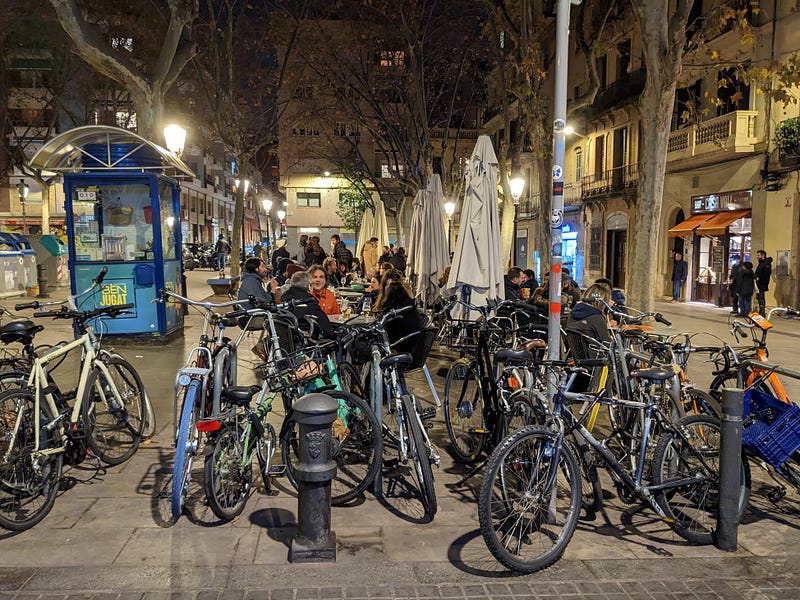
It’s the public social life.
Even if you have the money to live in the best setting urban America has to offer, you’ll never find the equivalent — taking all the interrelated factors together — of the built environment much of Europe and, in this instance, Spain offers.
We can talk all day long about plazas, squares, tapas bars, terraces facing the street and evening strolls. Yes, they’re different there than they are — to the extent that they actually exist — here.
But the biggest difference — that makes it all possible — is that motor vehicles come last in Spain. At least in the cities where we’re looking to live. Streets are designed first and foremost for people, bikes and public transit. Cars must fight for space. And they must fight slowly and quietly, not aggressively.
In the United States — even where cities are trying to malign the automobile — cars come first. If we’re trying to make a space more pedestrian friendly, we’re almost always doing it around cars. Cars come first, then we fit in the improvements for people, bikes and transit.
I could go on.
But there’s no point. Because this isn’t changing. Maybe incrementally. But never on a large scale. America will always be a car culture.
It might seem hyperbolic to make this my #1 reason why when I leave I’ll never come back. But you cannot overstate the impact of the built environment on pretty much every element of life. From the obvious ones like how we get around and socialize. To the less obvious, like the impact on your pocketbook.
It doesn’t only cost less to live in Barcelona or Valencia than San Francisco or Los Angeles because of complex historical and economic reasons. It costs less because people have myriad options for how to organize themselves. They’re not held hostage by cars and an absurd amount of space set aside for cars. And, of course, they don’t have to shell out hundreds, if not thousands of dollars each month to own and maintain a vehicle.
Because they have a choice in the matter.
In many — make that most — parts of America, you have no choice. You absolutely need a car. And this is not only often one of your biggest budget line items, it’s one of the main reasons for non-existent or degraded public spaces and a subsequent lower quality of life.
You can’t talk about money, retirement, budgeting, or moving to a different country to start a new phase of your life and/or thrive in your second act without seriously considering your transportation situation and how it’s connected to other (potentially) big expenses such as housing and healthcare.
Which brings it back to the financial side of this equation.
In closing, here’s a glimpse at some of my own numbers I wrote about the other day —
Where you live doesn’t only dictate what you spend on housing. It determines other pretty much unavoidable costs, particularly transportation, healthcare and the aforementioned cost of food.
To not have a car in Los Angeles — even living in our relatively walkable neighborhood — would be a major inconvenience. And it’s not one we’re willing to accept.
As I have mentioned before, I have a car payment. I expect/hope to get rid of that by the end of the year. Obviously, I also pay for car insurance, gas, registration and occasional maintenance. This comes to roughly $400 a month most months, except for when the registration is due or something else comes up (like a stolen license plate or busted side view mirror, both of which have happened so far in 2023!).
However, living in the United States as a freelancer, I also have to pay for healthcare. Between medical, dental and vision, I’m on the hook for another roughly $400 a month.
So between the car and healthcare, we’re talking $800 a month.
When I pay off the car, this brings that number down to approximately $450 a month. Fantastic, however I can’t put a dent in that $450 while living in the United States. Moving within the US isn’t an option because my girlfriend and I don’t want to move domestically, but even if we did, there’s no way we can do better than $1,404 a month on housing in other desirable (or even not-so-desirable) LA neighborhoods or different large-to-medium size cities.
Moving to Spain eliminates the transportation expenses completely. And, by my calculations, even paying for private international health insurance will cut that line item by half — at least…
To receive a notification each time I publish a Medium article, go here.
To subscribe to my Never Retire: Living The Semi-Retired Life newsletter where we go even more in-depth and get way more personal, go here.
Grab your free expense tracker when you subscribe to the MOAM newsletter
This article is for informational purposes only. It should not be considered Financial or Legal Advice. Not all information will be accurate. Consult a financial professional before making any major financial decisions.