
The $1 Fix No Vinyl Addict Can Resist. Part 2.
The Bargains Keep Rolling In.
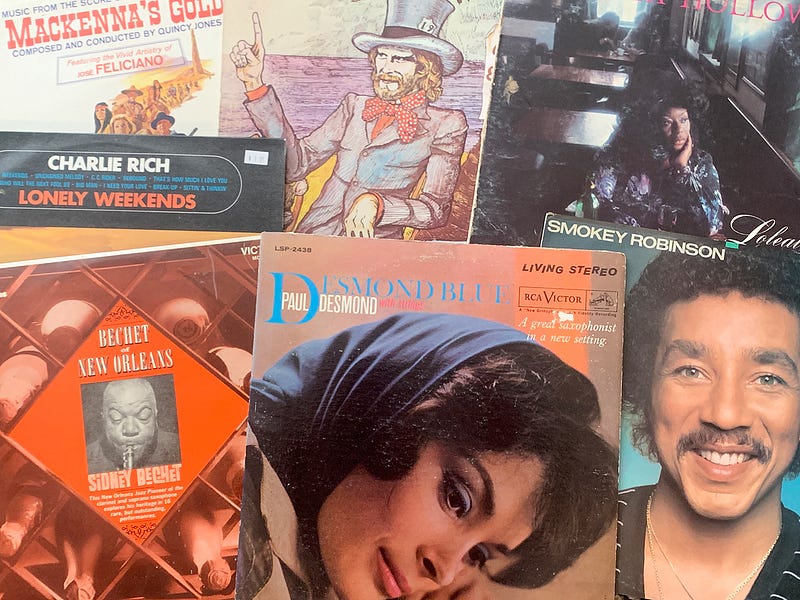
Bargain hunting is such a hit-and-miss enterprise. In some ways, that is part of the fun of it all.
For months, it can seem like a drought, then all of a sudden, there’s a cascade of new stock as some poor soul has had their garage cleared out as they head off to the nursing home.
Five of the above have been purchased in the last month.
I can remember the first time I saw someone pull out their phone to price-check something.
We were having an event at the restaurant, and we knew we would need lots of vases. One of the staff mentioned she had cupboards full of vases at home. She’d be happy to bring some in.
A young gentleman came in one day, and as was common, we started a conversation when he came up to the counter to order. It was mid-afternoon and quiet, so I had a little more time than usual to chat.
He was a second-hand dealer. He spotted one of the vases on the shelf and asked if he could look closer.
“Where did you get this? This is proper cut glass.”
He immediately put the vase down and pulled out his phone. As his eyeballs popped out on stalks, I guessed it hadn’t come out of the $2 bin.
“It’s old and collectible. At least a few hundred dollars.”
I suspected he might have been understating the matter a little.
The line between gold and garbage can be a slender one. To this day, my phone remains a constant companion on my bargain-hunting forays. Sometimes it pays off in unexpected ways.
Which brings me to my first disc, one I would surely have passed over had I not had my phone in my pocket.
Loleatta — Loleatta Holloway
I’ve bought more than my share of mediocre R&B records by artists I’ve never heard of in my time. They typically aren’t terrible, but they’re rarely great.
As a result, I’m more gun-shy than I used to be, and typically, the phone comes out to offer an imperial thumbs up or thumbs down.
The cover of this one looked underwhelming, with some of the hallmarks of easy listening, a sure sign of it containing something mediocre. Holloway was not someone I had heard of. I’m glad I checked.
The reviews were excellent. 4/5 stars were typical.
The record starts with some squiggly synths, then straight into disco strings. I’m not averse to disco, but then the voice hits.
Wow, Holloway can sing! It’s not all disco either; there’s some very solid 70s R&B going on here. I can’t really pinpoint a surefire hit single, but it’s an entertaining listen from start to finish.
Bargain-o-meter: 6/7.
Being With You — Smokey Robinson
I expect most readers know Smokey Robinson and are likely familiar with the title track.
Released in 1981, it’s a bit smoother and more low-key than his 60s output, veering just that little bit closer to the middle of the road.
The title track, which was a hit I can remember from the time, still sounds pretty swell. Light and breezy, its slinky melody and featherweight vocal are just about perfect for a romantic day at the beach or driving in the country.
Unfortunately, it’s all downhill from there. Smokey continues to mine similar territory, yet it all comes across as perfunctory professionalism. Not necessarily bad, but hardly as uplifting as the title track.
Bargain-o-meter: 4/7.
Desmond Blue — Paul Desmond
Desmond, best known as the sax player with the Dave Brubeck Quartet, is responsible for the iconic sax solo that makes Take Five one of the most recognisable tunes in the annals of jazz.
Yet, if this album cover doesn’t shriek “easy listening,” then I don’t know what does. A great saxophonist in a new setting? Strings accompany that setting. That shriek is turning into a howling scream.
Still, Desmond’s rep is enough to drop it in my basket. Hey, it’s only a dollar.
The thing is that this album is actually easy listening. In my book, this is usually a death sentence. While most easy listening comes on like a bunch of cheap plastic flowers, Desmond delivers pure silk.
Tasteful, perhaps even soulful, I can’t help but compare it to a delicious slice of cake. We do need a break from the Stooges every now and then, after all.
Mellowing out as you get older isn’t all bad.
Bargain-o-meter: 7/7.
Bechet of New Orleans — Sidney Bechet
One of the finest jazz clarinet and soprano sax players to come out of New Orleans, his vibrating tone delivers an extraordinary emotional impact.
A compilation of supposed rare tracks; I’m not expert enough to verify the veracity of that claim. However, Bechet fails to disappoint.
The production values, including the sound quality and the cover, have a certain budget feel to them. Still, a very worthwhile listen.
Bargain-o-meter: 6/7.
Mackenna’s Gold (Original Soundtrack) — Quincy Jones
There’s no doubting Jones's flexibility, having produced everything from Latin jazz to Michael Jackson’s Thriller.
Having said that, I wasn’t expecting his oeuvre to include soundtracks for Westerns.
While I wouldn’t say it’s bad, it sounds generic. Ennio Morricone he is not.
The soundtrack also features Jose Feliciano singing Old Turkey Buzzard, which would be used as a running gag on The Late Show With David Letterman.
Bargain-o-meter: 4/7.
Lonely Weekend — Charlie Rich
The title was a hit for Rich in his early days at Sun Records. The record bares some resemblance to his stable mates, including Elvis and Johnny Cash in their rockabilly phase. It’s a long way from the string-heavy 70s country that Rich is better known for. A good thing in my book.
Lonely Weekends leads the album, and it’s a great track. The rest of the album is less rewarding. Covers of the likes of CC Rider and Unchained Melody don’t have much to offer beyond some of the more famous versions.
A 1973 budget reissue by Sun Records, the cover inexplicably shows a lady walking her dog on the beach. A guess that’s someone’s version of a Lonely Weekend, yet it doesn’t reflect the record's content in any meaningful way.
Bargain-o-meter: 3/7.
Everything Stops For Tea — John Baldry
I got a surprise when I first dropped the needle on this one. It opens with a cover of Come Back Again, a hit for local Australian legends Daddy Cool. Written by Daddy Cool’s lead singer, Ross Wilson, it foretells what a mixed bag this one will be.
The other surprise is the album’s producers. Side one is produced by Elton John, and side two by Rod Stewart. Both also contribute their musical talents, including Stewart on banjo.
More familiar covers include Iko Iko, and You Can’t Judge a Book by its Cover, the former being the most successful to my ears.
Of the two sides, the Elton John side works the best. Overall the album is a fairly decent iteration of early 70s laidback blues rock.
I found Baldry’s warm and quirky voice endearing. Pleasant listening on a warm Saturday afternoon.
Bargain-o-meter: 5/7.
Interested in some further bargain-hunting adventures? You might enjoy this:


