
Sports / Olympics
That’s It for The Olympics and Me
Is Anyone Still Watching This?
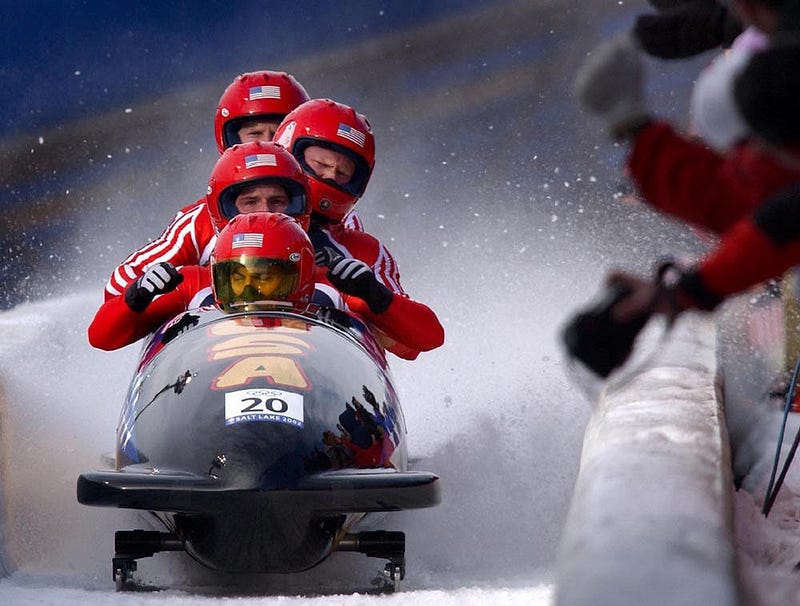
I think my Olympic memory goes as far back as the 1984 Summer Games in Los Angeles. As a kid growing up in Canada, the sight of Alex Baumann and Victor Davis swimming to gold medals and setting world records in the process were the catalyst that made me want to be a swimmer as well. It didn’t matter that the Communist Bloc boycott diluted the pool, so to speak. These were still the best in the world. And they were from my country.
From that point on, I was an every four year Olympic fanatic. I’d watch sports I’d never heard of, dominated by people from countries I couldn’t place on a map. I’d check the medal standings every morning in the newspaper, disappointed to see us sandwiched between Finland and Nigeria, way too far down the list for a country of our imagined stature in the world.
Calgary in the winter of 1988, Barcelona in the summer of 1992, Sydney in the summer of 2000 and Salt Lake City in the winter of 2002, at which we proved our hockey supremacy in the second best-on-best tournament of professionals. Glory. And we beat the US in the final. Even better. Sweet vindication after the national hand wringing that occurred due to the disappointing results of our team in Nagano in 1998.
The one and only Olympics that I’ve ever attended were in Vancouver, Canada and I say attended because I lived there at the time. What a party. What a show. I had my doubts before it all kicked off in January 2010. Why wouldn’t we put that money into education and health care?
But once the IOC moved into town, I was convinced. “Own the Podium” was the slogan of the Canadian Olympic Committee, and own it we did. On top of that, it was the greatest outpouring of red and white maple leaf national pride I’d seen in my lifetime. And then, on the last day, in overtime against the Americans again, Sidney Crosby banged in the winning goal in mens’ hockey. I’ve never seen a city erupt like that. Worth every penny of the $10 billion that was spent putting this show on.
And then, I lost interest.
It happened gradually. I still watched London in 2012 while travelling, now checking the medal tables online constantly, Bu the Sochi Winter Games in 2014 were clouded by Russian cheating and the ones in South Korea in 2018 were on at the wrong time for me to watch, owing to being on the other side of the world. The world didn’t need the Tokyo games of 2020 in the middle of a pandemic, but they happened anyway, albeit in 2021. And now, just 6 months after the last international sporting bonanza, here we are back in Beijing again for the Winter Games of 2022.
It won’t be getting a single second of my attention.
Sure, the Olympics were founded on high minded principles of international unity, gentlemanly sporting endeavour, and the provision a safe outlet for national pride. Higher, faster, stronger is the slogan, and yes, the Olympics have certainly provided performances that have constantly pushed the boundaries of human athletic achievement.
But if there is one silver lining of the last two years, it is that many people are taking a serious look at and asking some serious questions about the myths, the values, the understanding, the notions, the beliefs, the power structures, and the attitudes that underpin our society. Some want to hold on to those things, but many aren’t liking what they see and are making choices accordingly, especially when it comes to consuming what is presented to them.
Some Neil Young fans aren’t using Spotify anymore. Some people won’t buy things from Amazon. Some people are demanding that the reality of what went on in residential schools in British Columbia finally sees the light of day. Everyone makes their little contribution in their own way.
And some people aren’t watching the Olympics anymore. Here are a few reasons why:
1. The International Olympic Committee. This is an unelected international cabal of Olympic committee members from all the countries of the world. It is a money making machine that is ripe for corruption as it is accountable to no one. When controversy erupts as it often does, they’ll say that sport should not be politicised and they are right.
However, they have no more political act at their disposal than the awarding of these games to a particular city and country. Interestingly, most places in which the people have any kind of say in government and politics speak very clearly that they don’t want their city or country to host these events anymore.
One only need look as far back as Athens (2004) and Rio de Janeiro (2016) to see examples of multi million dollar facilities that were shuttered as white elephants as soon as the games ended, left to fall into dereliction and never to be used again, while the host countries were left mired in debt.
Who suffered at that point? Not the IOC, not the members of the local organising committee, not the politicians who pushed for the games but then were out of office by the time they happened, not the companies who were awarded the construction contracts. No, it was the people, as always. Cuts had to be made somewhere for the state to even hope to pay the interest on this debt. Education, healthcare and social services in general are always the easiest places to let the axe fall.
On top of that, it is meant to be a global games. And yet, not once has it been held in Africa. Only once in South America. The medal tables in the Summer Games are somewhat more of a representation of the countries of the world, but those of the Winter Games are dominated by the global (wealthy) north. Obviously, it takes a lot more of a financial investment to train a bobsledder than a marathon runner.
2. The Government of China. It is not the people I refer to here, I hasten to add, and not the country itself. And there isn’t a country in the world that doesn’t have skeletons in its closet that are in dire need of being held up to the light, including mine.
But you’d be looking for a while to find examples of more egregious state sponsored violations of human rights across the globe than those this government has perpetrated and continues to, with impunity. The Uighurs, the Tibetans, the Taiwanese, the people of Hong Kong have all borne the brunt of this recently. Support for North Korea and aggressive actions in the South China Sea point to a country that will do what it feels is necessary to assert what it perceives as its rightful place in the world.
The decision by the International Olympic Committee to award another games to China supports this reality.
3. The State of the World. What a crazy place this is that we can’t vaccinate everyone, we can’t feed everyone, and we can’t provide clean water and education to everyone. But we can justify and rationalise the spending of billions upon billions on a two week show.
Yes, I know that if there was no Olympics, the allocated budget wouldn’t go to those things. You told me that when I voted against having them in the plebiscite held in 2002 about bringing the games to Vancouver. I remember asking “why not”? I also remember no one being able to answer that question either.
The world is in absolute upheaval at the moment. Maybe we need a distraction. Or maybe we need to keep our attention squarely on a looming climate catastrophe, increasing wealth disparity, democracy deficits, the rise of authoritarian strongmen, an endless global pandemic, and more wars. Everyone knows how to fix these things and no one does. So the question really should be, “Do we really need another bread and circuses event to take our minds off of reality?” Or can we just get real for a second.
Remember all this when the FIFA World Cup rolls into Qatar later on this year. It is exactly the same thing, complete with 8 massive new stadiums magically constructed with imported slave labour. There’s another article in there somewhere.
4. The Myth of National Pride. I mentioned the winning goal in the 2010 Winter Games. It was a great feeling and it brought us all together. For a minute. Whatever feeling of joy and unity it created in Canada is certainly gone now, which shows just how artificial it was.
This issue of pride in one’s country always strikes me as somewhat retrograde. It’s from an earlier time in which our worth as a people or culture depended on to what extent we could dominate other people — with military might, economic influence and belief systems. Our standing on a medal table is not the same thing, but it is a big part of our national brand. It is made up, constructed, contrived, wrapped in a flag and marketed back to us. In Canada, it comes as a bizarre mix of smug superiority to the US and yet an inferiority complex at the same time. That’s a big part of the national identity.
On their own, each of these is probably reason enough to boycott this Olympics. All of this is without a word on the myriad of sports that very few people in very few countries excel at that the IOC has added in an effort to be inclusive / remain relevant / cash in. None of this is to take away from the preparations and achievements of the athletes who take part. They are representing their countries, in sport and surely that’s better than representing them in war.
It’s possible that in a different world, perhaps this one with a brighter future, the Olympics might get me back. But not this time. There are enough other things to keep me distracted right now.