
That Time My Daughter Hit a Policeman on the Head with a Banana
It wasn’t me, Sir!

The price of bananas was through the roof that day. Most of the resident banana sellers had run out and men had travelled in from other places with piles of the things, asking four times the regular price for their bananas!
Rude!
But, there was a reason. Everyone wanted as many bananas as possible that day, and not to eat them.
Let me backtrack for a moment.
We were in the town of Gokarna in Karnataka, South India. It’s a place I wrote about in this story — an important religious town, with many Brahmin priests, an honour that is passed down through the generations. Every boy born into a Brahmin family in Gokarna would be expected to learn how to be a priest from his father, and take over the role when he becomes an adult.
It is home to a very important temple — Mahabaleshwara Temple — dedicated to Lord Shiva. Dating from the 4th Century, it is a significant pilgrimage site, especially during the Mahashivaratri festival, which celebrates the birth of Lord Shiva.
While in most of India the celebrations of Mahashivaratri, also known simply as Shivaratri, will last for one night only, the celebrations in Gokarna span several days and nights. Thousands of pilgrims will come from far and wide, for it is an extremely auspicious place to pass this special festival, especially the night of Shivaratri itself.
On that night, people will queue for hours and hours to be able to enter the Mahabaleshwara Temple, to be allowed into the inner sanctum where stands the Atma Linga, or the Shiva Linga, which will bestow blessings upon all who even glimpse it.
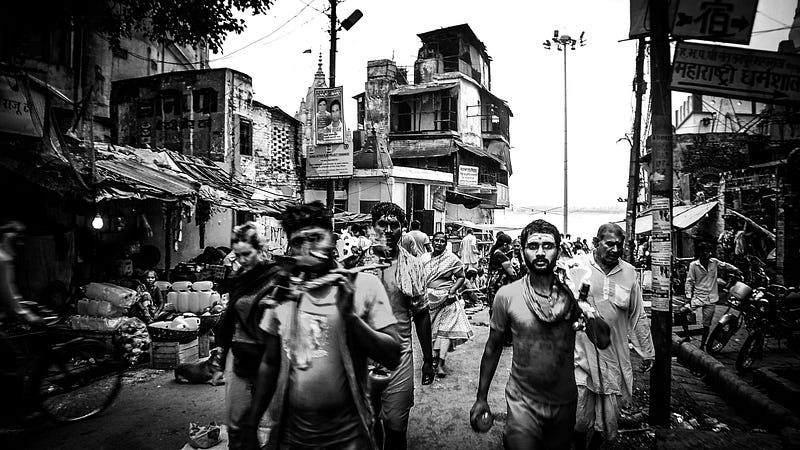
The Atma or Shiva Linga represents the union of duality. In the physical plane, it symbolises the union of masculine energy and feminine energy — of the phallus with the yoni or vulva, while on the spiritual plane the phallus represents the Universe and the yoni represents the Supreme Power that holds the Universe within it.
The story behind this Atmalinga comes from the ancient Hindu epic The Ramayana, in which Ravana, the Demon King of Lanka, went in search of a Shivalinga that had been stolen and thrown in the sea. Ravana’s mother had loved that linga, and worshipped it in order to bring prosperity to her son. She was devastated and vowed not to eat until it was found. Ravana promised to bring her the most revered linga of all — the Atmalinga — for her worship. He went to Mount Kailash, where Shiva resided, and performed extreme penance before him until Shiva would give him the Atmalinga. Shiva gave it to him on one condition — that the Atmalinga was never to be placed on the ground. Should it ever be, it would become rooted in that spot and never move again.
As he made his way back to Lanka with the Atmalinga, some of the gods began to play tricks on him. Lord Vishnu blotted out the sun to create the appearance of dusk, and Lord Ganesha disguised himself as a Brahmin boy herding cows, offering to hold the Atmalinga while Ravana performed his evening rituals. Ravana explained that he must not put it on the ground and requested that he call Ravana’s name three times, should he need to put it down. Ganesha did call his name as requested but did not give Ravana the chance to reach him before putting the Atmalinga down, and it became rooted. Ganesha then disappeared along with his cows.
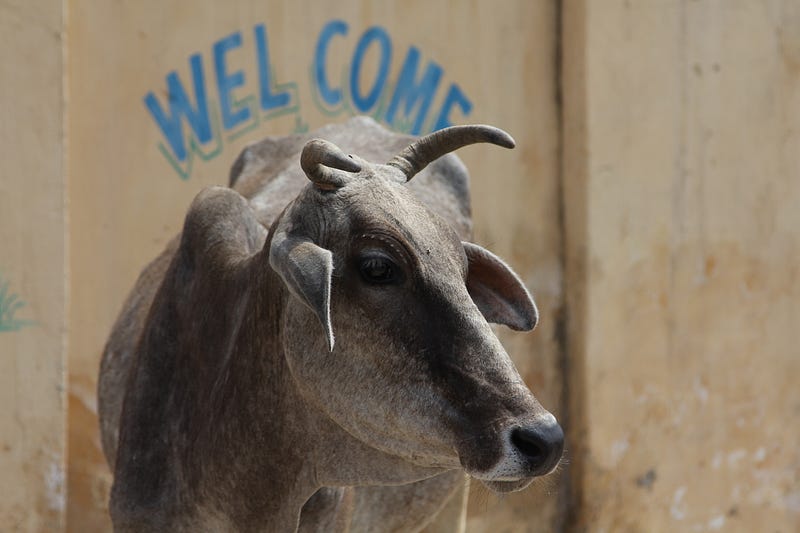
There remained one cow that was making its way underground. Ravana chased it and grabbed hold of it’s ear, but, while the rest of the cow disappeared underground, the ear remained and became petrified. The name Gokarna means Cow’s Ear.
Now, back to bananas
One of the highlights of the Mahashivaratri festival in Gokarna is when a giant wooden carriage, intricately carved with depictions of deities and scenes from The Ramayana, carrying all of the town’s Brahmin priests and their sons, is pulled through the streets by hundreds of the town’s strongest men. The carriage is truly enormous and gets decorated for the occasion. It takes weeks to prepare for this one afternoon’s frolics.
As the cart filled with priests is pulled through the town, devotees line the streets and make offerings of bananas by throwing them into the cart, hence the severe shortage that day, and the steep mark-up of the price of bananas.
However, while this is evidently an extremely holy affair, it wasn’t clear how many people were there for the religious representation of banana ‘offering’ and more for a game of banana ‘pelting’. Though a very serious, religious tradition, as the cart filled with men and boys travelled down the street, I could see great amusement, particularly on the faces of the young boys, as they dodged bananas coming their way.
In the lead-up to the event itself, excitement was mounting. All the tourists staying at Kudli Beach, where we were residing, discussed getting into the town and buying as many bananas as possible, while they were still available. We all got there before the local fruit sellers ran out, but still paid double the normal price.
We compared our stashes of bananas and waited in the main street as people started to gather. Soon it was full of people, and police were holding ropes in front of the crowds that lined either side of the street.
And then the great procession began. It took many, many men to drag this enormous wooden carriage, weighed even more heavily by the number of people inside it, down the street. There was drumming, symbols being struck, chanting, and lots of shouting. The energy was high!
And then the banana pelting began!
My completely childish sense of fun kicked in and I got right into the whole thing while holding my littlest daughter close to me. My partner, Tristan, lifted our older daughter, then six, onto his shoulders, so that she could get a good view and a good aim. She thought it was the best fun in the world.
We all tried to hit the priests and their sons with the bananas — after all, that was the aim right? — but it wasn’t easy, for the distance between us and the cart required a good, strong lob. My daughter was starting to feel terribly disappointed, because she just didn’t have the throwing capabilities to get her bananas anywhere near the cart.
But then her moment arrived…
She totally messed up her throw and failed to catapult it high enough to reach very far. While her banana cleared the heads of the crowd, it fell short of even the road, and…
Wham!
It hit one of the policemen, who was holding the crowd back, right on the head.
We all saw it! Then we all saw the policeman look up in surprise at the sky, as if he thought it could be a sign directly from the gods, before coming to his senses and turning around to search for the culprit. Whether or not his eyes picked out my daughter among the large banana-lobbing crowd — now squealing with delight and glee at her unexpected triumph — I will never know.
But for her, something worthwhile had been accomplished. She had no hope of ever making her holy offering to the Brahmin priests, and thus to Lord Shiva, but she had whopped a policeman on the head. And that was an achievement to treasure forever!
Perhaps she missed out on this rare opportunity to be blessed by the gods, but it was an opportunity worth sacrificing for that one moment of glee!
Check out this video I found on YouTube, taken by a traveller to Gokarna in 2018, to see this fabulous event in action:
And stay tuned for more ridiculous travel adventures!
Subscribe to Medium here and support myself and other writers to keep churning out great stories! This link is affiliated to myself and will pay me a commission from your subscription.


