
That Time a Dead Guy Won an Olympic Medal
Have you ever been to the Olympics?
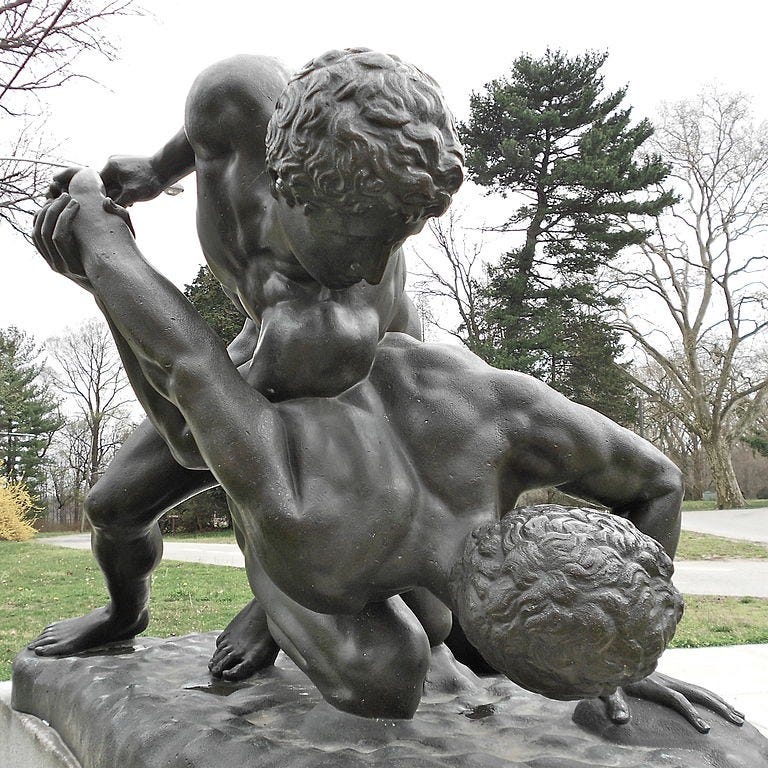
I appreciate the history and the long tradition of Olympian athleticism. The old-school O G Olympics in Greece was the real stuff. It was like hand-to-hand combat with javelin throwing and the sorts.
Today’s article takes us right back to that time in Ancient Greece. There is an infamous Olympic Victor named Arrhachion of Phigalia, who was engaged in one of those pretty violent Olympic sports back in the day in 564 BCE. This guy was known for his aptitude in a sport called pankration, kind of like the early equivalent of Mixed Martial Arts (MMA) or Ultimate Fighting today.
This sport in particular became part of the Olympics in 648 BCE but we know people probably practiced different versions of this for a while beforehand. This was one of the times when there were multiple things that we would kind of think of as Pan-Hellenic games, in general. And this was one of the only sports to be included in all four festivals.
We know about the story of Arrhachion because much later, in the second and third century CE, some historians wrote about this. And by the time they wrote about it, was probably already an oral tradition. Before we get into the details of what happened with Arrachion, and what makes him so special, maybe we delve in a little bit more about his background.
So he was like a Tiger Woods or a Michael Jordan of his time. This guy was a big deal. He was known throughout Greece and beyond by the Olympics of 564 BCE. He was a bit older than many of the competitors in this fierce and no-holes-barred fight style that he was going to compete in.
There was an upcoming contender who was a favorite to take Arrhachion’s crown. His name is lost in history, but we know he was a bruiser for sure. In pankration matches, they don’t have a ton of breaks between bouts. So, Arrhachion’s already pretty close to exhausted.
He’s older and worn out. He has to lean on his experience to make up for what he might have been lacking in terms of physical skills. So he’s still fighting like a wild cat, and then all of a sudden, his opponent gets him in a chokehold which is legal in this brutal sport. Now, Arrhachion is desperate. He grabs this younger guy by one of his feet and wrenches the foot and it causes an audible sound.
It’s not a cute pop. I imagine it would be a horrific snapping of bones. The foot is now dangling like a floppy fish on the end of this guy’s leg. And Arrhachion is milking it, literally grinding it back and forth to cause this guy excruciating pain. On the other hand, this guy, in an attempt to get Arrhachion off and maybe even win the bout, continues choking and throttling him.
Eventually, this guy does the signal to concede because he can't take the pain anymore. I believe in those days, it was putting one finger up. He tapped out and, therefore, Arrhachion came out the victor but there was a slight complication, he was dead.
Arrhachion had died of suffocation. This is likely the only time a corpse has been declared the winner of a sport, and this just went further in solidifying this dude’s legendary status. Nothing better than death to cement someone’s place in the stratosphere of a sport or a musical genre or a film. If you die at the peak of your game like that, then you are likely going to be revered or remembered.
They started immortalizing him in sculpture. The whole reason we know about this story today is because of how much people idolized this match and Arrhachion’s role in it. One thing we should note is that Arrhachion was able to get a hold of his opponent’s ankle because he pretended to pass out before he actually passed.
But because he was trapped in that chokehold by a guy who was very good at chokehold, he did die of suffocation, but you’ll see other reports that say, he died with a broken neck. Could you imagine if something like that occurred in modern sports?
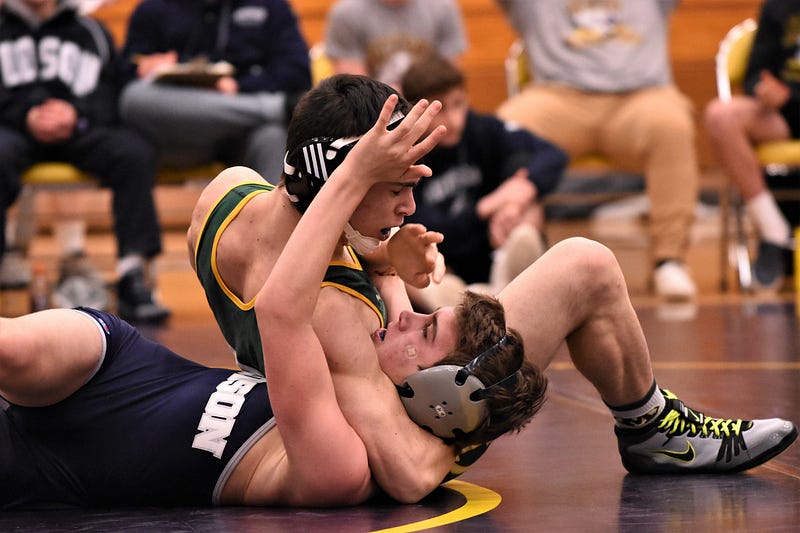
Sadly, deaths in boxing are not as uncommon as you’d think. One thing that stood out to me in my research is that multiple athletes have died in the course of the Olympics, and some of them are a little more recent than you might imagine.
There’s an excellent list of this on time.com by Lisa Marie. Though I haven’t found any example of someone winning the fight in the same way Arrhachion did and I hope not to ever experience that myself.
We found some direct quotes describing this like there’s one from Pausanias, who was a Greek geographer in the second century CE II.
‘For when he was contending for the wild olive with the last remaining competitor, whoever he was, the latter got a grip first, and held Arrhachion, hugging him with his legs, and at the same time he squeezed his neck with his hands. Arrhachion dislocated his opponent’s toe, but expired owing to suffocation; but he who suffocated Arrhachion was forced to give in at the same time because of the pain in his toe. The Eleans crowned and proclaimed victor the corpse of Arrhachion.’
There’s another guy about 100 years later, Philostratus the Younger, who tells a similar story. And he writes in his Gymnasticus that Arrachion’s failure to submit to his opponent was the result of his trainer, Eryxias, shouting to him, “What a noble epitaph, ‘He was never defeated at Olympia.
We mentioned the four Pan-Hellenic festivals, and we should name them. There were the ancient Olympic Games, the Isthmian games, the Pythian Games, and the Nemean games, which had almost no safety restrictions. People weren’t talking about the idea of concussions. Pankration was considered by far the most dangerous combat sport in the Olympics.
And, oddly enough, it continued even after Arrhachion died. Pankration continued as an official part of the Olympics until 394 CE. Arrhachion’s death was probably great PR for the sport. People started to be thought of as courageous, and real hard cases for participating.
It did eventually end because of a decree by Christian Emperor Theodosius I. After Theodosius announces his proclamation or what have you. All of the festivals slowly started to die out. They got less and less popular for a number of factors but I would argue one of those factors was that people knew that they probably wouldn’t see someone die.
It was not necessarily required for it to be a fight to the death but it was certainly on the table. And it is kind of back in a weird way. There is a modern movement that created a kind of small revival of the sport, but it is a bit more regulated and less violent.
So where does this leave us? Well, history is a conversation, but it’s also a study of precedent. And a lot of experts trace the emergence of mixed martial arts to the revival of this style in 1969. We know people are fascinated by the idea of one-on-one combat, even with fewer rules.
It’s not the only story but for some people, this is a very inspirational story. It’s a story of the absolute commitment to competition and victory at any price. The question is what price would you pay for victory? And that’s a question that people have to answer on their own.
Sources


