
HISTORY / WOMEN IN HISTORY / FEMINISM
That “Rascally” Woman: Jenny Geddes and Her Place in Scottish History
The story of the mysterious woman whose rebellious action sparked the Prayer Book Riots of 1637 is inextricably linked with Scotland’s identity and independence
“Daur ye Say Mass in My Lug?”: The Riots and the Reasons Behind Them
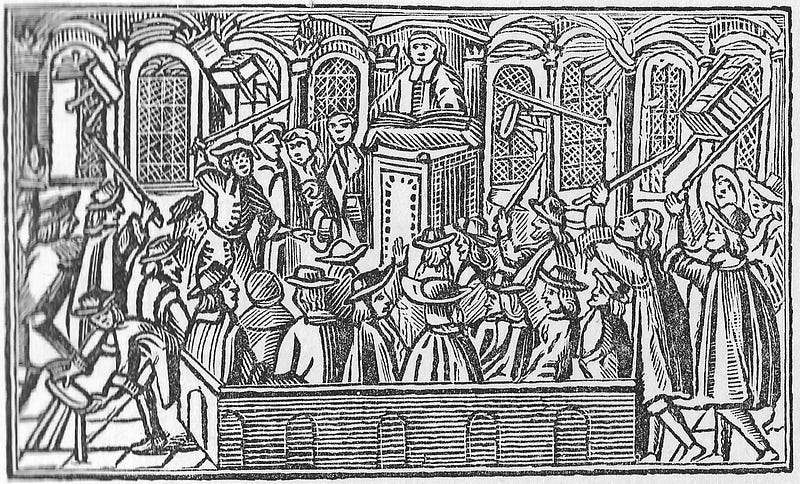
On the Sunday morning of July 23, 1637, James Hannay, the Dean of Edinburgh’s St. Giles Cathedral, took his position at the reader’s desk and began to read from the liturgy. A murmur arose from the congregation. The liturgy that Hannay was reading was not the traditional Scottish liturgy. Rather, it was the new Booke of Common Prayer of the Church of England. The reading of this text was an affront to the Scottish congregation and their religious convictions.
The Church of Scotland had been modelled on the Presbyterian beliefs of European reformer John Calvin, which had been brought to Scotland by John Knox. The High Kirk (Church) of St. Giles had served as a Presbyterian church until 1633 when King Charles I elevated the High Kirk to Cathedral status and forcibly introduced English Episcopalianism into Scotland. The episcopate was ruled by a hierarchy of bishops and was thus similar to the Catholic and Anglican systems.
For the predominantly Protestant population of Scotland, (and, indeed, for the Protestant hordes of England) Charles’ Episcopacy stank of outmoded papist theology. When combined with his exorbitant taxation system and his attempts to undermine secular land-holders by reclaiming land revenues and tithes for the church, Charles’ controversial religious policies added to the simmering tensions in seventeenth-century Scotland.
In 1629, Charles had broached the subject of a new text to replace Scotland’s preferred liturgy, the Book of Common Order. However, it was not until May of 1637 that Charles’ Book of Common Prayer was published. This new text, revised by two Scottish bishops and complete with additions from both Charles and Archbishop William Laud, was objectionable to the Scots on two accounts. Firstly, the illustration that accompanied the Lord’s Prayer featured a king seated on a throne underneath a canopy. This was reminiscent of the portraits of both King Charles I and his father, King James I of England VI of Scotland. Murdoch Lothian observes that
…this image would have been an affront to Presbyterians: visually, it commemorated their antagonists: doctrinally, it symbolised the concept of intercession, which was totally at odds with their belief that God speaks through His word directly to the individual conscience. (The Cutty Stool, 1995, p. 11).
Secondly, the new liturgy was introduced on the authority of the crown alone, with the consent of neither parliament nor the General Assembly. Thus, while enforcing his religious policies, Charles was also thumbing his nose at Scotland’s constitutional system. It is not surprising, then, that as James Hannay read from the new prayer book, the congregation erupted.
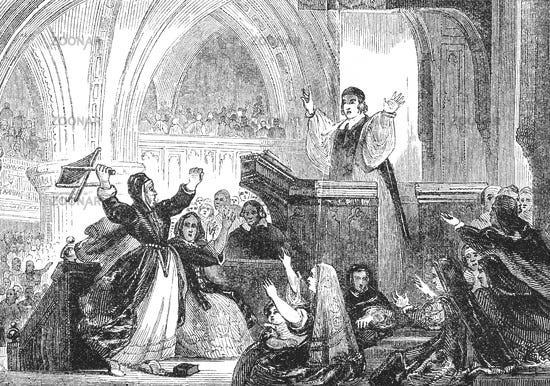
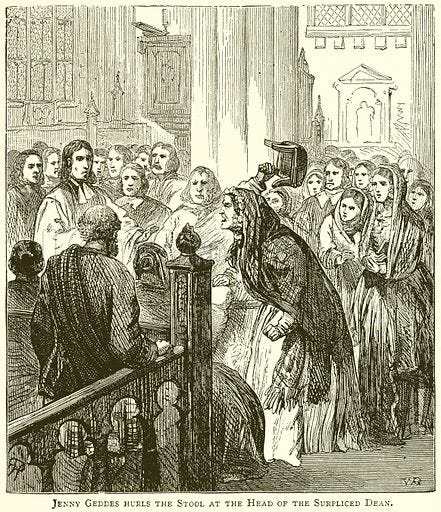
As the tumult grew, David Lindsay, the Bishop of Edinburgh, rose from the pulpit, ordered the audience to be silent, and bade the Dean continue. One “rascally” woman, an Edinburgh kail-wife (see below) named Jenny Geddes, threw a stool at the Dean, shouting, “De’il gie you colic, the wame o’ ye, fause thief; daur ye say Mass in my lug?” (“Devil give you colic in the belly of you, false thief: dare you say the Mass in my ear?”).
Relating the event in Tales of a Grandfather, Sir Walter Scott wrote
… the women of lower condition [instigated, it is said, by their superiors] flew at the dean, tore the surplice from his shoulders, and drove him out of the church. The Bishop of Edinburgh mounted the pulpit, but he was also assailed with missiles, and with vehement exclamations of “A Pope! A Pope! Anti-christ! Pull him down, stone him!” while the windows were broken with stones flung by a disorderly multitude from without (p.414).
The tumult soon descended into a full-blown revolt, and the Prayer Book Riots of 1637 fast became (and, indeed, continue to be remembered as) a vital blow in the Scottish struggle for independence. Scott described the St Giles Riot as “the signal for a general resistance to the reception of the Service-book throughout the whole country” (Tales of a Grandfather, p.414). Indeed, the religious tumult that followed the Prayer Book Riots ultimately led to the signing of the National Covenant, a document of tremendous importance in the Scottish fight for liberty, both civil and religious.
Tradition portrays Jenny Geddes as a brave heroine of the Scottish cause. However, there is some doubt as to whether the Geddes story is entirely accurate. Lothian notes, however, that “although it is not possible to establish the name of the stool-thrower, it is equally impossible to dislodge the name of Jenny Geddes from the popular imagination” (1995. p. 26).
The Rebellious Kail-Wife
Popular tradition states that Jenny Geddes was a green-grocer or market-stall owner and that her stall or shop sat in an area of the High Street (or ‘Royal Mile’) known as the Tron. Scott describes Geddes as an old woman “who kept a green-stall in the High Street” (Tales of a Grandfather, p.414). Edinburgh’s Joy for His Majesties Coronation in England, a 1661 pamphlet that is the earliest document to explicitly name Jenny Geddes as the infamous stool-thrower of the Prayer Book Riots, refers to Geddes as a shop-owner whose wares include “sallets [salads], radishes, turnips, carrets [sic], spinnage [sic], cabbage, with all other sort of pot Merchandise that belongs to the Garden”. Later tradition thus describes Geddes as a ‘kail-wife’ and a herb-woman.
The word ‘kail’/ ‘kale’ is translated as ‘cabbage’, with ‘kail’ being a Scottish term for any dish composed of cabbage, in particular, a broth or stew. Hence the attribution of the term ‘kail-wife’ to Geddes would seem to indicate that she had a greengrocer’s stall. However, ‘kail’ can also refer to an unruly, scolding and/or gossiping woman, portraying Geddes as a trouble maker. Indeed, a 1688 poem entitled The History of the Most Famous and Most Renowned Janny Geddes acknowledges Geddes’ reputation for unruly conduct, proclaiming that
… when a scolding woman, mad is, She’s called, e’re since, a Janny Geddes.
Indeed, to this day, to refer to someone colloquially as a ‘Jenny Geddes’ is to infer that they are unruly, badly-behaved, cheeky, and/or a trouble-maker.
Street vendors such as kail-wives were frequently seen as loud, scolding and unruly. Poet William Dunbar, writing during the early part of the sixteenth century, criticized Edinburgh market women for their noise and raucousness, and there has always been an explicit association between Geddes and the riotous, rowdy and gossiping market women. The question arises, then, was Geddes really a market-woman, or did the written accounts that emerged in the 1660s portray her as such to associate Geddes with a profession that was acknowledged as being un-feminine, rough and disorderly? If this is the case, the anonymous architects behind such an invention might have been attempting to distil a rising mythology involving Geddes as a Scottish heroine with a reminder that she was, in fact, a rough and uncouth woman. Indeed, later accounts of the Prayer Book Riots refer to Geddes and her fellow rioting women as “women of lower condition”, “rascal serving women” and “women of the meaner sort” (David Stevenson, The Scottish Revolution 1637- 1644: The Triumph of the Covenanters, p.62).
“Princesse of the Tron Adventurers”: Geddes and Prostitution
Another intriguing possibility as to the attribution of the title ‘kail-wife’ to Jenny Geddes pertains to prostitution. James Grantham Turner notes that in early modern London, prostitutes were associated with “other kinds of mobile and full-throated vendor — the oyster-wench, the Billingsgate fish-seller, or the Parisian poissarde”(Libertines and Radicals in Early Modern London: Sexuality, Politics and Literary Culture, 1630- 1685, 2002, p. 9)
One “Miss Elizabeth” is recorded as a prostitute who was “formerly a Retailer of Oranges at the Playhouse; the very Quintessence of Leudness [sic], who brags she has been tilted at by as many Lances, as there are men in the Confederate Army: her price is 5 s. and a Clap she gives into the bargain. (Ames, Catalogue, 1691, cited in Turner, 2002, p.42). As the orange-sellers, oyster sellers, fish-wives, cinder-women et al sold their wares for money, so too did the street-walking prostitute sell her charms for a fee. Thus a literal connection existed between the market vendor and the whore.
There seems to be an undercurrent of libertinism interweaved within the Jenny Geddes story, with allusions to scolding, disobedience, and the practice of ducking as a punishment for ‘bad’ women. Moreover, the puzzling description of Geddes as “Princesse of the Trone Adventurers” in the anonymous 1661 pamphlet Edinburgh’s Joy begs the question of exactly who or what the Tron Adventurers were, and why and how the seventeenth-century reader might be expected to recognize the expression.
The term ‘Trone’ refers to the Tron, an area located on the Royal Mile between Edinburgh Castle at the top end of the Mile and the Canongate at the bottom end. Construction of the Tron Kirk, which now stands in the area, began in 1637, the very year in which Jenny Geddes made her rebellious stand. The term ‘Tron’ reputedly refers to the “salt-tron”, a public weighing device that once stood in the area alongside many vendors and market stalls. However, the connection with salt is suggestive, as to hire the services of a prostitute was known as buying the ‘Salt Commodity’ (Turner, 2002, p. 9).
Thus, with the figure of Jenny Geddes being associated with market-vending and the ‘salt-tron’, there is an implicit insinuation of prostitution. Perhaps, then, the ‘Tron Adventurers’ mentioned in the tract refers not to a collective of market traders (as is generally reckoned), nor to a grass-roots political protest group based in the High Street’s market district, but is instead a veiled colloquial reference to a band of prostitutes. By describing her as their ‘Princesse’ or leader, is the anonymous author of Edinburgh’s Joy identifying Jenny Geddes as a madam? Indeed, given her explicit connection to the Cutty Stool, it is not surprising that such snide references to vice, wantonness, and sexual depravity would be woven into the Geddes story.
The Cutty Stool
Edinburgh’s Joy for His Majesties Coronation in England relates the festivities that took place in Edinburgh upon the occasion of King Charles II’s restoration to the throne of England following the years of the Cromwellian Protectorate. The celebrations involved bonfires and copious amounts of alcohol, where “gravity was laid aside to give place to all sort of Frisking and Gamboling”. As the revels progressed, the pamphlet reports, that “infamous Jenet Geddis, Princesse of the Trone Adventurers” threw the very stool “where she used to dispense Justice to the rest of her Langkale Vassals” into one of the bonfires.
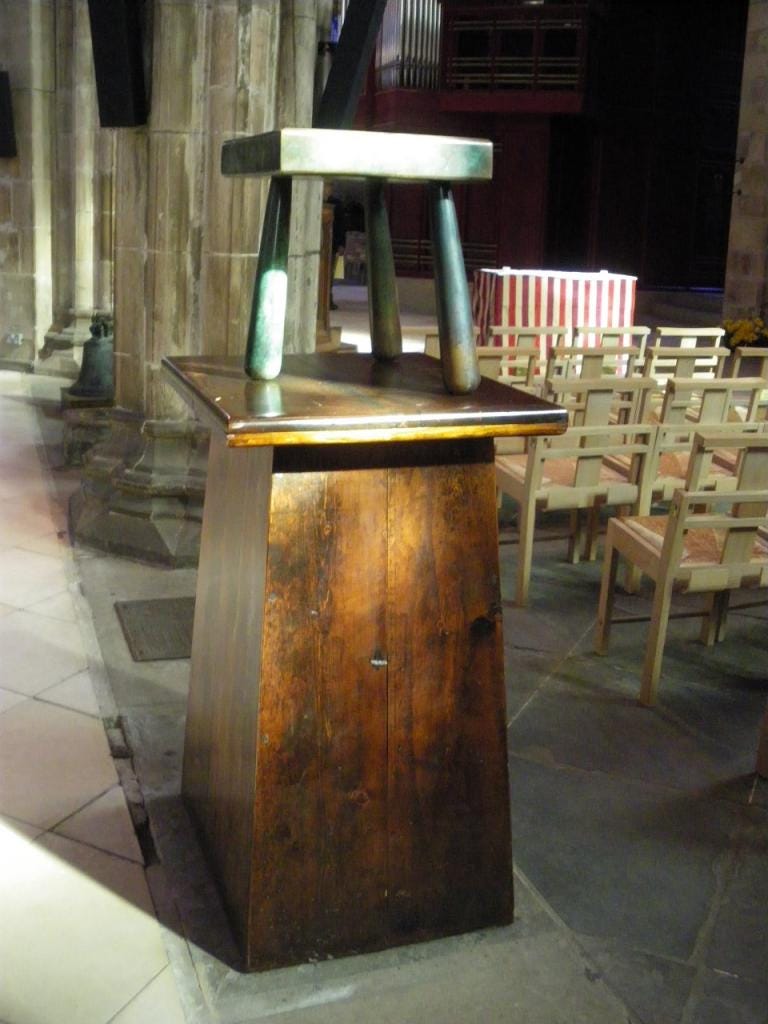
The stool that Jenny Geddes threw at Dean Hannay at the onset of the Prayer Book Riot is known as the Cutty Stool. The word ‘cutty’ is generally translated as ‘short’, and thus the Cutty Stool is said to have been a short stool with three legs. However, the word ‘cutty’ also refers to both a short, thick-set girl and, most tellingly, an immoral or disobedient girl or “a vulgar or worthless woman”.
The ‘Cutty Stool’ was a short stool, housed in a kirk, upon which a person found guilty of immoral behaviour would be forced to sit and perform penance. With the low stool putting the guilty party in a posture of submission, other church-goers could, literally, look down their noses at the unfortunate (alleged) miscreants.
The Cutty Stool, otherwise known as the Stool of Repentance, bears a marked resemblance to the ‘cucking stool’ (‘cucking’ from the French word ‘coquine’ meaning “hussy”), or ‘ducking stool’. This apparatus was used to ‘duck’ the disobedient woman into a pond or other body of water to make her ‘cool off’. In France, ‘la sellette’, or ‘little stool’ was used to similar effect. Use of the Stool of Repentance in Scotland is mentioned in 1603 in an address from James VI, with the King insisting that the ecclesiastical court be charged with the task of identifying troublesome and disobedient subjects and “bringing the parties to the stoole [sic] of Repentance” (The Summe and Substance of the Conference, 1604).
Though the Stool of Repentance was theoretically designed for the punishment of men as well as women, it was most frequently used against women. On the occasions where men were made to sit upon the stool, it was seen not so much as a sign of disgrace, but as a form of absolution, with the punishment seen as a means by which “their mortal sins were all forgiven, and this the meritorious way to heaven” (Lothian, 1995, p. 31). For women, however, the punishment would have been humiliating and embarrassing, a means of shaming those who spoke out of turn, acted disobediently, or bore children out of wedlock.
According to James Kirkton’s Secret and True Historie of the Church of Scotland from the Restoration to the Year 1678, Jenny Geddes had “done penance on the stool of repentance” (cited in Lothian, 1995, p. 29). Certainly, the fact that Geddes and the Cutty Stool are so intrinsically linked would seem to be an allusion to Geddes as having a reputation for bad behaviour and as we have seen, the name ‘Jenny Geddes’ is associated with mad and scolding women. However, is the close association between Geddes and the Cutty Stool a later appellation designed to connect Geddes’ actions with misbehaviour, or is it based in fact? Did Geddes really throw the Stool of Repentance and, if so, does it not stand to reason that she must have been seated close to it? Indeed, the story entices us to ponder the possibility that Geddes was well-positioned to throw the Cutty Stool because she was sitting upon it at the time.
Historical Heroine or Fictional Icon?
In 1937, W.L. Mathieson described the Jenny Geddes story as “irrelevant, if not apocryphal” (‘Laud’s Liturgy: The “Jenny Geddes” Riot’, The Scotsman, 23 July, 1937). A correspondent to The Scotsman, writing in 1932, argued that “glorying in the rabble of July 1637 is out of date, and the continued existence of a monument to a possibly mythical participator is of doubtful propriety [italics mine]” (‘D.B.D.’, ‘Jenny Geddes’, The Scotsman, 1 April, 1932). In 1920, William Muss-Amolt wrote that “the tradition [associating Jenny Geddes with the stool-throwing incident] has long been abandoned as a myth, and has been disproved by careful historians” (James King Hewison, ‘Jenny Geddes: Who Was She?’, The Scotsman, 30 March, 1932). Regardless of academic opinions about the Jenny Geddes story, however, there is no dislodging her from the minds, and indeed, hearts of the Scots.
There has, indeed, been much debate as to the historical accuracy of the Jenny Geddes legend. A record was located in the 1638 Session Records of St Andrews of a bequest left by a Jenny Geddes. This Jenny Geddes, identified as the wife of a William Barclay, left ₤40 “for the purchase of damask “boordclothes” for the “Communion boords” (cited in Lothian, 1995, p.25). Lothian notes that the term “kail-supper” was used to refer “not just [to] a person who is fond of vegetable broth, but … is a name given to people from Fife” (1995, p.26). Similarly, Lothian notes that the names ‘Jenny’ and ‘Johnny’ were used by townsfolk to refer to “country folk” and suggests that “Jenny-gaddie could have been a gaudy, showy or tricky country-woman, a country-cousin “in for the day” in her fantoosh finery” (1995, p.25). Indeed, she may have been a church-goer from St Andrews, in the Kingdom of Fife, who made her way into the town specifically to protest against the reading of the Prayer Book.
Unfortunately, this possibility does not take into account the connection between Jenny Geddes and the markets of the Tron. Moreover, according to the research of one correspondent to The Scotsman, the Jenny/Janet Geddes mentioned in the 1638 record died in 1636, a year before the riots (‘J.G’, ‘Jenny Geddes’, The Scotsman, 31 March, 1932). This same correspondent argues that another Janet Geddie from St Andrews, widow of merchant Thomas Welwood, died in 1616.
This continuing inability to identify the figure of Jenny Geddes within the historical records has resulted in a variety of theories as to her identity and to her involvement in the 1637 riot. According to J.M. Henderson, Assistant Lecturer in History at Aberdeen University in the 1920s, there existed a manuscript copy of the minutes of a meeting held before the tumult, in which it was recorded that a plan was hatched amongst some of the “well-affected” members of the parish to attend the Kirk, but to “absent themselves therefrom” once the Prayer Book began to be read. (Church News: Jenny Geddes Incident’, The Scotsman, 16 January 1926).
David Stevenson elaborates, suggesting that this meeting took place in April 1637, with two disgruntled ministers, Alexander Henderson and David Dickson asking and receiving permission from the king’s advocate to oppose the prayer book (The Scottish Revolution 1637- 1644: The Triumph of the Covenanters, 1973, p.18). This was followed by a meeting held in a house in the Cowgate, where “various Edinburgh ‘matrons’” were in attendance. Here, according to Stevenson’s research, “it was decided that women should lead the protest when the prayer book was first used in Edinburgh, and that afterwards men would take over the demonstration” (1973, p. 18). Thus, it is said, the riots were not a spontaneous protest but emerged, and indeed, were instigated, by disaffected nobles and ministers who objected to the Prayer Book not just on religious grounds, but on the basis that the heightened power of King Charles and his English councilors would impact upon the Scottish lands and parishes.
According to W. Forbes Gray, Jenny was “probably a woman of little, probably of no, education, and was therefore incapable of arriving at a reasoned opinion of or being well informed regarding the problems of her time” (W.Forbes Gray, ‘Who Was Jenny Geddes?’, The Scotsman, 2 October, 1915). Although Gray uses this reasoning to explain Jenny’s back-flip over the Stuart royalty (rebelling against Charles I in 1637, then celebrating his son’s Restoration in 1661’s Edinburgh’s Joy), it could also be used to strengthen the suggestion that Jenny was not acting of her own accord during the riots, but was instead acting under the auspices of wealthier patrons who loathed to involve themselves in the base ‘nitty-gritty’ of popular protest.
Attempts by various historians to shed light on the figure of Jenny Geddes have led to the emergence of another contender for the position of heroic stool-thrower. This woman, Barbara Hamilton, was the wife of Edinburgh merchant and religious radical, John Mean (or Mein). Hamilton first emerges in connection to the St Giles Riots in ecclesiastical historian Robert Wodrow’s Analecta (1705), where it is recorded that the stool-thrower was Mrs Mean (Wodrow cited in Lothian,1995, p. 23). Hamilton is mentioned again in 1787 in Alexander Kincaid’s The History of Edinburgh, from the earliest accounts to the present time: by way of guide to the city and suburbs; to which is annexed, a gazetteer of the county, embellished with a plan of the town and suburbs, as also, a map of Edinburgh.
In Robert Mean’s obituary notices, published in Scots Magazine and The Weekly Magazine in 1775, it is written of Barbara Hamilton that she was “better known in our history by the name of Jenny Geddes, though called so erroneously” (W. Forbes Gray, ‘Who Was Jenny Geddes?’, The Scotsman, 25 September, 1915. See also W. Forbes Gray, ‘Jenny Geddes: Who Threw the Stool?’, The Scotsman, 30 January, 1925).
If Hamilton was indeed the stool-thrower, and her actions have come down through history as being those of a fictional market-woman, from where then does the figure of Jenny Geddes emerge? Is it possible that Jenny Geddes is nothing more than an invention, a fictional character created either to conceal Hamilton’s involvement or to create a fictional heroine whose name and character traits contain implicit ideas and information about disobedience and rebellion?
The first printed mention of Jenny Geddes emerged in 1661, but it is likely that this record reflects an oral tradition already in circulation. Therefore, it is possible that ‘Jenny Geddes’ was invented in the early days following the riots when authorities attempted to trace the rioters and punish them for their actions. With misinformation and rumours abounding, it would have been easy to blame a mysterious market-woman for the affray while those who were involved lay low. By the time the story came to be recorded in documents and history books, the oral tradition surrounding Jenny Geddes may have been so deeply entrenched in the Scottish psyche that no attempt was made to establish the veracity of the story.
The other possibility is that the name and figure of Jenny Geddes was a creation that was intended to make certain comments and observations about disobedience and rebellion, particularly in relation to women. Certain hints as to this possibility lie in the etymology of the name Jenny Geddes.
What’s in a Name?: A Possible Etymology of ‘Jenny Geddes’
In his study of folklore and rebellion in England, Thomas Pettitt notes that leaders of popular revolts either chose for themselves or were assigned “pseudonyms with distinct festival overtones” (‘Here Comes I, Jack Straw:’ English folk drama and social revolt’, Folklore, Vol. 95, №1, 1984, p. 8). Pettitt cites as an example the case of rebel John Williams, an opponent of the West Country enclosures in 1628–31, who was known by his followers as ‘Lady Skimmington’- an appellation which refers to “the ‘Skimmington Ride,’ an English variant of the charivari” (1984, p. 4).
Likewise, Pettitt discusses the case of Jack Straw, leader of a peasant rebellion in London in 1381. Though the rebellion of 1381 came to be known as “Jack Straw’s Rebellion”, Pettitt notes that Straw’s “historical status is doubtful” (1984, p. 8). Rather, it is argued by several historians that ‘Jack Straw’ was, in fact, a pseudonym used by Watt Tyler, likely adopted from an English folk tradition to refer to a figure “from seasonal folk revelry” (Pettitt, 1984, p. 8).
English folk customs often involve the use of “John/Jack names” of which the appellations ‘Jack in the Green’, ‘Jack o’Lent’, ‘Johnny Jack’, ‘Jack Finney’ are offered as examples. Similarly, in Scotland there are a variety of ‘Johnny’ and ‘Jock’ names, such as ‘Jock Tamson’, Scott’s famous ‘Jock of Hazeldean’ and ‘Pulpit Jocke’. Indeed, the name “Jock’ is a slang name for any Scottish male, and Scottish folk stories feature a plethora of ‘Jacks’ and ‘Jocks’.
Similarly, the feminine variants, Jenny, Jane, Janet and Joan occur frequently in Scottish parlance. The names ‘Jenny’ and ‘Johnny’ were general titles used by Scottish townspeople to refer to ‘country folk’. Subsequently, just as names and titles from folk customs proved popular as pseudonyms for English rebels, it is possible that Scottish rebels found similar aliases in the patois of their own traditions, and that the name ‘Jenny Geddes’ reflects this practice.
In Scottish parlance, a “jenny-a’-things” is “a shop selling a wide variety of goods”. Note then, that Jenny Geddes’ market stall is said to sell a variety of goods. As well as the various vegetables listed, Edinburgh’s Joy includes amongst Jenny’s inventory, “creels, basquets, creepes…”. It is possible then, that the term ‘jenny-a’-things’ bears some connection to the name and/or person of Jenny Geddes.
In Maidment’s 1828 Book of Scottish Pasquils, there is printed a poem which is contained in the manuscript collection of Sir James Balfour. The fact that Balfour died in 1657 suggests that this poem pre-dates the record of Jenny Geddes mentioned in Edinburgh’s Joy... Indeed, according to W. Forbes Gray, the poem was written around 1640 (W. Forbes Gray, ‘Jenny Geddes: Who Threw the Stool?’, The Scotsman, 30 January, 1925).
The poem refers to “Gutter Jennie” and “Pulpit Jocke”. Although this is not a direct reference to “Jenny Geddes”, nor does it extrapolate upon the name “Gutter Jennie”, the herb-women and oyster-sellers of the Tron were “assigned to the gutter opposite the Tron Kirk” by the Town Council [emphasis mine]” (Will Findlay, ‘Bishop Wordsworth and Jenny Geddes’, The Scotsman, 14 October, 1886).
Geddes is indeed a well known Scottish surname, the Scottish Geddeses originating from the Upper Nith Valley before spreading out into Ayrshire, the Clyde Valley, Dumbarton, Argyll and beyond. However, in Glaswegian colloquial speech, the word ‘geg’ or ‘geggie’ is used to refer to the mouth (for example, ‘shut your geggie!). Therefore, it is not altogether impossible that a ‘geggie’ might come to be synonymous not just with ‘mouth’ but ‘big mouth’, in the same way that we might nowadays refer to an out-spoken or particularly verbose individual as ‘the Mouth’. If the ‘Jenny Geddes’ of the 1637 Riots is indeed a linguistic reference to a particular type of woman, rather than a specific individual, one wonders if it might have originated from a combination of ‘Jenny-a’-things’ and a corruption of the term ‘geggie’. In other words, Jenny Geggie; literally, the store owner with a big mouth!
If this were the case, it would be not just a remark about outspokenness. As Boose observes, “the talkative woman is frequently imagined as synonymous with the sexually available woman, her open mouth the signifier for invited entrance elsewhere” (Lynda E. Boose, ‘Scolding brides and bridling scolds: taming the woman’s unruly member’, Shakespeare Quarterly, Vol. 42, №2, 1991, p.196).
As has been shown above, there existed in the seventeenth century a connection between market women and prostitutes. Though this does not mean that every woman who ran a market stall was immediately impugned as being a prostitute, it does suggest that to refer to a woman as a market stall owner could just as easily be a snide reference to her character and morality as to the mode of her employment. If Geddes is, indeed, a corruption of geggie, and is intended to refer to a woman’s mouth, such a reference is as likely a sexual reference as one pertaining to female speech.
If ‘Jenny Geddes’ is indeed a creation designed to comment on disobedient women, it is possible to read in the tale an implicit admonition against female disobedience: women who rebel are of questionable integrity, scolding, nagging, immoral, overtly sexual, and they deserve to be punished upon the ‘Cutty’ Stool of Repentance. That the story of Jenny Geddes has gone on to be one of heroism and positive national identity is an outcome that was probably not intended by its authors!
The Legacy of 1637 and the Memory of Jenny
In 1992, a bronze replica of the Cutty Stool, created by Arbroath-born artist Merilyn Smith, was unveiled at St Giles. Poet Iain Crichton Smith composed a poem, ‘The Stool’, in honour of the occasion, and the final stanza exemplifies the heroism seen in Jenny Geddes’ actions:
… She knew a target when she saw it nor did she need a quill to draw it- nor was deflected from her view by subtle swishings of the New, but threw the trusted wooden stool straight from the heart and at the bull.
(Iain Crichton Smith, ‘The Stool’, cited in Lothian, 1995, p. 36–7.)
The great Scottish bard, Robert Burns (1759- 1796) is known to have named his favourite horse Jenny Geddes, a fact he records in ‘Epistle to Hugh Parker’:
…Here, for my wonted rhyming raptures, I sit and count my sins by chapters; For life and spunk like ither [other] Christians, I’m dwindled down to mere existence, Wi’ nae [with no] converse but Gallowa bodies, Wi’ nae kenn’d [with no known] face but Jenny Geddes. Jenny, my Pegasean pride! Dowie [sad, sorrowful] she saunters down Nithside, And aye a westlin leuk [western look] she throws, While tears hap [hop] o’er her auld [old] brown nose!
Thus, we can see that by Burn’s era, the name ‘Jenny Geddes’ had some special significance. Burn’s naming of his horse may reflect a contemporary tradition of bravery, heroism and patriotism associated with Geddes. Conversely, of course, the appellation could reflect a connection between Geddes and a head-strong ‘nag’! Indeed, in the figure of Jenny Geddes, heroism and disobedience are often inextricably linked.
In the late nineteenth century, when addressing the Scottish Episcopal Church Synod, St Andrews’ Bishop Wordsworth launched a diatribe against the erection of the commemorative plaque in St Giles Cathedral. Wordsworth referred to the plaque as a monument
… to the memory of an ignorant and fanatical woman, whose name has come down to us associated with no other act than that of offering violence to a minister of the Gospel, when engaged in the performance of public worship. It is a bad omen for a nation when in bestowing public marks of distinction, especially in sacred things, it confuses the first principles of right and wrong, and crowns with honour what ought to be branded with infamy and disgrace. (Bishop Wordsworth, cited in D.P. Thomson, 1975, p. 64).
Bishop Wordsworth’s tirade inspired Professor J.S. Blackie of Edinburgh to pen The Song of Mrs. Jenny Geddes, which includes the rousing verse,
…And thus a mighty deed was done by Jenny’s valiant hand, Black Prelacy and Popery she drove from Scottish land; King Charles he was a shuffling knave, priest Laud a pedant fool, But Jenny was a woman wise, who beat them with a stool!
Indeed, Bishop Wordsworth’s attack received a hostile reception from many Scots, who felt that as an English-born cleric with little or no knowledge of the background of Scottish history, Wordsworth had no right to assault the memory of their national heroine. Moreover, the Bishop’s denunciation of Jenny Geddes was viewed as “a thinly veiled attack not only on the Scottish Church, but on the Scottish people” (Thomson, 1975, p. 64). Perhaps Wordsworth should have done his homework before he dared to speak: if there is one thing guaranteed to rile the Scots, it is being lectured to by a Sassenach!
The story of Jenny Geddes has been, and will continue to be, passed on to the next generation, as it has been for hundreds of years. I learned the story from my mother, who learned it from her mother, who learned it from her mother, and so on. In this way, the question of Jenny Geddes’ veracity as a true historical personage is moot. The tradition that surrounds the story has been powerful enough to remain a part of Scottish memory and mindset through four centuries, and Geddes continues to be inextricably linked with Scotland’s identity and independence.
Jupiter Grant is a self-published author, blogger, narrator, and audiobook producer. Buy me a coffee here: https://ko-fi.com/jupitergrant
More by Jupiter:


