
Thank You, Yoga Teachers, but Please Keep It Simple
Making sure home yogis practice safely should be a top priority
My friend works in executive education. The other day, she said, “I have all these brilliant professors who are having problems figuring out Zoom.” I laughed, “Really? It seems yoga teachers have figured out what all those PhDs haven’t?”
Right after the world went home in the name of social distancing, nearly every yoga teacher I know started posting yoga videos or hosting live streams. I am eternally grateful for the opportunity to tune out pandemic news, roll my yoga mat onto the living room, and spend time moving my body to a familiar voice.
I thank every one of those yoga teachers who have given me this gift in a time of crisis. So, it is from a well of gratitude that I am asking yoga teachers to please keep that online practice accessible and straightforward.
My living room is full of stuff
I’ve been doing yoga for 25 years. Right now, I am figuring out how to get overcome the mental obstacles that have prevented me from having a robust at-home practice.
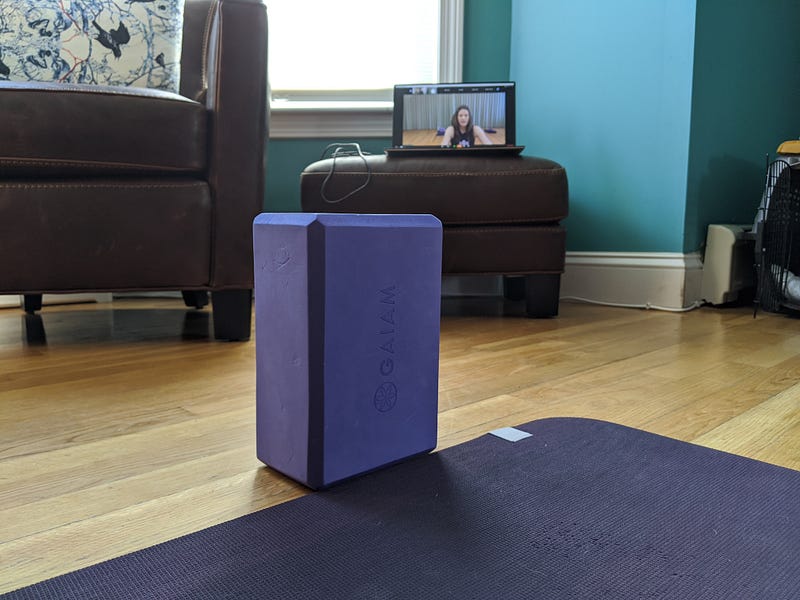
I set up in on the living room floor. I push the coffee table against the couch. The armchair and ottoman go against the wall by the window opposite a media stand with a television. My computer sits on the ottoman so I can see it.
My 75-lb sheprador’s bed is a few feet from my mat, and the geriatric chihuahua that I inherited from my mother has a bed next to that. There is more furniture, an overhead fan, framed artwork on the walls, and more.
The point is, my living room is pretty crowded.
It is great that so many yoga teachers have allowed me to turn this space into a makeshift yoga studio. But, streaming and video aren’t the same as in-person yoga classes, and living rooms are imperfect proxies for yoga studios.
Sorry, you lost me
The other day, I attended a live class with a new instructor. I opted to keep my video off. Being able to participate in a class anonymously is one privilege of an online class. I can hide from the instructor and take in their style and methods without them checking out my practice. Only a handful of the 20 participants used video.
The class started well enough. The instructor led us through several Sun Salutation As then several Sun Salutation Cs. I didn’t need to watch to follow along, but a few words caught me off guard, and I had to peer up at the computer screen. She was deep into her practice showing off some impressive bendiness.
After the traditional warm-up flow, things started to get complicated.
My years of practice have taught me to respect the limitations of my body. A knee injury keeps me from deep knee bends. I rarely do arm balances. My thickness and fatness mean certain poses are inaccessible to me. And I will never do a handstand without a spotter. I happily modify poses when I need it.
First, was a confusing transition downward dog to a figure four squat. Despite my experience, I don’t recall ever doing this transition. It’s not overly complicated, but it is undoubtedly not done very often. I didn’t care for how it put pressure on the top of my knee, so I clumsily made my way to figure four squat from standing.
Then, a traditional yogi squat (malasana) progressed to a revolved bound malasana. I was okay with modifying to an unbound twist, but the instructor progressed further. Unable to follow, I glanced at the screen as she started pushing up toward standing flamingo pose (marichyasana).
Flamingo is a complex and advanced pose. I didn’ even attempt it. I don’t have the flexibility in my hips, and that thickness problem keeps my legs from folding that way. So, I just sat back onto my blocks in a relaxed malasana. I watched the instructor show off while a few students made poor attempts to emulate her.
After my long rest in malasana, the class moved through another sequence. Again, I didn’t follow and had to keep looking toward the screen. When the series ended up with side crow, a twisting arm balance, I decided to skip it and do a few bridge poses. I had no interest in cracking my head on the coffee table or landing in my dog’s bed.
The class ended, and I felt a bit defeated. I didn’t feel bad about not being able to get into the complicated poses. I was disappointed because I didn’t have a good practice. I didn’t find my center.
I just wanted 60-minutes to escape the insane world. Instead, I got an overly complicated, hard-to-follow hour of watching acrobatics.
Don’t confuse complicated with challenging
The yoga studio called me later that day asking me how online classes were going and whether I had feedback. I wondered if it was a good idea for instructors to offer such complicated poses when they can’t see the whole classes.
The health care system is stretched so thin right now that I also was concerned that home yogis might injure themselves, trying to imitate their instructor’s advanced poses.
Classes suddenly going online may be attracting a whole bunch of new people to the practice. People who were intimidated by going to a studio and being seen might find an online class more inviting with its anonymity.
Without the benefit of in-person classes where an instructor can see all students and offer assistance, the class shouldn’t be so complicated that even someone with a 25-year practice can’t follow. It should be accessible to everyone.
The caller asked if I thought they should mark some classes as advanced or add poses to descriptions so inexperience yogis would know to avoid those classes. He felt they had a large audience of experienced yogis that attended in-person classes regularly who wanted a more challenging at-home practice.
Aside from having no way of knowing if only advanced people sign up for advanced classes, I thought this was unnecessary.
Challenging does not mean complicated. Experienced yogis should know how to take any pose in the primary ashtanga sequence and customize it for their experience. An experienced student modifies a primary practice to be more challenging. An inexperienced student may not know how to simplify a complicated practice.
Keeping it Simple
Yesterday, I joined a live class with one of my favorite instructors. It was an incredible hour. We chatted before class started then she fell into the familiar rhythm of her flow. The practice was sweaty, intense, and centering. We hit incredible power poses and wobbled through primary balances. And, as I laid in savasana, I absorbed what a perfect practice it was.
That practice was perfect because it was simple.
It helped that I was familiar with the instructor, but she didn’t get too clever with sequences. I didn’t have to keep looking up to the screen. She didn’t venture into complicated poses that require explanations or demonstrations.
I think the hardest pose she hit was Warrior III.
That is not to say Warrior III is an easy pose. It requires concentration, balance, and strength. All of these things are wonderful for getting centered and building strength. Even better, they are great for getting out minds off the chaos surrounding us.
The class was as challenging as I wanted it to be. And most importantly, it was the 60-minutes of mental isolation that I needed.
Kimi is a recovering corporate engineer figuring out what’s next. She is a Boston area freelance writer with work featured in HerStry, For Women Who Roar, Snapdragon: A Journal of Art and Healing, The MOON Magazine, Backroads, and Culture. Follow her at NoReturnTicket.kceridon.com or as [at]WordsbyKimi on Facebook, Twitter, Instagram.


