avatarJeremy Roberts

Free AI web copilot to create summaries, insights and extended knowledge, download it at here

6301

Abstract

been successful for decades, but Lew is the one that laid the ground work.</p><p id="ff42"><b>Did you ever discuss writing together?</b></p><p id="b871">Yeah, we talked about it. I know that his family has some of the songs that he never finished. I tried to get in touch with them to see if I could flesh them out and eventually record. Then we’d have co-written a song[s] together.</p><figure id="ca70"><img src="https://cdn-images-1.readmedium.com/v2/resize:fit:800/1*WvHdK-s7jLD7xoWMwkZ9aA.jpeg"><figcaption><b>Cool cats, indeed: Statler Brothers baritone Phil Balsley, a partially obscured Johnny Cash, Carl “Blue Suede Shoes” Perkins, and tenor-electric guitarist Lew DeWitt rehearse at the Hotel El Rancho in Sacramento, California, on either January 11 or 12, 1968, a couple of days before the career-affirming “Johnny Cash at Folsom Prison” 16-track record. Perkins first joined the Man in Black’s band in January 1966 at a Chattanooga, Tennessee, concert when his career was at a low ebb — alcohol exacerbated the situation — and remained a vital acknowledgement of Sun Records’ timeless rockabilly until bidding adieu to Cash in 1974 to resume his solo career. Photography by Jim Marshall / The Denver DeWitt Collection / The Official Lew DeWitt Facebook Fan Page</b></figcaption></figure><p id="f80b"><b>Was Lew still writing as his affliction worsened?</b></p><p id="0c30">Not to my knowledge. Maybe he jotted down some lyrics. If you walk by a guitar, you can’t help but pick it up and start strumming. It’s the same way with writing songs. In the back of your mind you go, ‘Oh man, that’s a pretty good idea. I might sit down here and fool with that.’</p><p id="c7da"><b>When did you last speak with Lew?</b></p><p id="471d">Lew was always encouraging me, and we kept in touch. I went by Lew’s house to see him about a month before he passed away, and he was really sick. It was just Lew, his wife Judy, and me. We visited and had a good time [the Statlers were playing at the Erie County Fair and Expo in Hamburg, New York, the evening of DeWitt’s passing when Don Reid announced the terrible news]. At his funeral I’m grateful there were no regrets. I spent time with Lew when it counted — while he was among the living. I won’t ever forget him. In every show that I do I pay tribute to Lew with “Flowers on the Wall” because he deserves it.</p><div id="d3dd" class="link-block"> <a href="https://readmedium.com/searching-for-elvis-presleys-humanity-with-statler-brother-jimmy-fortune-3e28dc0589e9"> <div> <div> <h2>Searching for Elvis Presley’s humanity with Statler Brother Jimmy Fortune [PART ONE OF THE INTERVIEW]</h2> <div><h3>“More Than a Name on a Wall” lyricist Jimmy Fortune sheds light on a heretofore unexplored facet of his artistic…</h3></div> <div><p>medium.com</p></div> </div> <div> <div style="background-image: url(https://miro.readmedium.com/v2/resize:fit:320/1*sBnrv5jqnT70i89pYb5OYw.jpeg)"></div> </div> </div> </a> </div><div id="de63" class="link-block"> <a href="https://readmedium.com/the-serendipitous-final-romance-of-statler-brothers-tenor-lew-dewitt-874be1288421"> <div> <div> <h2>The serendipitous final romance of Statler Brothers tenor Lew DeWitt</h2> <div><h3>At last Judy Wells DeWitt breaks her silence to commemorate the 30th anniversary of the Country Music Hall of Fame…</h3></div> <div><p>medium.com</p></div> </div> <div> <div style="background-image: url(https://miro.readmedium.com/v2/resize:fit:320/1*B8J0G69W2h4_rD0_fHBljQ.jpeg)"></div> </div> </div> </a> </div><div id="e7f1" class="link-block"> <a href="https://readmedium.com/the-lew-dewitt-songwriting-discography-d7a3bf208e11"> <div> <div> <h2>The Lew DeWitt songwriting discography</h2> <div><h3>The Statler Brothers tenor launched a career by penning “Flowers on the Wall,” a 1965 crossover smash. His songs are…</h3></div> <div><p>medium.com</p></div> </div> <div> <div style="background-image: url(https://miro.readmedium.com/v2/resize:fit:320/1*bgzLWDfCDZhxGXFg1C1p5g.jpeg)"></div> </div> </div> </a> </div><figure id="d534"><img src="https://cdn-images-1.readmedium.com/v2/resize:fit:800/1*cgZ59qg7OcQ2WivSnJvWnQ.jpeg"><figcaption><b>The Statler Brothers spend a day with the Great One, Jackie Gleason: Standing left to right are music producer Snuff Garrett, bassist Harold Reid, baritonist Phil Balsley, stuntman-director Hal Needham, tenor-guitarist Lew DeWitt, and lead singer-songwriter Don Reid during the shooting of “Smokey and the Bandit 2,” ultimately issued on August 15, 1980, by Universal Pictures to robust box office receipts. The country-gospel quartet provided two soundtrack contributions — “Do You Know You Are My Sunshine” and “Charlotte’s Web.” The former number was sung on-camera during a scene where an airplane dumped bright orange paint all over them! Image Credit: The Statler Brothers Archives</b></figcaption></figure><figure id="5311"><img src="https://cdn-images-1.readmedium.com/v2/resize:fit:800/1*te3S5h2wQMSLC-Z-8crAXw.jpeg"><figcaption><b>Presenting Statler Brothers altar-egos Lester “Roadhog” Moran and the Cadillac Cowboys circa 1974. Left to right are banjoist Henry “Red” Vines [Phil Balsley], doghouse bassist Wesley W. Rexrode [Don Reid], fiddle player-emcee Lester [Harold Reid], and doing the best he can on electric guitar — Ray “Wichita” Ramsey [Lew DeWitt]. According to Don in a <a href="https://www.yahoo.com/entertainment/news/statler-brothers-don-reid-recalls-origin-lester-roadhog-050030333.html">2015 interview with Billboard</a>, “We had done an album in 1972 called ‘Country Music — Then And Now’ [No. 7 C&W]. One side was ‘then’ and the other was ‘now.’ We did some old songs on the ‘then’ side, as well as this nine-minute comedy routine that we had written about the old local radio shows we would be

Options

listening to while growing up. We created these characters. We had no idea that it was going to take off like it did. It became so popular that Mercury came to us and asked for an entire album. So we wrote ‘Alive at the Johnny Mack Brown High School’ [1974]. It took off and still lives on…” Image Credit: The Statler Brothers Archives</b></figcaption></figure><figure id="2460"><img src="https://cdn-images-1.readmedium.com/v2/resize:fit:800/1*lp37uJOJu3rPEU8ZKuxsRA.jpeg"><figcaption><b>Struggling musician Lew DeWitt and Glenda Kay Simmers pose inside her mother Kathleen’s home circa 1960 in Waynesboro, Virginia. Married from 1961 to 1973, the constant companions had four children together — Denver, Donna, Brian, and Shannon. Notice the dirty socks, brown loafer, Army helmet, and empty Maxwell House cardboard box. Blame it on Glenda Kay‘s messy little brother Dennis Wayne! Image Credit: The Glenda Kay DeWitt Collection / The Official Lew DeWitt Facebook Fan Page</b></figcaption></figure><figure id="8929"><img src="https://cdn-images-1.readmedium.com/v2/resize:fit:800/1*XTMX1aDH9ja8QOmWbu8ZmA.jpeg"><figcaption><b>Clockwise from top left: Bassist Harold Reid, baritonist Phil Balsley, tenor Jimmy Fortune, and lead singer Don Reid are the revamped lineup of the Statler Brothers in this circa 1983 promotional still. Right out of the gate Fortune wrote a number one song for the harmony-laden quartet honoring one of the highest earning female actresses of the 20th century — “Elizabeth” — i.e. Elizabeth Taylor. Fun fact: the Statlers’ debut and very last hit singles involved walls — “Flowers on the Wall” and Fortune’s Vietnam War-remembering “More Than a Name on a Wall.” Image Credit: Michael Ochs Archives / Getty Images</b></figcaption></figure> <figure id="b6a3"> <div> <div> <img class="ratio" src="http://placehold.it/16x9"> <iframe class="" src="https://cdn.embedly.com/widgets/media.html?src=https%3A%2F%2Fwww.youtube.com%2Fembed%2Fi-0GkS0txf8%3Ffeature%3Doembed&amp;display_name=YouTube&amp;url=https%3A%2F%2Fwww.youtube.com%2Fwatch%3Fv%3Di-0GkS0txf8&amp;image=https%3A%2F%2Fi.ytimg.com%2Fvi%2Fi-0GkS0txf8%2Fhqdefault.jpg&amp;key=a19fcc184b9711e1b4764040d3dc5c07&amp;type=text%2Fhtml&amp;schema=youtube" allowfullscreen="" frameborder="0" height="480" width="640"> </div> </div> </figure></iframe></div></div></figure> <figure id="f3a1"> <div> <div> <img class="ratio" src="http://placehold.it/16x9"> <iframe class="" src="https://cdn.embedly.com/widgets/media.html?src=https%3A%2F%2Fwww.youtube.com%2Fembed%2FIJx1JCTvAwE%3Ffeature%3Doembed&amp;display_name=YouTube&amp;url=https%3A%2F%2Fwww.youtube.com%2Fwatch%3Fv%3DIJx1JCTvAwE&amp;image=https%3A%2F%2Fi.ytimg.com%2Fvi%2FIJx1JCTvAwE%2Fhqdefault.jpg&amp;key=a19fcc184b9711e1b4764040d3dc5c07&amp;type=text%2Fhtml&amp;schema=youtube" allowfullscreen="" frameborder="0" height="480" width="640"> </div> </div> </figure></iframe></div></div></figure> <figure id="43ee"> <div> <div> <img class="ratio" src="http://placehold.it/16x9"> <iframe class="" src="https://cdn.embedly.com/widgets/media.html?src=https%3A%2F%2Fwww.youtube.com%2Fembed%2F1LECxbL4LeI%3Ffeature%3Doembed&amp;display_name=YouTube&amp;url=https%3A%2F%2Fwww.youtube.com%2Fwatch%3Fv%3D1LECxbL4LeI&amp;image=https%3A%2F%2Fi.ytimg.com%2Fvi%2F1LECxbL4LeI%2Fhqdefault.jpg&amp;key=a19fcc184b9711e1b4764040d3dc5c07&amp;type=text%2Fhtml&amp;schema=youtube" allowfullscreen="" frameborder="0" height="480" width="854"> </div> </div> </figure></iframe></div></div></figure><div id="9fcc" class="link-block"> <a href="https://readmedium.com/never-givin-up-with-foremost-country-troubadour-danny-dawson-6a274e21cc3c"> <div> <div> <h2>Never givin’ up with foremost country troubadour Danny Dawson</h2> <div><h3>The Georgia Traditional Artist of the Year alum covers his hardscrabble Georgia roots with 18 siblings, Waylon…</h3></div> <div><p>medium.com</p></div> </div> <div> <div style="background-image: url(https://miro.readmedium.com/v2/resize:fit:320/1*DKf4QeHaByShK6MtUZsIGg.jpeg)"></div> </div> </div> </a> </div><div id="82fa" class="link-block"> <a href="https://readmedium.com/jerry-reeds-guest-guitar-on-ringo-starr-s-countrified-15-draw-252bbcb46d8e"> <div> <div> <h2>Jerry Reed’s guest guitar on Ringo Starr’s countrified ‘15 Draw’</h2> <div><h3>That’s Jerry Reed counting off ex-Beatle Ringo Starr’s “15 Draw” and clawin’ up a catchy guitar riff. The best song on…</h3></div> <div><p>medium.com</p></div> </div> <div> <div style="background-image: url(https://miro.readmedium.com/v2/resize:fit:320/1*1r_3aMXnlzgaPzZkFkdKTw.jpeg)"></div> </div> </div> </a> </div><div id="e107" class="link-block"> <a href="https://readmedium.com/hold-on-partner-the-day-clint-black-met-the-king-of-the-cowboys-roy-rogers-46eee1612191"> <div> <div> <h2>Hold on partner — The day Clint Black met the King of the Cowboys, Roy Rogers</h2> <div><h3>Hayden Nicholas, best known as the songwriting and guitar sidekick of singer Clint Black, relives the serendipitous…</h3></div> <div><p>medium.com</p></div> </div> <div> <div style="background-image: url(https://miro.readmedium.com/v2/resize:fit:320/1*hSiPrbsi_jQnHJMNVp99bA.jpeg)"></div> </div> </div> </a> </div><p id="c389"><i>© Jeremy Roberts, 2020. All rights reserved. To touch base, email <a href="mailto:[email protected]"></a></i><a href="mailto:[email protected]">[email protected]<i></i></a><i> and mention which story led you my way. I appreciate it sincerely.</i></p></article></body>

Thank you world for contributing founding Statler Brother Lew DeWitt
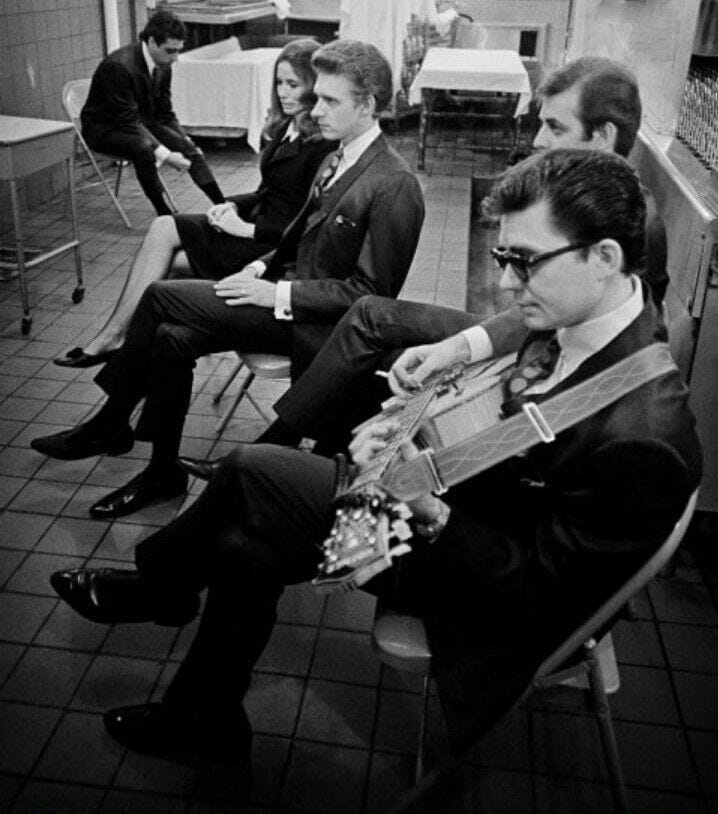
Clockwise from top left finds Statler Brothers bass vocalist-songwriter Harold Reid adjusting his long black socks, Mother Maybelle and the Carter Sisters comedienne June Carter Cash, baritonist Phil Balsley, lead singer-songwriter Don Reid, and sunglasses-clad, tenor-guitarist-songwriter Lew DeWitt combating pre-show jitters in a makeshift backstage area — actually a kitchen — minutes before debuting with Johnny Cash at Folsom Prison on January 13, 1968, in Folsom, California. The subsequent live album climbed to number one country and crossed over to the pop charts for a staggering 123 weeks at No. 13. Photography by Jim Marshall / All About the Statlers [Facebook group]

“Flowers on the Wall” endures as “one of country music’s most vivid descriptions of a bitter reject trying to convince himself of his indifference toward his ex-lover,” AllMusic reviewer Vince Ripol convincingly insists. Cut during a March 1965 Johnny Cash session at Nashville’s Columbia Studio after the star suddenly left to grab some lunch, the Statler Brothers seized their unpredictable boss’s serendipitous opportunity and taught the other musicians the chords to “Flowers” as well as Tom T. Hall’s “The Ballad of Billy Christian.” The former was merely slated as the B-side until canny deejays flipped the record over, yielding a crossover Top Five pop record penned by guitarist Lew DeWitt. A natural tenor capable of making arm hairs salute, DeWitt composed two subsequent hits in the ’70s for the three-time Grammy-winning quartet nurtured on gospel music — the nostalgic “Pictures” and “The Movies.” Soon to be 30 years since DeWitt’s premature demise at age 52, Jimmy Fortune offers a fond remembrance of the clever, unassuming B-Western admirer who personally selected him as his permanent replacement in 1982 [catch up with part one of the interview entitled “Searching for Elvis Presley’s Humanity…” here].

The Jimmy Fortune Interview, Part Two

What comes to mind when you reflect about Lew DeWitt?

I got to know Lew some. He suffered from Crohn’s [an inflammatory bowel disease]. After he saw me performing at a local ski lodge and recommended me for the group, we still kept in touch [Author’s Note: Fortune’s debut concert was January 28, 1982, in Savannah, Georgia. DeWitt’s health improved enough by June that he temporarily rejoined the group for a Hee Haw taping and to host the Music City News Awards in Nashville. Fortune was part of the band. DeWitt reconsidered his decision before the month was over and stepped down permanently].

Lew would need surgery, and there were times that he wanted to give up. I’d say, “Lew, you’ve gotta try to get this surgery so it’ll give you a few more years.” He would finally give in and say, “Okay.” He had about four or five good years after his 1983 operation [DeWitt rebounded for two solo albums — On My Own and the ironically titled Here to Stay — on the indie Compleat label that have yet to be reissued in any format]. Finally he needed a heart transplant, and he got so far down that he couldn’t come back [March 12, 1938 — August 15, 1990]. I loved Lew. He was a great guy, great talent, and great friend to me. I miss him and still can’t believe it’s closing in on 30 years since he passed away.

What’s a deep Lew cut deserving rediscovery?

“Chet Atkins’ Hand” [1981 B-side of Don and Harold’s No. 5 C&W “Don’t Wait on Me;” available on Years Ago]. Lew of course wrote “Flowers on the Wall” [No. 4 POP, No. 2 C&W, 1965] and a lot of other great songs that the Statler Brothers recorded [e.g. “I’m the Boy” (No. 60 C&W 1969], “Pictures” (No. 13 C&W 1971 in collaboration with Don), “Thank You World” (No. 31 C&W 1974 with Don) and “The Movies” (No. 10 C&W 1977)].
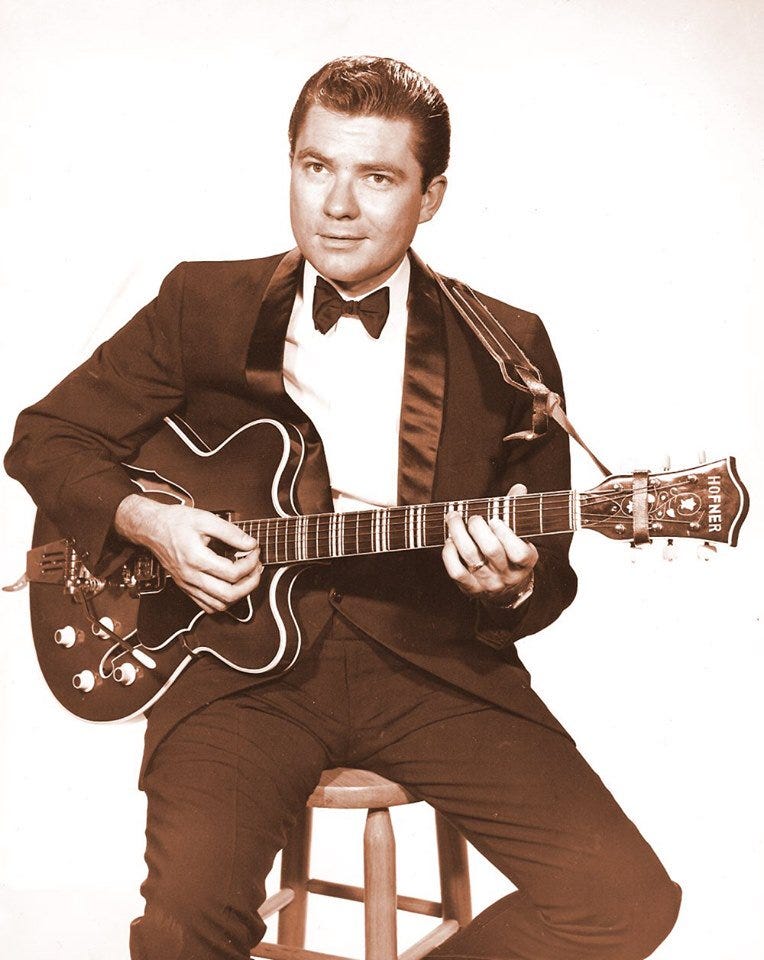
A Hofner electric guitar-wielding Lew DeWitt is a classy tuxedo-clad singer-songwriter in this mid-1960s promotional still. During the swingin’ sixties DeWitt contributed the Statler Brothers’ best tune — “Flowers on the Wall” — as well as “I’m the Boy” and obscure B-sides “Is That What You’d Have Me Do” and “Do You Love Me Tonight.” After “Flowers” became a Top Five pop single, Columbia never quite knew how to market the quartet. Fortunately, Mercury Records and producer-guitarist Jerry Kennedy had no such quandary at the dawn of the 1970s with “Bed of Rose’s,” “I’ll Go to My Grave Loving You,” and a plethora of other hits. Image Credit: All About the Statlers [Facebook group]

Being a guitarist, how would you evaluate Lew’s six-string prowess?

Lew was one of the most talented people I’ve ever met. People don’t realize what a great guitar player he was. He could sit down and play with Chet Atkins. You would think, ‘My gosh, he’s going lick for lick with Chet Atkins!’ He was that good. Matter of fact, when the Statler Brothers first started Lew was their band. It was Lew on guitar and those four singing [Author’s Note: A Sunday evening in June 1955 at the Lyndhurst Methodist Church in Lyndhurst, Virginia, was their official gig, albeit billed as the Four Star Quartet. Joe McDorman was the original frontman before being replaced by Harold’s 14-year-old brother Don in 1960].

What about Lew’s tenor vocals?

The timbre of Lew’s voice was magical. Harold and Don [Reid] held down the low end, and Phil [Balsley] and Lew were solid on the high end. I’m not saying it wasn’t magical when I came, but it was different. It’s pretty unbelievable how things are meant to be. I helped them sustain a career that had been successful for decades, but Lew is the one that laid the ground work.

Did you ever discuss writing together?

Yeah, we talked about it. I know that his family has some of the songs that he never finished. I tried to get in touch with them to see if I could flesh them out and eventually record. Then we’d have co-written a song[s] together.
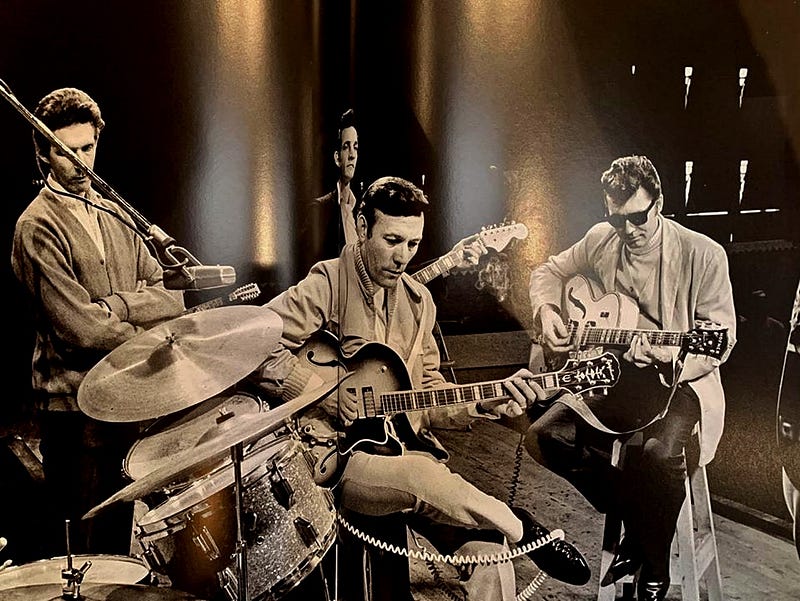
Cool cats, indeed: Statler Brothers baritone Phil Balsley, a partially obscured Johnny Cash, Carl “Blue Suede Shoes” Perkins, and tenor-electric guitarist Lew DeWitt rehearse at the Hotel El Rancho in Sacramento, California, on either January 11 or 12, 1968, a couple of days before the career-affirming “Johnny Cash at Folsom Prison” 16-track record. Perkins first joined the Man in Black’s band in January 1966 at a Chattanooga, Tennessee, concert when his career was at a low ebb — alcohol exacerbated the situation — and remained a vital acknowledgement of Sun Records’ timeless rockabilly until bidding adieu to Cash in 1974 to resume his solo career. Photography by Jim Marshall / The Denver DeWitt Collection / The Official Lew DeWitt Facebook Fan Page

Was Lew still writing as his affliction worsened?

Not to my knowledge. Maybe he jotted down some lyrics. If you walk by a guitar, you can’t help but pick it up and start strumming. It’s the same way with writing songs. In the back of your mind you go, ‘Oh man, that’s a pretty good idea. I might sit down here and fool with that.’

When did you last speak with Lew?

Lew was always encouraging me, and we kept in touch. I went by Lew’s house to see him about a month before he passed away, and he was really sick. It was just Lew, his wife Judy, and me. We visited and had a good time [the Statlers were playing at the Erie County Fair and Expo in Hamburg, New York, the evening of DeWitt’s passing when Don Reid announced the terrible news]. At his funeral I’m grateful there were no regrets. I spent time with Lew when it counted — while he was among the living. I won’t ever forget him. In every show that I do I pay tribute to Lew with “Flowers on the Wall” because he deserves it.
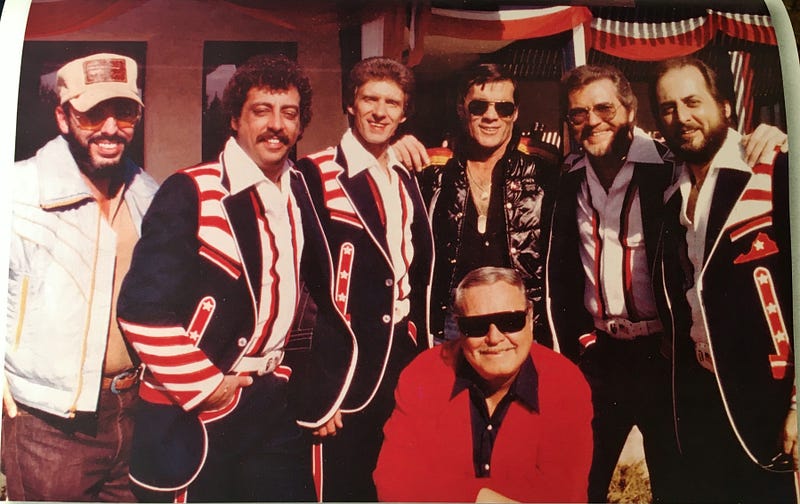
The Statler Brothers spend a day with the Great One, Jackie Gleason: Standing left to right are music producer Snuff Garrett, bassist Harold Reid, baritonist Phil Balsley, stuntman-director Hal Needham, tenor-guitarist Lew DeWitt, and lead singer-songwriter Don Reid during the shooting of “Smokey and the Bandit 2,” ultimately issued on August 15, 1980, by Universal Pictures to robust box office receipts. The country-gospel quartet provided two soundtrack contributions — “Do You Know You Are My Sunshine” and “Charlotte’s Web.” The former number was sung on-camera during a scene where an airplane dumped bright orange paint all over them! Image Credit: The Statler Brothers Archives
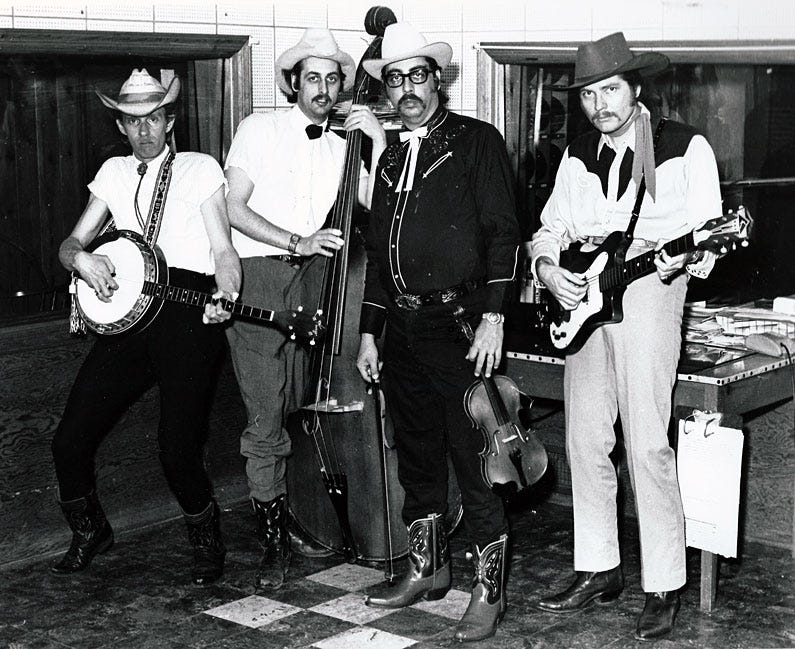
Presenting Statler Brothers altar-egos Lester “Roadhog” Moran and the Cadillac Cowboys circa 1974. Left to right are banjoist Henry “Red” Vines [Phil Balsley], doghouse bassist Wesley W. Rexrode [Don Reid], fiddle player-emcee Lester [Harold Reid], and doing the best he can on electric guitar — Ray “Wichita” Ramsey [Lew DeWitt]. According to Don in a 2015 interview with Billboard, “We had done an album in 1972 called ‘Country Music — Then And Now’ [No. 7 C&W]. One side was ‘then’ and the other was ‘now.’ We did some old songs on the ‘then’ side, as well as this nine-minute comedy routine that we had written about the old local radio shows we would be listening to while growing up. We created these characters. We had no idea that it was going to take off like it did. It became so popular that Mercury came to us and asked for an entire album. So we wrote ‘Alive at the Johnny Mack Brown High School’ [1974]. It took off and still lives on…” Image Credit: The Statler Brothers Archives
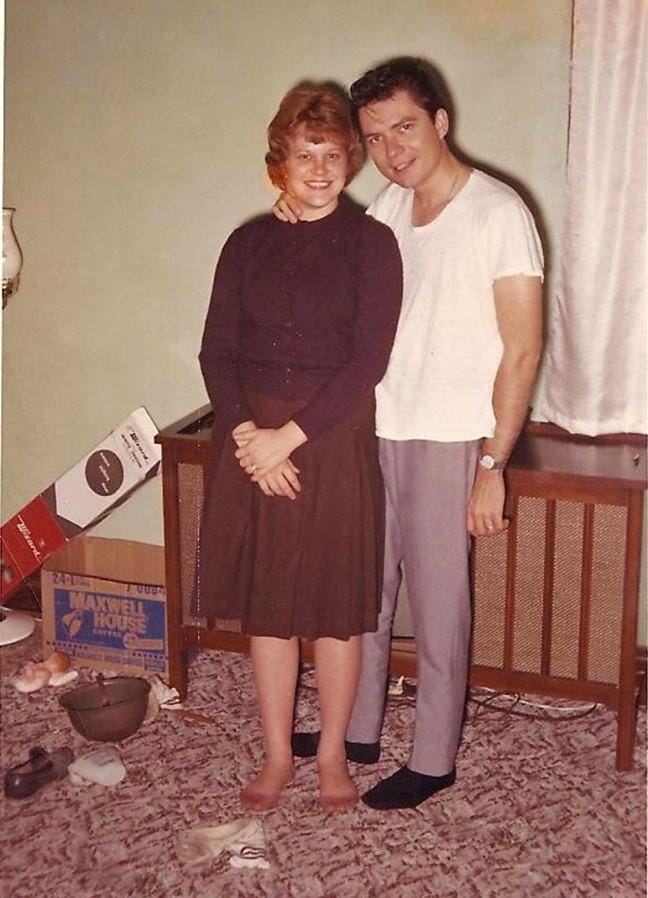
Struggling musician Lew DeWitt and Glenda Kay Simmers pose inside her mother Kathleen’s home circa 1960 in Waynesboro, Virginia. Married from 1961 to 1973, the constant companions had four children together — Denver, Donna, Brian, and Shannon. Notice the dirty socks, brown loafer, Army helmet, and empty Maxwell House cardboard box. Blame it on Glenda Kay‘s messy little brother Dennis Wayne! Image Credit: The Glenda Kay DeWitt Collection / The Official Lew DeWitt Facebook Fan Page
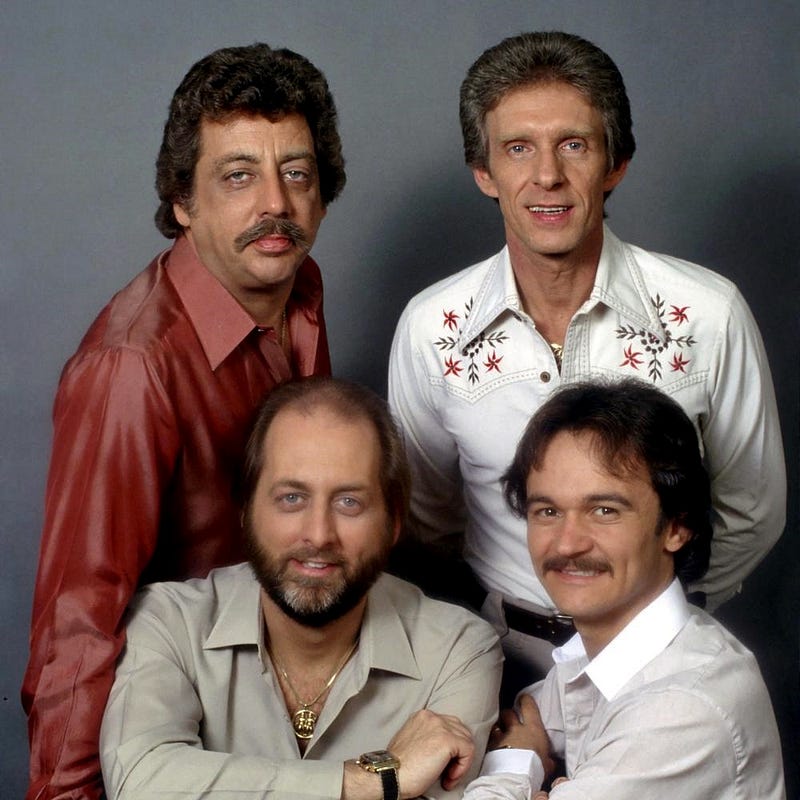
Clockwise from top left: Bassist Harold Reid, baritonist Phil Balsley, tenor Jimmy Fortune, and lead singer Don Reid are the revamped lineup of the Statler Brothers in this circa 1983 promotional still. Right out of the gate Fortune wrote a number one song for the harmony-laden quartet honoring one of the highest earning female actresses of the 20th century — “Elizabeth” — i.e. Elizabeth Taylor. Fun fact: the Statlers’ debut and very last hit singles involved walls — “Flowers on the Wall” and Fortune’s Vietnam War-remembering “More Than a Name on a Wall.” Image Credit: Michael Ochs Archives / Getty Images

© Jeremy Roberts, 2020. All rights reserved. To touch base, email [email protected] and mention which story led you my way. I appreciate it sincerely.

Music
Country Music
Inspiration
Life Lessons
Statler Brothers
Recommended from ReadMedium