
Thank you for not just standing aside
Fast Lane Ukraine — 25 essential volunteer driver tips
“Thank you for not just standing aside. It means the world — Really.
No words can describe how much we all appreciate what you do and how grateful we are.
The trip that you, our drivers and your team, organised to help us get safely out of Ukraine seemed too good to be true and it still seems to be a kind of miracle. You are our saviours.”
If ever doubting your worth as a volunteer driver for Fast Lane Ukraine, these words posted following trip FLU259 (18–20 July 2022) by the mother of a young boy suffering from trauma and travelling with her own ageing mother, put into context the value of your selfless contribution.
It’s a big ask, but Fast Lane Ukraine’s dedicated volunteers who step forward to undertake this vital humanitarian aid are making a difference.
You’re part of an extraordinary team. The contribution you’re making is supporting some of the most vital behind-the-scenes voluntary work currently being undertaken throughout this mindless war in Europe.
Our contribution may be small in isolation given the scale of the humanitarian disaster that continues to unfold, but scores of tonnes of aid have been getting through to where its needed and hundreds of refugee families have been transported from their war-torn homes to safety.
Having undertaken multiple road trips with Fast Lane Ukraine (FLU) delivering aid cargo throughout Poland and bringing displaced refugees and injured soldiers back from the Ukraine border and various other destinations, this driver guide has been compiled to assist other volunteer drivers embarking on their own journeys.
It’s not definitive by any means. It’s merely intended to offer some guidance from a driver’s perspective having made the journey and experienced a lot of the challenges and frustrations you’ll encounter along the way.
If nothing else, it will hopefully focus attention on the need for as much planning and preparation as possible before you depart. The more thought you put in, the more you’ll be equipped to help your passengers on their often traumatic journeys.
The more organised and relaxed you are, the more they will relax and have confidence in you and FLU. This creates the impression of a well organised and genuinely caring voluntary humanitarian organisation. You can help so much with a prepared, calm and reassuring approach.
With that in mind, here are 25 pieces of personal advice for you to consider and maybe add to on your return to assist other drivers who follow us on the major highways and autobahns across Europe and back to the Netherlands.
1. Don’t take your voluntary driving role with FLU lightly
Driving with FLU isn’t a holiday or a jolly.
While it can be extremely fulfilling voluntary work, it can also be physically and mentally challenging — Long days often working with refugee passengers who have endured considerable distress and hardship.
They may have lost loved ones, their homes and all their possessions.
By volunteering to drive with FLU, you can help give them hope and an opportunity to rebuild their lives, but it’s not an undertaking to be taken lightly.
Things can go wrong and they do. These trips can be emotionally draining and you need to be prepared for it.
Obviously, you will need to be an experienced and confident driver, but will also require compassion and flexibility in good measure. If you possess these qualities, you have the fundamental requirements for this vital aid work.
2. Sleep well before you travel
Driving can be tiring and fatigue can creep up on you particularly as you’ll be constantly on the go and working in unfamiliar surroundings.
Before undertaking a trip, make sure you’re well rested and have a good night’s sleep the night before you depart for day one.
3. Plan your route daily in advance of travelling
Prepare your journey route in detail, ideally the day before departure checking pick-up and delivery locations.
Your itinerary can change at short notice, so check for Back Office updates during your trip and particularly unfamiliar destination spellings and area codes.
Check if the pick-up location you’ve been given is accurate. You don’t want to get Lubin in west Poland mixed up with Lubon in the centre of the country, or Lublin in the east! I’ve been required to travel to all three during this past year working with FLU.
4. Familiarise yourself with your navigation software
Whether using Maps, Google Maps or Waze, make sure you know your way round your navigation app of choice.
That means knowing how to plan your route; add stops; drop and send a pin for a FLU colleague or waiting passengers; and re-plan a route at a moment’s notice. This saves time and reduces anxiety while travelling.
For what it’s worth, having used all three mainstream apps and various hire vehicles’ often outdated navigation software, Google Maps gets my vote for being the most consistently reliable and user-friendly.
5. Secure your Polish toll clearance before setting off
Prepare a draft of the templated email available from the FLU website to the Polish Ministry of transport in advance to secure your toll exemption as part of the ‘Humanitarian Aid Convoy’. I carry a draft template on my mobile for convenience.
This enables clear access through the tolls without paying and saves time. So, if you can, obtain you hire vehicle registration number in advance and complete the form 24-hours before you depart.
You will then receive an email confirming your toll exemption for your vehicle. Keep this handy on your mobile to prove to any ‘reluctant’ toll attendants that you have toll exemption. This also saves the equivalent of 50–60 Euros on major highways through Poland, depending on your route.
Email confirmation of your toll exemption normally comes through same day, but if you can, do it the day before departure .
6. Prepare an A4 landscape sign for the toll booths
In conjunction with the previous tip, before you set off, prepare an A4 landscape sign for the toll attendants.
In clear capitals, write: HUMANITARIAN AID CONVOY with the vehicle registration beneath it. Show this to the attendant at the booth, who will then check the clearance on their system. This avoids a frustrating exchange and saves time explaining your journey to non-English speaking toll attendants.
7. Organise a passenger list as early as possible
You need to know who you’re picking up with a pre-organised list of names (forenames and surnames) and mobile numbers as early on as possible.
Ukrainians use various name formats which can be confusing — Valeria is also commonly Leera, for example; Stas for Stanislav etc.
So, be sure you link the names you’re given correctly with those who subsequently contact you while on your trip.
The sooner you have a definitive list of passengers with mobile numbers and where you’re due to collect them, the sooner you can start putting the detail on your itinerary.
This is important. I’ve had instances of people trying to convince me that I’m supposed to be transporting them at the Red Cross Centre in Przemsyl near the border in Poland when they are not on my list.
8. Check if your passengers have special requirements
Some of your passengers may have particular needs. You need to know in advance if you’re transporting mothers with babies, infants or elderly and infirm passengers. Baby seats may be required and some passengers may require additional assistance with wheelchairs, for example.
On one trip, we were due to collect three injured soldiers from the border only to find when I spoke with one of the doctors travelling in the ambulances to the arranged pick-up point that one of them was on a stretcher. The doctor thought we were travelling in a specially adapted vehicle.
With a family of four already on board, clearly we were not in a position to accommodate a passenger on a stretcher. Unfortunately, this passenger was unable to travel on this occasion. One of the other soldiers was in a wheelchair and the third was on crutches. While not without its challenges, we were able to provide transport for these injured soldiers.
Clearly, we need to know who we are carrying in such circumstances, so ask if there are any special requirements and respond accordingly if you can or make it clear that you’re unable to carry out certain requests.
9. Check if you’ll be transporting pets
As a volunteer driver, you have an opportunity to state on your Planned Drive Form whether or not you’re happy to pick up pets on your trip.
While this may be fine for you, just make sure your co-driver doesn’t have any pet allergies. One of my co-drivers had a pet allergy which had to be managed accordingly.
Just like humans, dogs and cats come in all shapes, sizes and tempraments. A belligerent 50-kilo British Bulldog comes with its own set of considerations particularly when travelling with two other dogs it has little affection for!
You need to know if you’ll be carrying pets as provision needs to be made in advance.
10. Don’t forget your charger cable and connection socket/port
Your mobile phone is going to be your most valuable communication, navigation and research tool on your trip. While driving, keep it charged up and working along with your co-driver’s.
A two-port adapter is useful for the cigarette lighter to keep both phones charged. Not, essential, but a spare phone has proved useful and charging battery unit for passengers’ phones as well.
11. Coins to access service station toilets
A number of service stations and all of them in Germany(!) levy a nominal charge and have an attendant standing at the entrance overseeing access. At the time of writing, the charge in Germany is 70 cents.
Our passengers seldom have money particularly coins and it can be somewhat demeaning to leave someone who doesn’t speak the language and clearly wants to use the bathroom, barred from entering because they don’t have any change.
To prevent this loss of dignity, it’s helpful to keep some coins in the van for you and your passengers — Euros and Zlotti.
12. Take plenty of water with you
It can get hot in the minibus particularly during the much warmer summer months when you’ve got a full passenger count.
Stay hydrated. Take plenty of water on board for you and your passengers. They’ll appreciate it. If it’s really hot, consider taking a cool bag and some ice-blocks to keep the water cool.
Temperatures reached 43 degrees on one trip returning through Poland and Germany during the summer and regular access to cool water was extremely well received.
13. Blankets and hot water bottles during the winter
While water during the summer may be the priority, during the bitterly cold winter months, consider carrying a couple of warm blankets and hot water bottles in the van.
Particularly important for elderly passengers and children, the hot water bottles can be filled in the hotel before departure and will stay warm for a couple of hours.
14. Take sweets, biscuits, energy bars, apples, mints etc.
Really helpful for a burst of energy or for when you’re feeling a bit peckish and don’t want to interrupt the flow of your journey. Take plenty and share them with your passengers.
It’s always good to share and, again, your passengers will really appreciate these small gestures of kindness.
15. Try to avoid city centres when arranging pick-ups
Wherever you can, try to avoid slow-moving city/town centre traffic.
This will keep you out of the slower-moving congested urban centres and save you time going in and then travelling back out. It’s less stressful driving and also more economical on fuel consumption.
Where you can, pick up on the outskirts of towns near fuel stations or hotels as close as possible to your navigation route. Try and avoid going into larger city centres like Warsaw to pick-up at the main central station, particularly during rush hours. This can add an hour to get in and another hour to get out on an already long journey, so plan ahead.
On occasions, passengers may be unable to move easily to more convenient pick-up points due to disability; injury; young children; luggage or simply cost. More experienced drivers work with the back office team and can liaise directly with the passengers and use their judgement to make the right call to serve the best interests of the refugees.
As with most aspects of this voluntary work, it comes down to working together as a team and simply trying to do our best.
16. Watch the speed limits — OR face the consequences
I speak from experience here and have learned costly lessons having collected several speeding tickets (and three parking fines) while volunteering with FLU, I’m ashamed to say.
The point is simple — Don’t make the same mistake and avoid all the hassle of the fines process in NL, Germany and Poland.
Observe the speed limits which are generally well sign-posted and note that despite views to the contrary, there are speed restrictions on sections of the German autobahns where particular care is required.
Vehicles can and often do travel up to 200kmh (and faster) on the autobahns. Use both of your side mirrors constantly, more than you would normally and allow plenty of time for signalling when changing lanes.
As you’ll be driving for extended periods, consider using the vehicle cruise control settings to ensure you’re within the legal speed limits and to make your drive easier and smoother.
17. Stay left when the road splits for roadworks
Having spent many hours behind the wheel, observing traffic flows on recent trips, almost without exception, when the road splits for maintenance work, unless there’s a clear reason not to, take the left-hand lane.
The lorries and bulk of the traffic generally opt for the right-hand lanes which then moves at slower speed with the increased volume of traffic and heavy goods vehicles. And, these roadworks can go on for miles!
18. Stay right at the toll booths
Opt for the right-hand booths (when they’re open and have the green arrow above, of course) when negotiating the tolls in Poland.
Not sure why, but people tend to go for the open toll booths in the centre where the queues tend to be longer. I’ve consistently found the right-hand booths less congested and therefore faster moving and to get through.
19. Refuel when you can in Poland — Save up to €30 a tank
Fuel in NL and Germany is considerably more expensive than in Poland at more than €2/litre (at the time of writing).
So, if you get the opportunity, plan your refuelling on Polish soil. The difference in price is significant and can be as much as 50 cents/litre less, particularly off the major highways.
For example, when picking up passengers on the outskirts of Warsaw at the Arena shelter (a highly convenient pick-up point), the cost of fuel at the adjacent filling station on a recent trip was 7.36 Zlt (about 1.55 Euros/litre)
For the 70-litre tank on the nine-seater Mercedes automatic hired for the trip, that represents a saving of more than €30 each time you fill-up.
20. Book overnight accommodation in Poland — It’s cheaper
On return trips with passengers, significant savings can be made on hotel/accommodation if you book a hotel in Poland rather than Germany.
The rooms can be basic, but are generally clean and comfortable and you can save up to €50 on a double room with breakfast.
I’ve also found it cheaper to call the hotels direct and get them to give a cheaper price than going through booking.com — Check if there’s convenient parking available; lift access, if required; what time the restaurant closes; and if breakfast is included. Everything that’s going to make your drive easier.
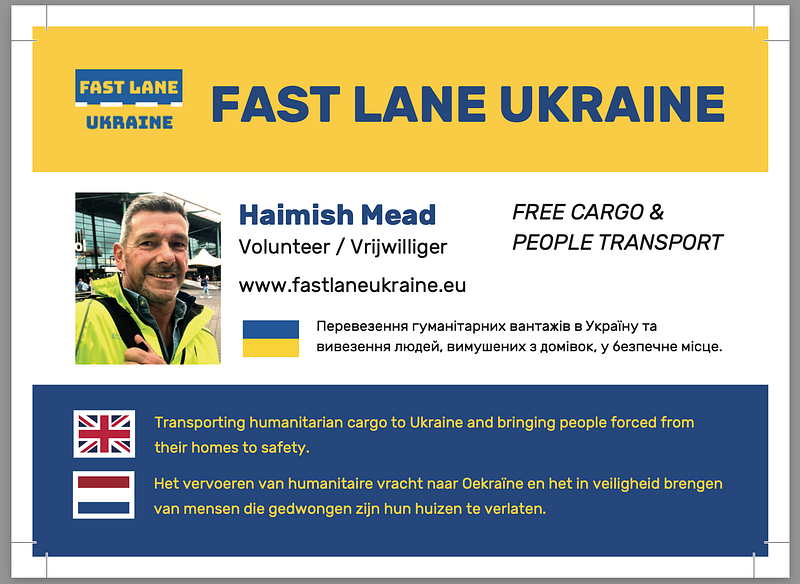
21. Create a FLU identity card with your picture on it
This is useful to communicate more easily what FLU does and our role as volunteer drivers.
It provides reassurance for our passengers when picking them up identifying who we are and that we’re from a legitimate and registered organisation.
It also gives greater credibility at check points, tolls and hostels/hotels etc. offering a quick explanation of who we are and what we do.
It can provide some preferential treatment from sympathetic individuals in authority. It’s even helped me avoid a speeding fine when pulled over on the Polish-German border and detained while my documents were being checked.
When the Polish police were satisfied that FLU is a legitimate organisation, they let me on my way and overlooked my speeding indiscretion on this occasion.
Happy to share the artwork so that you can drop in your picture and name. It’s two-sided in four languages — Dutch, English, German and Polish.
22. Carry a first aid kit
A simple first aid kit with various size plasters, some bandages, antiseptic wipes, basic pain relievers (e.g. Ibuprofen), antiseptic cream/gel and some latex gloves, safety pins, scissors etc. has proved useful on more than one occasion.
Hand gel also proved useful, almost daily.
23. Disposable plastic gloves
Believe me, these are extremely useful. Pick up a bundle up when you’re at the service station and place them in the driver’s side door for easy access.
When you’ve carried passengers who may be elderly or infirm, young children who may not be well or don’t travel well and dogs and cats couped up for 3–4 hours, you’ll be glad of them.
24. Check-in with your co-driver while travelling
This might sound like a strange one, but while you’re taking a break from driving in the front passenger seat, stay up to date with communications from the FLU Back Office Team and relay relevant updates to your co-driver.
Double-check the day’s journey plan and that you’re on the right route and on schedule. Take on the navigation responsibilities and keep talking to your co-driver.
Fatigue can set in, particularly late in the day and on the dark winter nights. So, it helps both of you to keep talking and checking in with each other.
25. Create a simple Ukrainian language words and phrase sheet
Unless you’re fortunate to have a Ukrainian or Russian language speaking co-driver with you which is obviously a big help, language is going to be a challenge.
However, with a little effort with some simple words and phrases it’s surprising what a help this can be. It’s also well received and prompts a source of humour for your passengers.
Useful words and phrase like: Hello; good morning; please; thank you; what’s your name?; are you okay?; can I help you?; are you thirsty? are you hungry? would you like something to eat? do you need a break for the toilet?; what part of Ukraine are you from?; cheers… Happy to forward on my home-made Ukrainian language aide-memoire.
These all go a long way and help create a bond with you passengers. It’s a bond that means more to them than you may ever realise.
This bond you’ll only start to appreciate when you’re driving away from your final ‘drop-off’ in an empty van.
On behalf of the FLU team of volunteers and the hundreds of refugees transported safely from Ukraine, thank you for not standing aside.
It helps when you read
Every word read on my Medium account in 2022 is going to help someone. All money raised will go to the following registered charities:
Children with Cancer UK — Helping children and young people with cancer Young Gloucestershire — Supporting disadvantaged young people facing challenges in their lives The Big Yellow Bus Project — Shelter and support for the homeless
It’s a small gesture and it’s not going to change the world, but if it helps one person, it’s worth it.
Thank you for clapping and making a difference.