Refugees | Structural help
Thailand’s Refugee Camps Might Never Disappear
The Financial Help Is Too Beneficial
Although the meeting wasn’t on my schedule I’d received from my NGO, I sat across the governor of the province of Mae Hong Son and he was asking for money. I was intimated by the governor’s question, age and his obvious superior experience in handling conversations like this. “I’ll see what I can do”, was the best possible reply I could give and left the governor’s office with mixed feelings.
How does a twenty-four-year-old Dutch history student get into this situation I asked myself?
In 2012 I bought a jacket in the town of Hpa-an with a flag stitched to it. “What flag is this?” I asked the shopowner.
“From the Karen National Union”, the man said. I’d never heard of it before. I’ve been reading about the Karen and their armed struggle ever since. In 2014 I became an intern at an NGO providing emergency aid all over the world. In the same year I studied at the National University of Singapore to study the history of the Karen. I studied the position of the Karen people in relationship to the nation-states of Myanmar and Thailand. Through my earlier internship at the NGO, I managed to go on a field trip to Thailand.
That’s how I ended up sitting across the table from the governor of a province of Thailand. The next days I visited several refugee camps of the Karen people within Thailand and I outline below the good and bad about the current status-quo.
The story of the Karen people starts in Myanmar. Myanmar is a collection of various ethnic, linguistic and cultural groups. Most of the current borders were established by the British colonial empire, which did not take local ethnicities and languages into account at the time.
After Myanmar became independent in 1948 the power vacuum left by the British was filled by the largest and historically most dominant group in this territory, the Bamar (or Burman).
With the exit of the British, the hope for independence for groups like the Karen, Shan and others who helped the British during the war, disappeared.
After Myanmar gained independence, an armed revolt broke out between various ethnic groups and the Bamar.
Some of the Karen are still fighting the governmental army of Myanmar for more autonomy. It’s considered the longest-running armed conflict in the world.
The armed conflicts in Myanmar in the second half of the twentieth century made many ethnic people like the Karen seek refuge in neighboring Thailand.
Thailand at the time of writing has nine refugee camps holding 93.298 people.
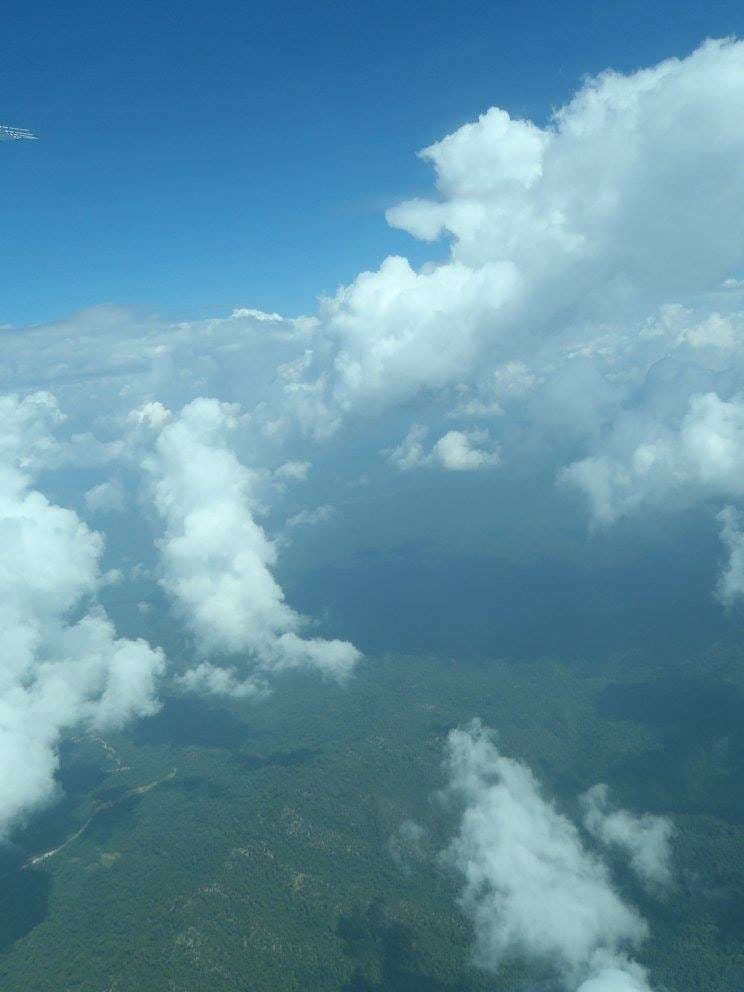
In November 2014, I flew from Singapore to Bangkok, from Bangkok to Chiang Mai and from Chiang Mai over the jungle filled hills to Mae Hong Son.
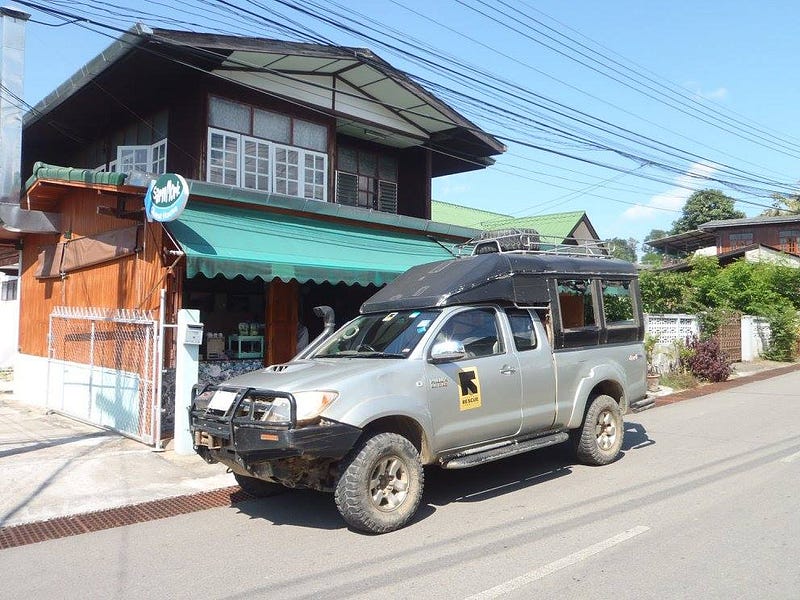
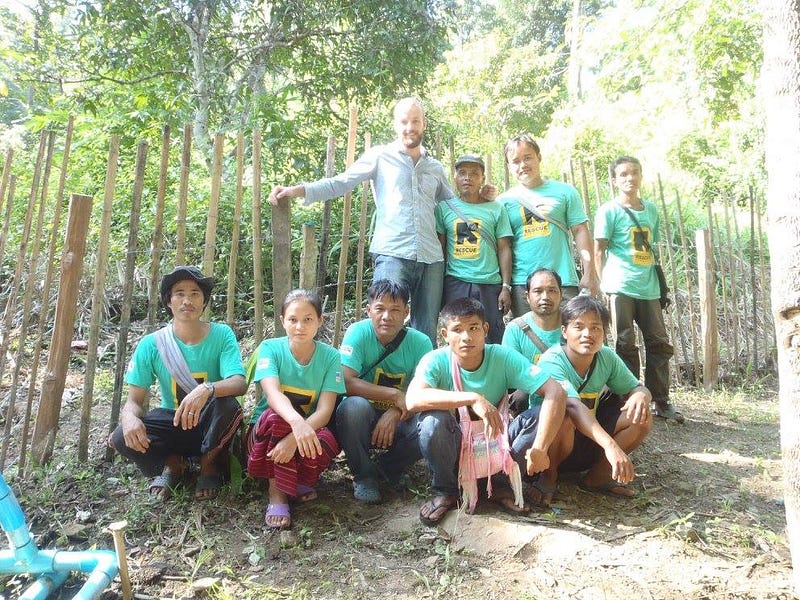
A local Thai who would turn out to be my private driver for the next days picked me up at the airport. He wore the t-shirt of the NGO where I was an intern. Funny to see this symbol on this side of the planet, I thought. While we drove into Mae Hong Son town I tried to teach him how to pronounce the name of the NGO, which is close to impossible for just about any non-native Dutch speaker.
Life within the town was comfortable for me. I enjoyed free accommodation, great food and having a private driver.
Coming straight from the airport the driver took me to the governor’s office, then to my hotel and then onwards to meet the local staff at the NGO’s local office.
The staff neatly lined up and both gave me a hand and a bow. I was treated with much respect.
I was about to enter a three-day program specially designed for me, an emissary from the Netherlands. An emissary from a far away NGO which had been providing funds for the projects in this region for over twenty years. It had been twenty years since a person from this NGO had visited Mae Hong Son, the staff told me.
Finally, I understood their position. My visit was a big event, even though I was an intern.
According to true Asian hospitality, the local staff didn’t leave me alone for a single minute. That night we ordered whole grilled fish, salads, chicken, rice, beers and much more. Although my Thai is still non-existent and their English -or their Dutch for that matter- was limited, we got a conversation going. The staff went to great lengths to give me a nice evening which I thoroughly enjoyed. But it didn’t feel right. It felt as if the staff used this opportunity to use the company’s money for a nice night out.
The next day started early. After a two hour drive we reached a gravel road turn off. I watched the houses and farms in the tropical heat whilst I was freezing in the airconditioned car.
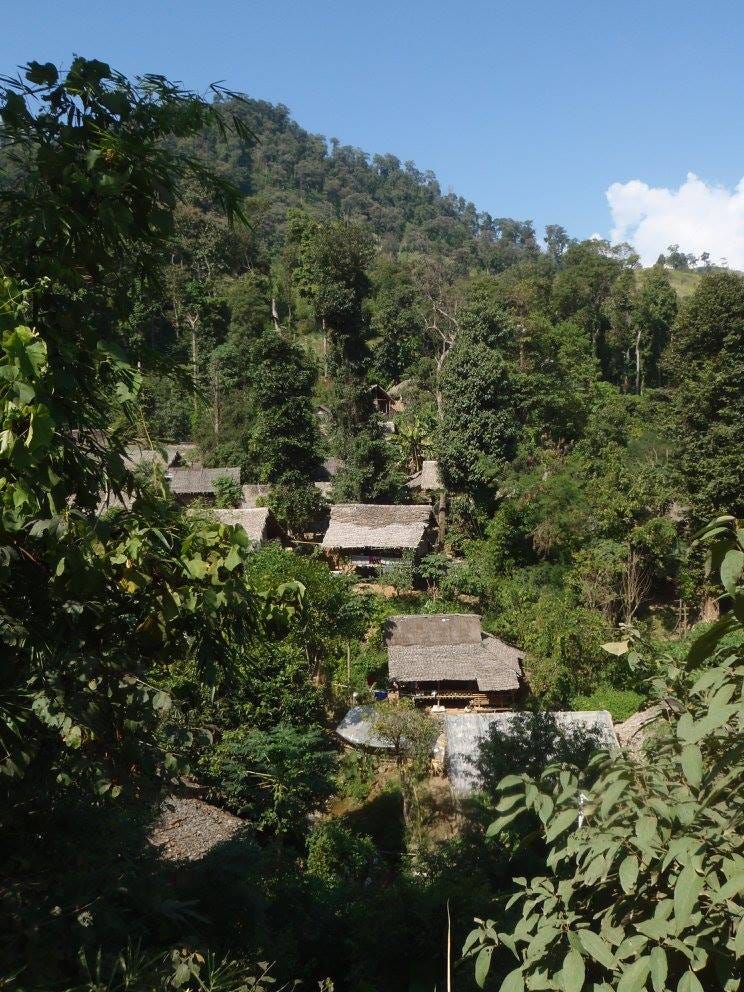
The utility poles disappeared. After another hour, reaching deeper into the jungle, the building material of the houses changed. The building material I had seen earlier like bricks, concrete and glass windows disappeared. The houses visible from the gravel road were built of what the local forest provided.
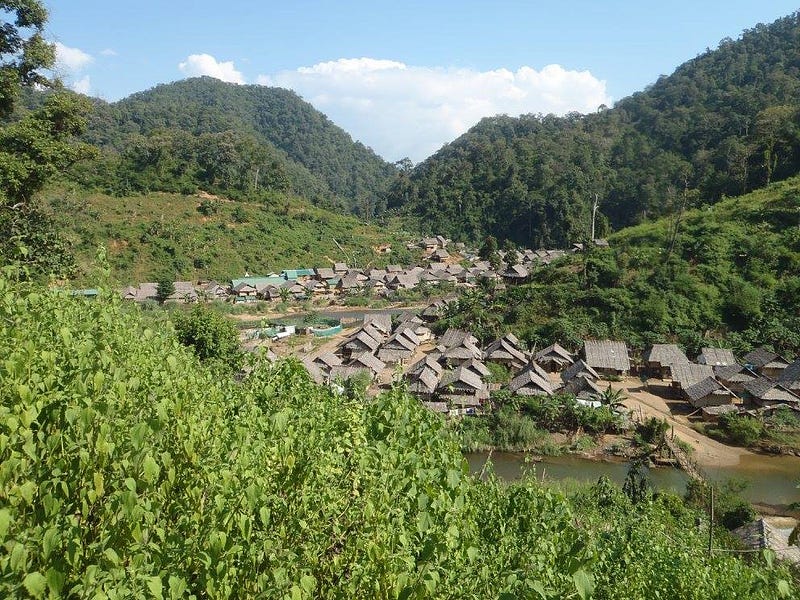
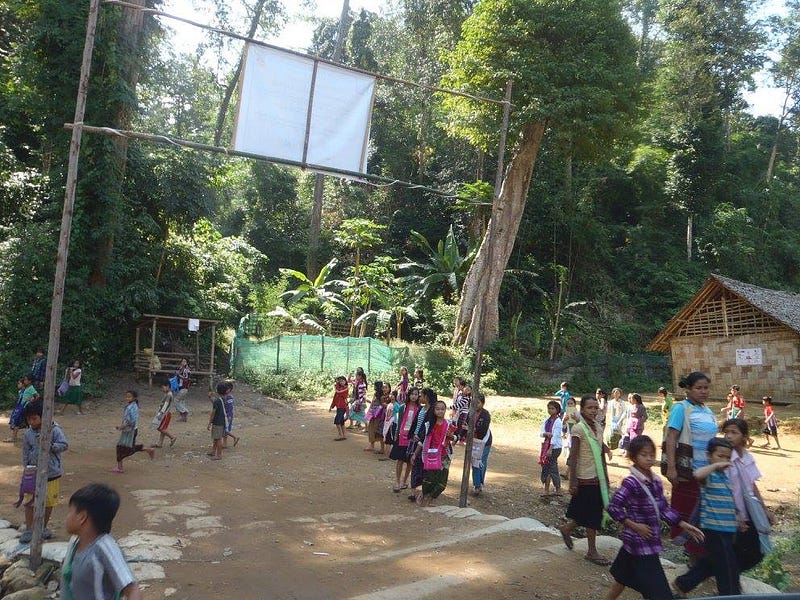
Once inside camp Mae Ra Moe, I was surprised by the level of sophistication and its established image. This little jungle town had been here for years.
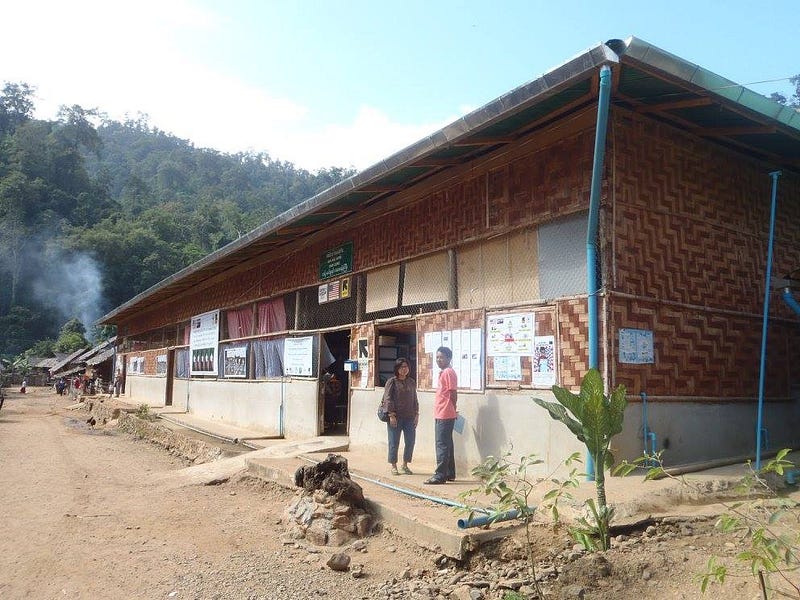
There were unpaved streets, sanitary infrastructure, houses not very different from the ones I’d seen from the gravel road, a school and a small hospital.
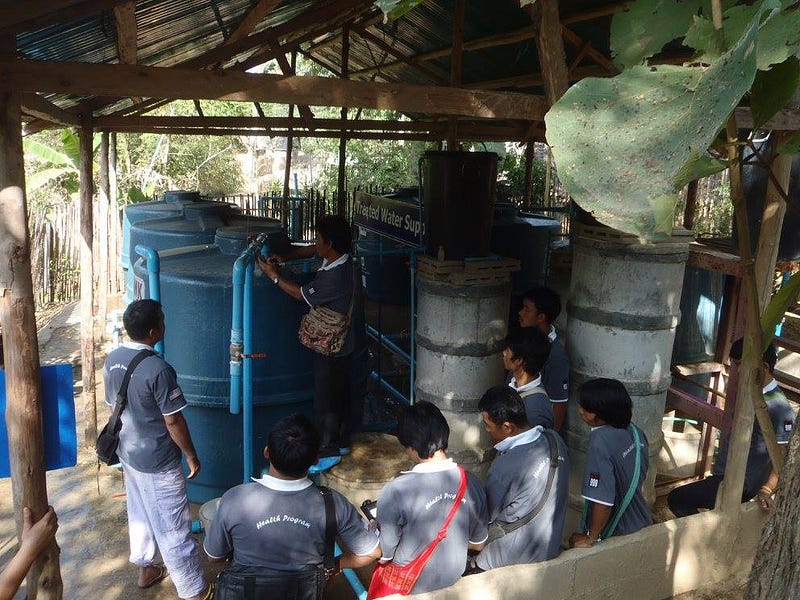
The staff running the camp showed the clean drinking water installation and the school. The medical clinic looked basic but decent. The tap water points were centralized and the refugees were able to cook at home over small campfires. The staff told me about how some Karen were able, after a long procedure, to receive a passport and leave for America, Australia and France.
I saw many young children being born and raised in the camp. I knew that the larger share did not possess any legal papers and thus they were not allowed to work. Early in the day, I saw a group of adult men leaving the camp. They were walking towards the rice paddies in front of the camp.
“Where are they going?” I asked Nu, my tour guide.
“They are going to work on the rice paddies”, Nu replied.
But they are not allowed to work, are they? I thought but kept the words to myself.
We spent three hours around the camp which ended at the garbage pit. The garbage was collected and dumped in a large pit just outside the camp. This clearly was the most efficient way of disposing of garbage.
My first visit to a refugee camp had not been that bad of an experience at all, I remember thinking going to bed that night.
The ride was twice as long as the day before. The gravel road wound through the jungle like a snake. This made campsite number two feel like a remote place. Ban Mae Surin was surrounded by green in all its different smells, sounds, shapes and sizes.
The program in Ban Mae Surin was like I had rehearsed this the day before. I saw the adult men leaving the camp to work.
The staff tried to tell me how terrible the situation was for the refugees. “They have no passports”, one said. “They have to cook over charcoal”, said the other. “Their drinking water is of poor quality”, said the next.
The staff showed me the school, medical clinic and the numbers and statistics of the people entering and leaving the camp, and I spoke some refugees who were learning English.
The third day I was taken to Mae Sot, the main town on the border between Thailand and Myanmar. The atmosphere was different from the rural north, Mae Sot was busier and more urbanized.
The Mae Tao Clinic in Mae Sot is open twenty-four seven and gives free medical healthcare to people coming from Myanmar. There were stories of people who had walked five days to get there.
The nurse showing me around had better stuff to do, I could tell. It was busy in the clinic. Here’s another guy from some far-away NGO who wants to see what we are doing, how we are doing it and where their money goes too. Here’s another person who is going to tell us how we can do things better is what she was thinking, I could tell.
The NGO industry and ex-pat community in Mae Sot was and is huge. I met several ex-pats living and working in Mae Sot. One Australian nurse invited me to a party organized by another NGO that night.
Hearing all these terrible stories of the refugees for three days did not get me in the mood. If you work in this field, I guess you’ll have to learn how to let it go.
I never went to that party.
On the flight back to Singapore I thought about my journey of the past four days. I met the governor of a province, refugees, local and international staff of different NGO’s and I spent three full days with Thai and Karen people. I still believe that providing healthcare and education for refugees is good. No matter what. This kind of work is incredibly important.
There is a difference however in providing first aid support and providing long term structural help. The big question is, when is someone a refugee? and when do we stop aiding a refugee? If you are born in a refugee camp, are you a refugee?
In my opinion, the second and third generations of Karen people living in the camps are not refugees.
What makes living in a camp hard is the fact that refugees do not know what the future holds. Are they allowed to leave the camp? Will they ever receive the status of full citizenship? The lack of stability in the refugees’ birth grounds excludes any chance of them returning home. The Karen and other ethnic people are officially not allowed to work or leave the camp. They are neither Burmese nor Thai. They are people without passports and no official identity. The vast sum of refugees in Thailand is stuck. The standard of living is low although I’d say it does not differ that much from the rural farmers living next to the camps.
T he visit to the governor -which was not on my schedule- who bluntly held his hand out for more money was shocking. I would not be surprised if the camps received so much help over the past decades that a fair share of the economy of the province of Mae Hong Son is dependent on the existing financial aid.
The chain is old, long and reaches deep.
The quality of the vehicles, the meals, the offices and material being used by the local staff were all in no proportion to how the refugees in the camps were living. All this money being sent over is meant for the people in the camps, right? The money stream is not there to make the lives of the office staff comfortable.
Yes, the history of the Karen is terrible. By that time I knew well about their history since I was studying it at the National University of Singapore. Seeing, feeling, hearing, even smelling this history and meeting the people behind the stories was an emotional experience.
But in a way, the refugees living inside the camp were better off compared to the Thai farmers living outside the camp. There is no air or sound pollution, food and water is provided for.
When a camp has been established for a longer period facilities for education and health care tend to be relatively good. The refugees have access to medical care, electricity, clean drinking water, education and they find work beyond the fences of the camp.
The Thai farmers in the rural area surrounding the camps have no access to any of these unless they pay for it. A garbage disposal service? Education? Learning English? No way the rural Thai farmer has access to it.
Imagine if the Karen refugee would have to return to the forests in Myanmar, they would have to provide for all these things themselves. The same goes for when the Thai government provides the Karen with a Thai passport. The lives the Karen live as a refugee is relatively comfortable.
Lastly the refugees are a perfect source of cheap labor for the Thai farmers. The Thai farmers don’t have to pay for insurance or other laborer rights. In case a refugee has an accident the hospital inside the refugee camp will take care of them. The medical costs will be paid for with money from an NGO like the one where I was an intern. The situation is mutually beneficial. What would happen to the rural Thai economy if the refugees move on?
Living in a camp where everything is provided for makes people lazy and dependent in the long run. A dog never leaves the house cause he knows he will get food from his owner.
The second and third generations living in the camps should be given incentives to start a new life. For they are strictly speaking not refugees anymore. Their parents are. The Thai government should allow the next generations to live within Thailand’s borders and allow them to create their own communities. Provide passports for the Karen and let them start a new life. A legal life.
As I reentered Singapore I understood that the support structure in place does and does not help at the same time. I understood why the governor of the province asked for money. I understood that the story marketed to me and the reality is not right.
“Eh, I’ll see what I can do”, was the best possible reply I could give the governor.
I wondered if maybe the local staff had set up the meeting with the governor since they too are strongly dependent on the constant flow of money.
So international NGO’s provide structural aid to provide 93.298 people with food, water, better hygiene, English education and healthcare. A portion of this works for the local Thai economy, illegally.
But what share of the 93.298 people is considered a refugee?
Shouldn’t we provide the local Thai farmer, who are present in much larger numbers and live in dire circumstances the same?
Thank you for reading this article. Ralph Deckers is a Dutch historian. He holds a BA in History and a MA in History of International Relations at the University of Amsterdam. Ralph has studied at the National University of Singapore. He’s been traveling and guiding for years and has explored over 65 countries. Due to the corona crisis his tour leading work evaporated and so he decided to start writing on Medium. He is recognized as a Top travel writer.