
TextBlob vs. VADER for Sentiment Analysis Using Python
A comparison of sentiment scores between TextBlob and VADER

TextBlob and VADER are two of the most widely used sentiment analysis Python libraries. Compared to machine learning approaches for sentiment analysis, TextBlob and VADER use a lexicon-based method. The lexicon approach has a mapping between words and sentiment, and the sentiment of a sentence is the aggregation of the sentiment of each term.
Lexicon sentiment analysis outputs a polarity score of -1 to 1, where -1 represents the highly negative sentiment, and 1 shows the highly positive sentiment. A value near 0 represents neutral sentiment.
A critical difference between TextBlob and VADER is that VADER is focused on social media. Therefore, VADER puts a lot of effort into identifying the sentiments of content that typically appear on social media, such as emojis, repetitive words, and punctuations (exclamation marks, for example).
In this article, we will compare the performance of TextBlob and VADER using sample sentences and see which one performs better!
Resources for this post:
Step 1: Import Libraries
First, we need to install the vaderSentiment package.
pip install vaderSentimentYou will see the output below after it was successfully installed. Note that your version might be different than mine.
Successfully installed vaderSentiment-3.3.2Now import the packages for VADER and TextBlob.
# Import the packages for sentiment analysis
from vaderSentiment.vaderSentiment import SentimentIntensityAnalyzer
from textblob import TextBlobStep 2: Define Functions for VADER and TextBlob
Let’s create functions for VADER and TextBlob separately, and this will help us code more efficiently later.
# VADER
vader_sentiment = SentimentIntensityAnalyzer()
def vader_sentiment_scores(text):
  score = vader_sentiment.polarity_scores(text)
  return score['compound']
# TextBlob
def textblob_sentiment_scores(text):
textblob_sentiment = TextBlob(text)
score = textblob_sentiment.sentiment.polarity
return scoreStep 3: Check Sentiment Difference
We get the sentiment score for a sentence using VADER and TextBlob separately. Both give us a positive sentiment score, and VADER has a higher value than TextBlob.
text = 'grabngoinfo.com is a fantastic website for step by step machine learning tutorials.'print(f"Sentence: {text} \nVADER sentiment score: {vader_sentiment_scores(text)} \nTextBlob sentiment score: {textblob_sentiment_scores(text)}")Output:
Sentence: grabngoinfo.com is a fantastic website for step by step machine learning tutorials.VADER sentiment score: 0.5574TextBlob sentiment score: 0.4Step 4: Check Impact of Capitalization
In this step, we use the same sentence. Just change the word “fantastic” to upper case. VADER considers the capitalized version to have stronger sentiment and increased the sentiment score. At the same time, TextBlob did not distinguish the sentiment between the upper and lower case version of the word.
text = 'grabngoinfo.com is a FANTASTIC website for step by step machine learning tutorials.'print(f"Sentence: {text} \nVADER sentiment score: {vader_sentiment_scores(text)} \nTextBlob sentiment score: {textblob_sentiment_scores(text)}")Output:
Sentence: grabngoinfo.com is a FANTASTIC website for step by step machine learning tutorials.VADER sentiment score: 0.6523TextBlob sentiment score: 0.4Step 5: Check Impact of Repeated Words
In this step, we repeated the word “FANTASTIC” three times to see if that impacts the sentiment score. As a result, VADER increased the score from 0.6523 to 0.9325. However, the TextBlob sentiment score barely increased. The results show that VADER considers repeated words to have stronger sentiment, and TextBlob does not account for the repeated words.
text = 'grabngoinfo.com is a FANTASTIC FANTASTIC FANTASTIC website for step by step machine learning tutorials.'print(f"Sentence: {text} \nVADER sentiment score: {vader_sentiment_scores(text)} \nTextBlob sentiment score: {textblob_sentiment_scores(text)}")Output:
Sentence: grabngoinfo.com is a FANTASTIC FANTASTIC FANTASTIC website for step by step machine learning tutorials.VADER sentiment score: 0.9325TextBlob sentiment score: 0.4000000000000001Step 6: Check Impact of Punctuation
In this step, we changed the punctuation from period to exclamation mark, and the sentiment score increased for both VADER and TextBlob.
text = 'grabngoinfo.com is a FANTASTIC FANTASTIC FANTASTIC website for step by step machine learning tutorials!'print(f"Sentence: {text} \nVADER sentiment score: {vader_sentiment_scores(text)} \nTextBlob sentiment score: {textblob_sentiment_scores(text)}")Output:
Sentence: grabngoinfo.com is a FANTASTIC FANTASTIC FANTASTIC website for step by step machine learning tutorials!VADER sentiment score: 0.9359TextBlob sentiment score: 0.43333333333333335Step 7: Check the Impact of Emojis
In this step, we added three emojis, a thumbs up, a star eyes, and a heart, at the end of the sentence. People use these three emojis usually when there is a positive sentiment. However, we can see that VADER’s sentiment score did not increase, and TextBlob’s sentiment score even decreased!
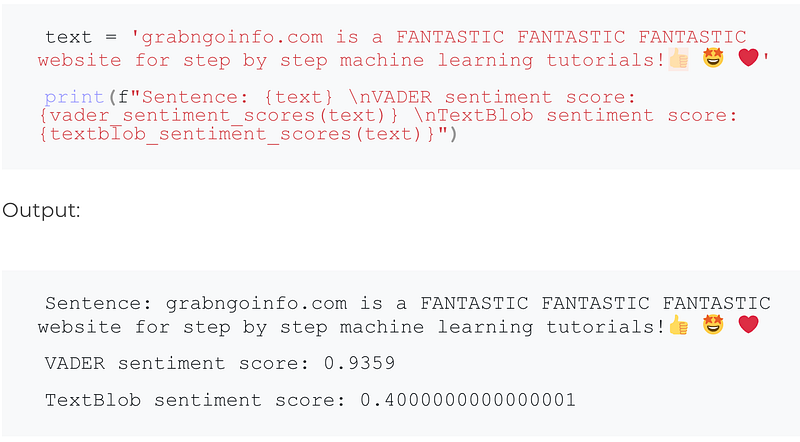
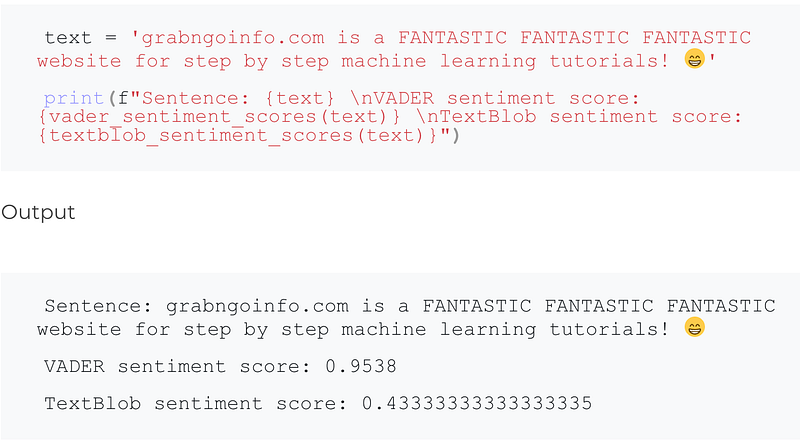
Now let’s try some smiley face emojis. It looks like Textblob did not change sentiment, and VADER increased the positive sentiment from 0.9359 to 0.9538.
Summary
Based on the comparison above, we can see that VADER provides more granular sentiment than TextBlob and takes capitalization, repeated words, and emoji into consideration when evaluating the sentiment of the text.
If you are interested in the video version of the tutorial, please check out the video below. Vist the GrabNGoInfo website or GrabNGoInfo YouTube Channel for more machine learning tutorials.
Recommended tutorials
- GrabNGoInfo Machine Learning Tutorials Inventory
- One-Class SVM For Anomaly Detection
- 3 Ways for Multiple Time Series Forecasting Using Prophet in Python
- Four Oversampling And Under-Sampling Methods For Imbalanced Classification Using Python
- Multivariate Time Series Forecasting with Seasonality and Holiday Effect Using Prophet in Python
- How to detect outliers | Data Science Interview Questions and Answers
- Time Series Anomaly Detection Using Prophet in Python
- How to Use R with Google Colab Notebook


