
Texas power-water coupled outages: What really happened?
Let’s use data to reveal the truth…
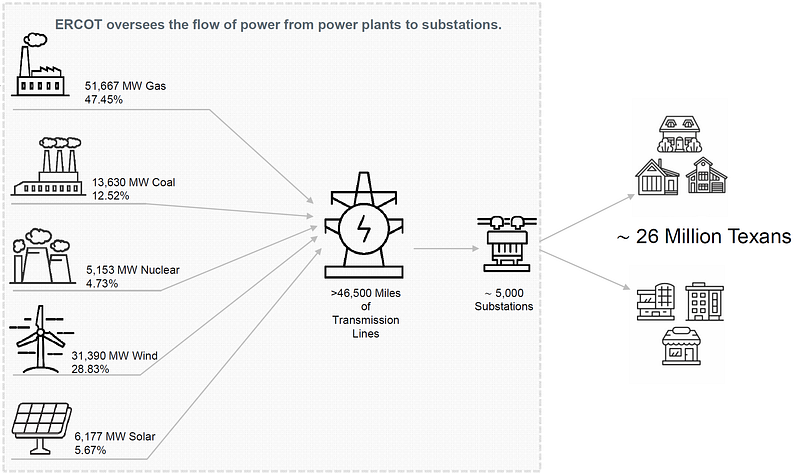
The day after Valentine’s day, Texas was less than 5 minutes from a black start — an indefinite blackout that could have lasted months. Thankfully this did not happen, but the 2021 Texas power crisis was a disaster, resulting in 70 people dead, and almost $200 billion in damages, making it the costliest disaster in Texas history. So what really happened?
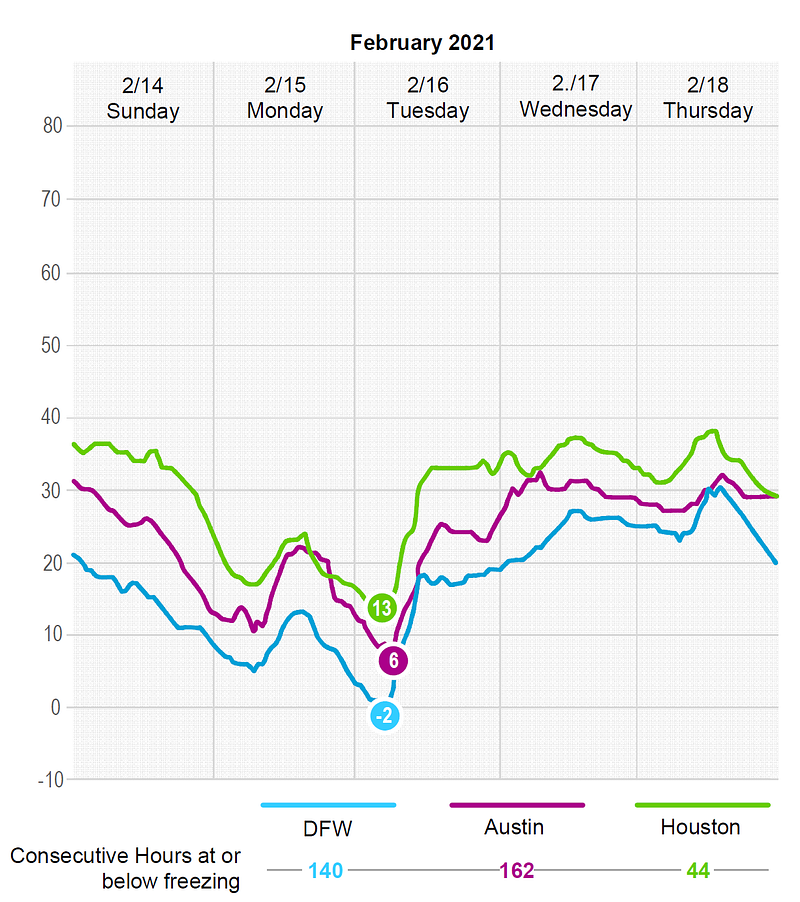
In the middle of February 2021, a series of winter storms swept across the United States. This resulted in record low temperatures and many cities in Texas were colder than Alaska for a brief moment! At the lowest point, Dallas was at -2 degrees, Austin at 6 degrees, and Houston at 13 degrees F.
Low Temperatures and Energy Infrastructure Failures
On February 14th, Texas started out with nearly 28,000 MW of lost electrical power capacity. A large part of this was due to Wind capacity loss (14,000 MW) and natural gas loss (12,000 MW), due to inadequately winterized wind turbines and natural gas equipment. As you can see, initially there was a larger loss of capacity from wind outages rather than natural gas, however that changed on the 15th.
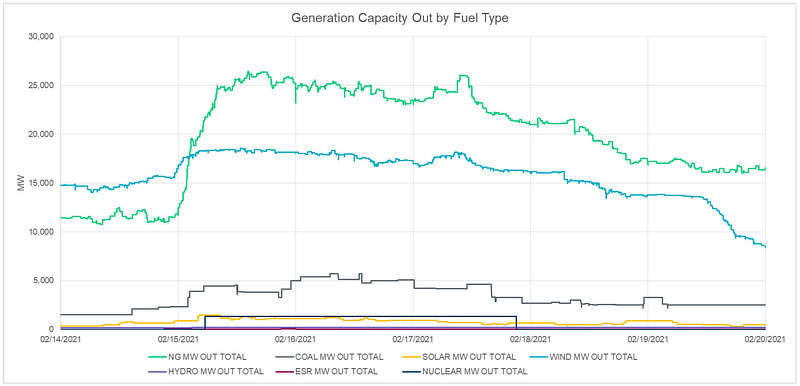
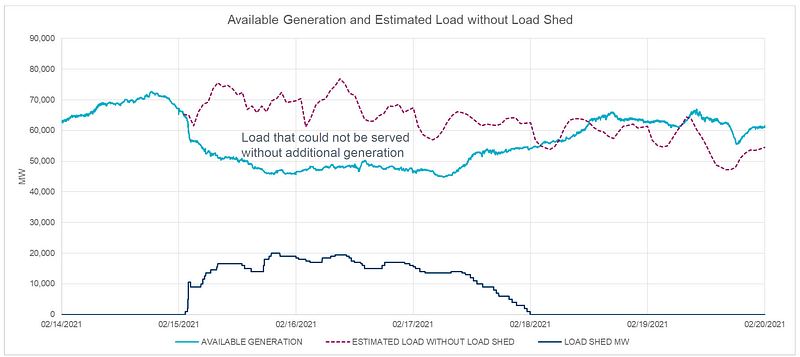
February 15th marked a particularly severe disruption of power. In particular, while the wind outages stayed fairly constant, natural gas outages doubled. The combination of decreased electrical power supply and increased demand due to the extreme cold weather conditions, led to electrical frequency imbalances that could only be resolved by immediate load shedding.
While you might know that electrical AC power has a frequency standard of 60 Hertz, there are fluctuations in frequency. In particular, imbalanced demand and supply lead to frequency imbalances. If demand is much higher than supply, electricity generators get bogged down, and frequency decreases. This can set off a chain reaction, with electrical generators performing improperly, leading to even more supply decrease, while demand remains high, and can ultimately lead to system collapse.
This is why utility companies set a cutoff frequency, below which load shedding is automatically triggered to reduce the demand on generators. This remains as a last resort to prevent total outage, although in itself can lead to significant loss of capacity. This frequency is set by ERCOT as 59.3 Hz. Accordingly, below 59.3 Hz, automatic load shedding would be triggered.
If a large part or the entire power grid is shut down, getting the power grid back up and running is quite a task. This is because power generators lack the electrical power to start up. Thus, a “black start” would involve providing external energy such as diesel powered generators, to get the grid up and running once again. The black start in itself is a considerable feat, especially in large power grids, and would involve first setting up power generation capacity in multiple islands, and synchronizing these islands.
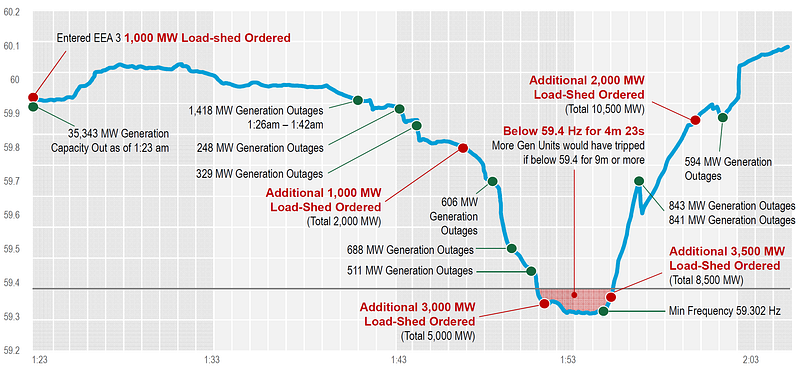
According to then ERCOT CEO Bill Magness, staying below a frequency of 59.4 Hz for more than 9 minutes could have triggered a blackout.
“We could not stay there long, we could not go lower, or we would have risked a blackout of the entire system…And that is the thing that we cannot allow to happen, because if we have a blackout of the system, the system is out for an indeterminate amount of time and it’s extraordinarily difficult to bring it back. We may still be here today talking about ‘When is the power going to come back on?’ if we had let the system get into that condition.” — ERCOT CEO Bill Magness, 2/24/2021.
With just 4 minutes and 37 seconds to spare, a potentially weeks long blackout was avoided, but still resulted in massive outages from load shedding. As a result of this, many parts of Texas were plunged into darkness. People faced hypothermia, and there were other cascading disruptions.
Cascading Water Outages
Just as the power was beginning to stabilize on Feb 18th, Texans started to experience water issues. A number of water pipes burst due to extremely low temperatures, and also because residents were concerned of potentially freezing water pipes because of lack of electric heating, and left their faucets on dripping. As a result, water pressures decreased below safe levels, and boiling advisories were issued.
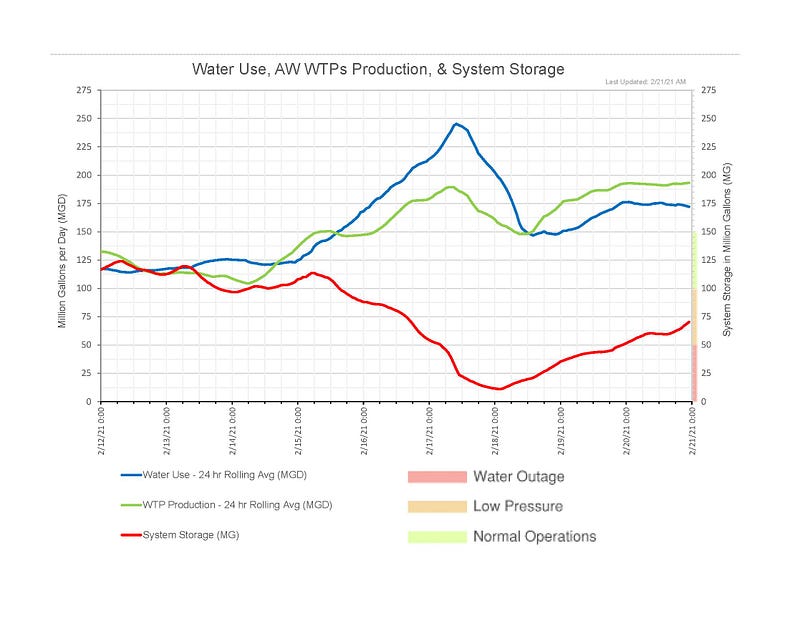
Finally, on Feb 21st, both water and power issues were resolved. But it took a while. First, power was out for half a week, followed by water out for the rest half of the week. While ERCOT is at fault for lack of power grid resilience, it provided detailed access to outage data, a valuable insight for future planners to understand what happened and how to make power grids more resilient in the future. However, no such dataset is readily available for the water issues. I had to search hard and far for the above graphic visualizing the disruption of system storage below the safe limit of 100 MG, and recovery of water pressure.

Mis/Dis — Information
Now let’s take the disinformation bull by it’s horns. House representative Dan Creshaw tweeted that the reason for Texas outages was because of wind energy.
Dan Creshaw’s statement is mostly false. Notice how I say mostly. This is because on February 14th, the large part of outages were wind related (14,000 MW), and natural gas a close second (12,000 MW). But on Feb 15th, there was a sudden increase in natural gas related outages, which quickly rose above wind related outages. Thus, it is quite conclusive that natural gas outages were the main cause of sudden decrease in electrical power supply, due to which frequency dropped, and ERCOT issued emergency load shedding orders, leading to large swathes of Texas without power.
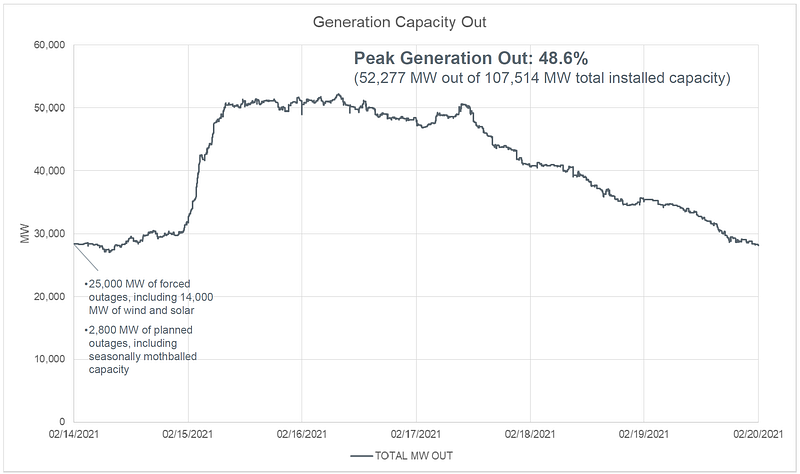
Another interesting aspect is the label on the ERCOT graphic, which states on February 14th, there was 25,000 MW of forced outages, including 14,000 MW of wind and solar outages. While that is true, the statement in itself might lead one to think that wind and solar formed the bulk of outages going into the Texas power crisis, when in reality it was wind and natural gas outages. Solar was just a miniscule fraction. That statement on the chart is quite perplexing.
Conclusions
Multiple factors led to the Texas power-water coupled disasters.
- Many parts of Texas faced historically cold temperatures the week of February 15th, and Texas infrastructures were clearly not prepared for such extremes
- Texas power generators were given the option to winterize, and not regulated to do so
- The Texas power grid is not connected with the rest of the U.S., thus it is wholly self reliant, and can’t borrow energy from neighboring states that might have excess energy generation. Interestingly, small parts of Texas like El Paso are part of the larger Western Interconnection consisting of multiple states. It did not experience outages for more than 10 minutes.
- Coupled societal infrastructures led to a power crisis becoming a water crisis, and a food crisis later in the week.
As a result of this, multiple ERCOT board members were fired. While ERCOT definitely takes the lions share of the blame, at least on the surface; they have come forward with open accessible data from outages, available to the public. However, there’s still a long way to go in understanding exactly what happened — which equipment failed, and how that progressed to societal disruptions over time. But the data from ERCOT is a good start.
On the other hand, while power grids are large interconnected networks with centralized managers like ERCOT, there is no central water utility network. Thus it is hard to know in a similar vein as the power outages, where and how water outages occurred. Going forward, it is also important to know the impacts on other essential services and goods — such as food shortages due to grocery stores unable to store and distribute food without electricity.
Hopefully, with increased access to various data sources during disasters, complex societal interconnections and perturbations during disruptions can be revealed. Ultimately, this could help inform how to build future resilient societies.
Follow me if you liked this article — I frequently write at the interface of complex systems, physics, data science, and society
References:
- https://www.texastribune.org/2021/02/18/texas-power-outages-ercot/
- https://www.youtube.com/watch?v=08mwXICY4JM
- https://ieeexplore.ieee.org/document/5697619
- http://www.ercot.com/content/wcm/lists/144927/Inertia_Basic_Concepts_Impacts_On_ERCOT_v0.pdf
- http://www.ercot.com/content/gridinfo/etts/keydocs/System_Inertial_Frequency_Response_Estimation_and_Impact_of_.pdf
- http://www.ercot.com/news/february2021


