
Tether-$USDT vs Coinbase-$USDC: THE STABLECOIN WARS BEGIN!
Awaiting The Fallout Amidst A Devastating Crypto Winter
Crypto received several ferocious blows in 2022.
Shocking events of a magnitude never witnessed before. Back in 2013, it was just MtGox. In 2017, the cryptocurrency field witnessed the Bitconnect Ponzi implosion, exchange hacks, and ICO scams, but it was all just a drop in the ocean compared to the 2022 experience.
So far, several multiple-billion-dollar crypto companies and projects have collapsed.
Terra Luna, UST, Celsius, BlockFi, and FTX collapsed, dragging the market into an unending downward spiral.
These crypto companies maintained vast cryptocurrency resources, that will soon be liquidated as these businesses declared bankruptcy, adding fears for a further decline in cryptocurrency prices.
Two crypto superpowers are now officially at war with each other, a war with multiple side parameters.
The crypto market is as wild as ever. While timing matters, and perhaps in 2023 we should expect a recovery, a cold war is turning into a hot one between two powerful factions of the crypto “industry”, the two main stablecoins, Tether (USDT) and USDC.

Coinbase Pulls The Trigger On $USDT
Coinbase announced what appears will be the beginning of the delisting procedure of Tether ($USDT) from one of the top cryptocurrency exchanges.
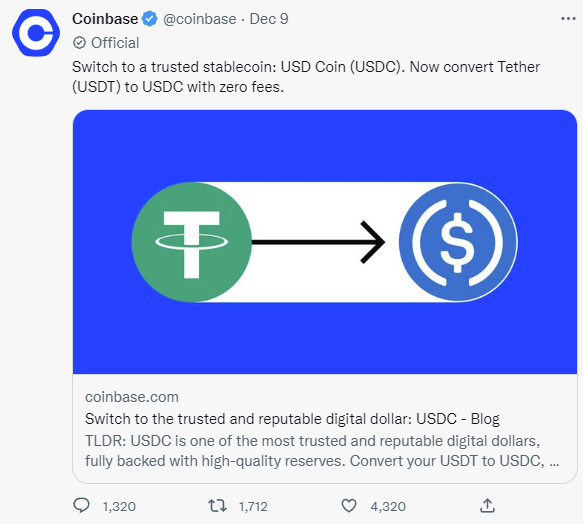
Coinbase informed the users of the exchange, that it enabled the global conversion of USDT into USDC for no commission fees.
Since the beginning of 2022, USDC has reduced its total supply by $13 Billion, especially after the delisting of USDC from Binance, a competitive exchange that promoted its stablecoin BUSD (note: BUSD is not listed at Coinbase either).
Center is the consortium founded by Coinbase and Circle that launched and operates stablecoin USDC.
USDT and USDC Shrunk By A Combined $30 Billion
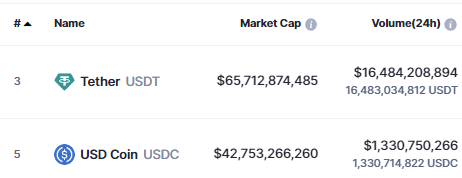
The 3rd (USDT) and the 5th (USDC) cryptocurrencies (according to market capitalization) engage in the first direct confrontation, which apparently will reshape the cryptocurrency foundations.
These two assets combined control more than $110 Billion in market cap, presenting significant influence and being backed (besides their reserves) by long-established exchanges (Coinbase and Bitfinex).
Both stablecoins reduced the tokens in circulation since the trading volumes dropped, and an outflux of funds summarizes the last year in the cryptocurrency markets.
Every cryptocurrency-related business and network shrinks in volume and userbase during the bear market. Donations and expenses limit to the bare minimum, and market caps decrease significantly.
USDT tokens in circulation:
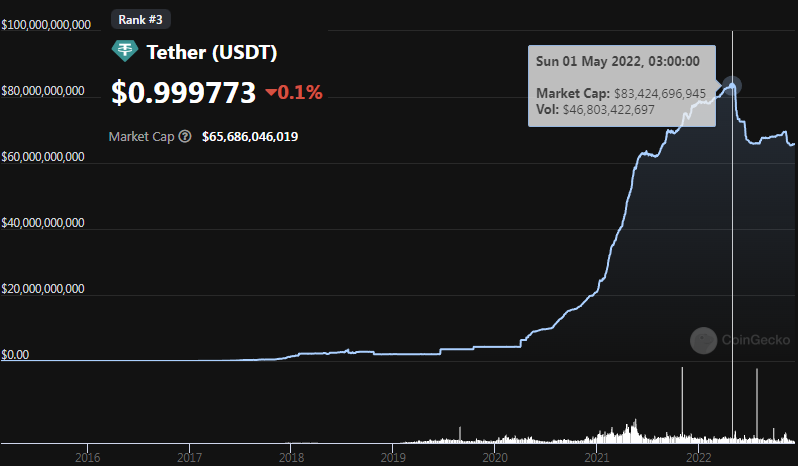
During 2022, Tether ($USDT) “burned” (removed from circulation, or “redeemed”) $18 Billion USDT and from the all-time high of $83 billion, it now sustains $65 Billion worth of USDT tokens.
In more than one month Tether processed 16B in redemptions (~19% of our total reserves)
Paolo Ardoino (Source), June 27th, 2022
USDC tokens in circulation:
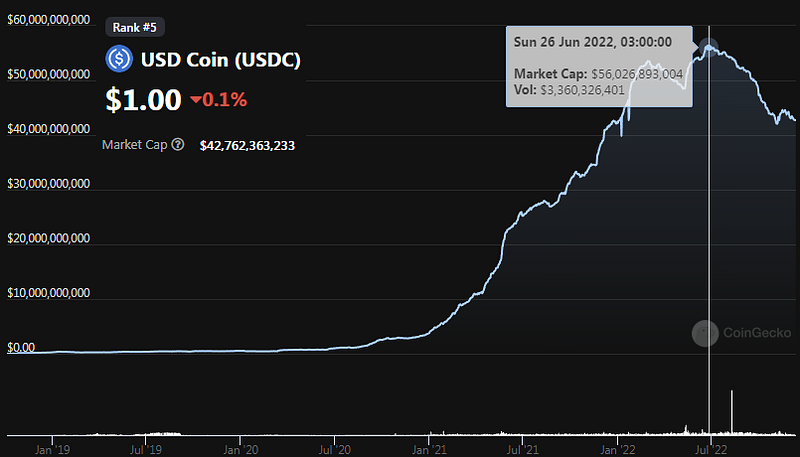
During the same period, USDC had to reduce its supply of tokens by $13 billion (from $56 Billion down to $43 Billion).
Circle estimates that USDC’s circulation nosedived by $3 billion in response to Binance’s move. The total decline was $8.3 billion QoQ and Circle cited the collapse of large crypto businesses such as FTX, Voyager Digital and Celsius, as well as higher interest rates as the leading cause of the drop.
(Source: FXStreet, September 12th,2022)
Both stablecoins appear to be in decline, as their primary function is to facilitate trading in exchanges, and trading volumes decline rapidly.
Coinbase Dealing With Its 3rd Bear Market
After the FTX incident and the supposed proof of reserves by certain exchanges (Binance, Kucoin, Bitfinex), Changpeng Zhao (CZ, Binance CEO) questioned Coinbase reserves (source).

Brian Armstrong (Coinbase CEO) responded to this Tweet calling it FUD, with CZ deleting it, but its meaning remains at a time when all trust is lost in a fiercely competitive environment between the remaining participants.
The stock of Coinbase is down by a whopping 87% since the 2021 heights, and the $COIN stock presents a negative outlook after various investment banks (Goldman Sachs, Bank Of America, Mizuho-Japan) downgraded in recent months, with some banks fearing contagion risk from the FTX collapse.
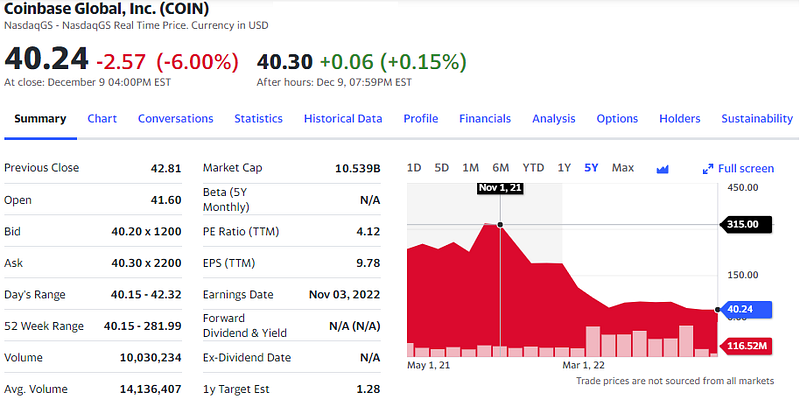
The stock price of Coinbase ($COIN) follows the profitability decline of the cryptocurrency exchange, with Coinbase reporting losses (EBITDA) in Q2 and Q3 2022.
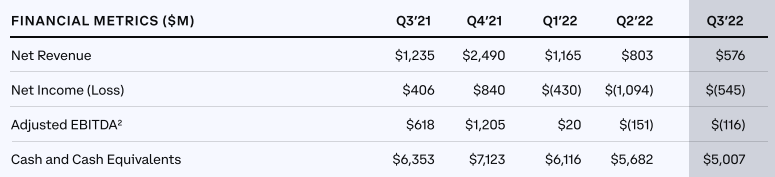
Coinbase proceeded in June to lay off 18% of its global workforce as part of preparations for a lengthy “crypto winter”.
Similarly to Coinbase, other crypto company stocks meet equivalent trajectories, facing volatility from the underlying assets they invested in.
Michael Saylor’s Microstrategy stock dropped 80% since its all-time high in January 2021.
The success of Coinbase and every crypto exchange relies on cryptocurrency adoption. However, it is an anecdote why these exchanges don’t support cryptocurrencies that push towards P2P adoption, yet experiment instead with credit/debit cards and financial tools of the legacy establishment.
The future is still decentralized, but crypto exchanges have not even performed the bare minimum to serve the adoption of cryptocurrency as permissionless digital cash. All these for-profit companies make this future seem far, far away with the course of action they selected.
Without a steady and organic adoption and promotion of cryptocurrency communities that work towards merchant and business adoption, most cryptocurrency exchanges and crypto companies only aim to freeload from the temporary success of the boom cycles.
The Reception Of The Coinbase Announcement




This group of (popular) supporters of Bitcoin (BTC), known as the “Bitcoin maximalists”, seems firmly inclined to support the centralized token USDT, in a hypocritical approach, to the maximalists’ ambiguous comments regarding any other innovation in the cryptocurrency field.
Time and again, the BTC-related influencers side with Tether (USDT). However, both stablecoins (USDT and USDC) are centralized tokens backed by fiat currency per claims of the respective companies that manage and control their circulation.
The maximalists’ support of Tether (USDT) originates in the sponsoring Blockstream by iFinex (the parent company of Tether and Bitfinex). Blockstream, a for-profit company that promoted sidechains as a scaling solution for Bitcoin, was created by several Bitcoin Core developers in 2012, and many suggest this company is the force controlling Bitcoin (BTC) developments.
These Bitcoin-related social media influencers disapproved and taunted Coinbase over its decision while taking the side of Tether (UDST) in this dispute.
Attestations, Audits, And “Bitcoin’s Ticking Time Bomb”
Coinbase has had its share of controversies (inside trading of an executive, the purchase of a spyware company), although Tether appears to be the top unprofessional hazard of the crypto industry, having strong support and ties (funding) with Blockstream and several BTC traders/maximalists.
We shouldn’t forget Vitalik Buterin’s (Ethereum founder) interview, calling Tether a ticking time bomb for Bitcoin.
Just as Tether USDT, Circles USDC is a centralized stablecoin, a token that according to Circle that manages it, it is backed 1:1 with dollars in cash and U.S treasuries.
Attestations:
Both Tether USDT and USDC deliver attestations by credible auditing firms, with USDC having hired Grant Thornton LLP and USDT employing BDO Italia, with one difference being that USDC delivers an attestation every month while Tether once every quarter.
Both these reports certify the reserves backing the underlying stablecoin for the stablecoins (USDT and USDC) only for the selected day the attestation occurs.
Audits:
USDC via Circle delivers a full annual audit which it publicly files on the SEC (link here), producing transparency under accepted accounting standards. The accounting firm (Grant Thornton) audits USDC as part of Circle’s treasury.
Meanwhile, Tether USDT has never performed a full audit, and the one time it hired an auditing firm to deliver one in 2018, it canceled the procedure confirming critics’ suspicions.
We shouldn’t confuse Tether USDT and USD Coin (USDT) with community-driven decentralized networks (blockchains) operating in an autonomous or semi-autonomous approach.
Both these stablecoins present a centralized entity with multi-billions of dollars of reserves, with the ability to control tokens in circulation and freeze funds at will (in exchanges or addresses).
In Conclusion
Trust is of paramount importance regarding centralized tokens like stablecoins, yet, Bitcoin was created to remove trust, and the multiple trusted third parties from the payments equation.
However, part (or the whole) of the Bitcoin (BTC) fanbase followed the speculative path, which aligns with the proposition of Blockstream executives, a company Tether also sponsors.
The ultimate goal for all these people is to assist BTC’s price by any means possible, even if this is centralized stablecoins backed by imaginary reserves.
The reason all digital attempts before Bitcoin failed was centralization. There is no side to take when two private companies wage war on each other. Except for those influencers that use social media as an income source, the rest of us are observing the escalation of events from a neutral standpoint.
The only significant point to make is cryptocurrency versus centralization. The legacy financial establishment versus permissionless P2P electronic cash.
Certainly, USDC appears to be regulated and trustworthy, while USDT seems like a mess operating on an excel spreadsheet.
Still, they are both stablecoins pegged to the US dollar, thus they are bound to face systemic collapse.
Perhaps the management of both stablecoins has performed risk assessment and realized how Facebook was not allowed to produce a similar stablecoin in 2019 and 2020.
Cryptocurrency will survive with or without Tether or Coinbase. Having an unbiased opinion on the Stablecoin Wars is the best choice possible.
- Cover Picture (background) on Pixabay
Disclaimer
External content published in this article is used for research and educational purposes and falls within the guidelines of fair use. No copyright infringement intended. If you are, or represent, the copyright owner of images used in this article, and have an issue with the use of said material, please notify me.
References
- Crypto exchange war: Binance questions Coinbase reserves
- Coinbase and Binance pick sides in stablecoin wars
- Coinbase CEO reaffirms exchange’s BTC holdings after CZ’s tweet
- Tether Confirms Its Relationship With Auditor Has ‘Dissolved’
- Switch to the trusted and reputable digital dollar: USDC
Also Read:
Platforms:
● read.cash ● noise.cash ● noise.app ● Medium ● Hive ● Steemit ●Vocal ● Minds ● Publish0x ● Twitter ● CashRain
Also visit my second Medium profile: Ex Cathedra and delve into the unknown!
Medium Membership:
Your membership fee directly supports Pantera and other writers you read. You’ll also get full access to every story on Medium:
Don’t forget to Subscribe and Like if you enjoyed this article!


