
Astrophysics
Testing the idea that mathematics created our universe (# 19)

This and the next thirteen articles outline ideas about testing the proposition that the primary source of our universe is geometry. The following points briefly summarize the content in the subsequent twelve articles.
- The starting point is a mathematical model developed by Professor Leonard Susskind of Stanford University to describe what happens inside a black hole in the Anti-de Sitter (AdS) space. His model extends research by Michael Neilson into ‘The Geometry of Quantum Computation’. Susskind’s model contains two equations describing what happens inside a black hole. The interior of a black hole contains boundaries where the contents of the black hole are displayed in one less dimension. Susskind’s equations need to be transformed to describe events in a boundary, i.e. what happens in one less dimension. The transformation of Susskind’s first equation leads to an explanation for dark energy. This explanation for dark energy raises the issue of the nature of time. It is argued that time is not a scalar variable but is associated with a force that is a source of torsion in space.
- Applying Susskind’s first equation to our universe raises the question of our universe’s computational capacity. When our universe behaves as if it were a quantum computer, related issues are whether the information is a form of matter and whether instantiating information in matter increases its mass.
- The idea that our universe consists of information is supported by indirect evidence that the divergence in the velocity of a star from that predicted by Newton’s inverse square law can be reasonably accurately ‘explained’ by the divergence in the velocity of a neighboring star. The underlying theory is that the fabric of space is more like memory foam rather than Einstein’s rubber sheet. The fabric of space retains a memory of what has been in that space before.
- Transformation of Susskind’s second equation, Kolmogorov complexity, along with the idea that our universe is some kind of quantum computer leads to a modification of Newton’s Law of Gravity; this transformed equation provides a new explanation for the existence of dark matter. In this explanation, dark matter is information.
- The dark matter hypothesis was originally conceived to explain the velocities of galaxy clusters and the velocities of stars in galaxies. The new equation for gravity based on Kolmogorov complexity is tested using the information on the velocities of 2,683 stars in 161 galaxies.
- Additional evidence about the predictive performance of the Kolmogorov equation comes from applying the equation to our Sun’s apparent contribution to dark matter. This equation may also explain the force of gravity on Earth.
- Cool hydrogen gas is a suitable medium for instantiating information. The temperature of hydrogen gas is very hot and ionized close to the center of a galaxy. At more than 2 kiloparsecs from the center, however, molecules of hydrogen gas can stay positively or negatively charged for long periods. Information is instantiated in hydrogen gas through the charge of a molecule. Negatively charged molecules have negative mass and repel other molecules. Dark matter reflects the relative density of positively and negatively charged molecules.
- The possibility that our universe was created rather than coming out of ‘nothing’, means super-determinism could be an explanation for quantum features such as entanglement i.e. all possible future states of the universe were set at the moment our universe was created. Super-determinism, however, does not mean we do not have free will. The intensity of the emotions we experience as watchers of events in a universe can determine which time path our universe follows.
- Susskind’s research about extracting selective information to be instantiated in a black hole provides the basis for considering the idea that each of us is being ‘field-tested’ for our suitability to inhabit a different universe. Our world is currently experiencing several crises including climate change. Based on the idea that the velocities of gases circulating a solid mass are linked to information, we may be able to develop a process that changes the information in the space around Earth i.e. a process that causes greenhouse gases to move into higher orbits. When the density of gases is reduced, the greenhouse gas effect could be temporarily lessened until societies stop burning fossil fuels.
Newton’s Law of Gravity
Science has not explained why the force of gravity varies inversely as the square of the distance between two objects. Einstein’s Theory of General Relativity argued that gravity was not a force but curvature in space linked to the mass of an object. Einstein assumed, rather than derived, the curvature as being the square of the distance between two masses.
In the following articles, it will be argued that the inverse square law is an outcome of the interior of an AdS black hole experiencing increases in quantum computational complexity. Our universe is described by how the content inside a black hole is displayed in the boundary. Content in a boundary of AdS space could be organized so that our universe appears to be in De-Sitter space.
The research by Leonard Susskind was concerned with investigating quantum computational complexity. Susskind has not suggested that his research explains the origin of Newton’s inverse square law for gravity. He was demonstrating theoretically how quantum information in a black hole might be communicated to another black hole through a wormhole in AdS space.
The proposed theoretical explanation for the existence of Newton’s inverse square law provides some guidance as to how Newton’s equation for gravity needs to be modified when dealing with long-lived matter such as stars and galaxies.
Velocities of stellar objects
Dark matter was ‘discovered’ when astronomers concluded some galaxies and stars were moving quicker than Newton’s law of gravity predicted. Cosmologists argued that the best explanation for the anomalous velocities was the presence of something they called dark matter. Cosmologists, however, have not yet been able to identify the constituents of this dark matter.
The theory developed in these articles is that Newton’s equation needs to be modified to take into account the age of the stars and galaxies, the temperatures of the stars, as well as the history of star movements relative to the center of their galaxies i.e. expansion of space due to dark energy.
All the necessary information is not readily available to someone who has not been trained in cosmology. Formal testing of the theory has not been possible. The ideas presented are a simplified version of what could happen during the lifetime of a star. More sophisticated empirical analyses could lead to modifications of the equations.
A preliminary conclusion arising from the theoretical analysis is that ‘dark matter’ is information instantiated in the mass of galaxies. Dark matter, however, is now an integral part of the explanation of how our universe has evolved since the Big Bang. More research may be required to understand the evolution of our universe when dark matter is information related to movements of baryonic mass rather than some type of non-baryonic mass.
Dark energy, Big Bang, and cosmological inflation
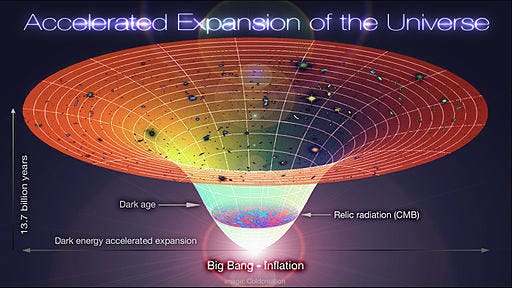

Susskind’s first equation may be interpreted as describing features that are currently explained by dark energy, namely the existence of a negative force. Our universe, however, is expanding not because there is some negative force but because the quantum computational complexity of a black hole is expanding.
The origin and evolution of our universe might be explained by the creation of two entangled black holes in a boundary in AdS space. These quantum entangled black holes create a wormhole. The creation of a wormhole may be analogous to an explosion i.e. the Big Bang at the start of our universe. The wormhole quickly achieves thermodynamic equilibrium. The short period required to achieve thermodynamic equilibrium is the period of cosmic inflation that cosmologists suggest happened at the time of the Big Bang.
Each of the two black holes would be seeded with information that could explain features in our universe such as a slight imbalance between matter and antimatter.
New universes
Susskind’s research explains how information inside a wormhole could be separated into at least two different ‘bags’. One bag of information could be extracted and put into a different black hole. Information in such a bag would not be entangled with the rest of the information in the wormhole. A new universe could be created that consists of only extracted information.
Susskind’s idea of creating a wormhole to create a bag of information uncorrelated with other information resembles Plato’s idea about creating a just society consisting of certain types of people.
An objective of our creator universe is to explore possibilities that are still to be manifested. There is no single objective truth out of which everything emerges. There are possibly an infinite number of set-theoretic universes. Each set-theoretic universe could explore the implications of different collections of truths.
As Plato is one of the most influential philosophers in Western Civilization, these articles reflect one of his primary concerns: creating a just society. This interpretation is not meant to imply there are no alternative ideas worth exploring. The aim is to use Plato’s idea of a just society as a basis for identifying a possible driving force to explain the evolution of society.
The question for this article is:
Is there an underlying purpose behind the evolution of society?
To view the headings of all the articles to be published in this series please click on https://readmedium.com/orbiting-stars-and-origin-of-our-universe-338906930f51
To obtain a copy of the book ‘Orbiting Stars’ which contains the first drafts of all these articles, please visit https://www.amazon.com