
Testimonies of Horror: the Ukrainian Famine of 1932–33
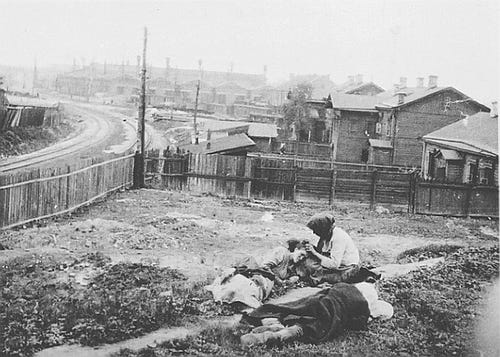
Millions died in the Ukrainian Famine of 1932–33. Although it happened within living memory in a European country, estimates of the death toll vary hugely — between 3 and 20 million people. As with Coronavirus, definitive deaths turn out to be difficult to count. Records were not consistently kept. Many died of starvation, others of related diseases. Still more fled the region or emigrated abroad. The birth rate was affected.
The Holodomor, as the famine is now named, from the Ukrainian word for ‘hunger’, was artificially created. Stalin’s grand and brutal vision to rapidly industrialise the USSR meant a harsh programme of forced collectivisation in rural Ukraine. People were to be replaced by tractors. Crops would be centrally collected and redistributed. Private land was confiscated and managed by Communist Party officials. Displaced agricultural workers sought employment in the growing industrial centres, building factories, railways, bridges.
Stalin’s Gold
Ukraine, with its vast, fertile plains was always a target for invaders, from Genghis Khan to Napoleon. Its brief period of nationalist independence, following the Bolshevik Revolution in 1917 had been quickly suppressed. Over the decade and a half between then and the Holodomor, the Soviet Government systematically centralised its control of Ukrainian agriculture. High taxes were imposed. Failure to pay would lead to confiscation of property. When there was no property left, they took grain. Merciless officials, assisted by armed soldiers, entering villages and homes. They even took the grain seeds needed to sow the crops for the following year.
Western Europe, more preoccupied in 1933 by the rise of Hitler, was deliberately misinformed. There was no public outcry, no intervention. The famine was officially denied by the Soviet Union, right up to its dissolution in 1991.
The 2019 film Mr Jones tells the story of Gareth Jones, a Welshman who journeyed to Ukraine in 1933. A dogged investigative journalist, who had already achieved some success after a personal interview with Hitler, he sought to repeat the exercise by interviewing Stalin. Jones knew that the Soviet Union was investing massively, building railways, bridges, factories, offices and homes all over its vast territories. He had a simple question: where was the money coming from? After wangling his way into a formal invitation to Moscow, he heard talk of ‘Stalin’s gold’. This gold turned out to be grain from Ukraine, exported all over the world to generate hard currency. Jones managed to get permission to go and see for himself, albeit travelling with an official ‘minder’. Soon, he gave him the slip, and boarded a different, less salubrious train.
The film shows him sitting on a crowded bench in a train carriage, with a crowd of silent peasants. He carelessly discards his orange peel into the stove, to watch incredulously as someone seized and devoured it. He bartered a piece of bread for a warm overcoat — the offer of money was rejected. We watch as realisation dawns on Jones. Next, he is at a grain depot, where grim-faced workers are guarded by armed police. His questions arouse their suspicions and he is pursued at gunpoint, running, then trudging for hours or days through bleak, snow-covered landscapes. The villages are empty except for a few dying people, barrows laden with corpses. He is followed by a pathetic group of children singing a haunting folk song about hunger and cold.
When Jones eventually returned to London, after his arrest and deportation, he struggled to publicise his findings. A different version of events was being circulated. The Pulitzer prize-winning Walter Durranty was chief Moscow correspondent for the New York Times. He, much better known than Jones, wrote a counter-article saying that Russian people were hungry, but not starving. Others, more gullible to Stalin’s propaganda or more corruptible, also published articles supporting Durranty. Jones was not believed. Shortly afterwards, he travelled to Mongolia where he was mysteriously kidnapped and died in 1935.
At the same time as Gareth Jones was visiting villages in the area around Donetsk, Jerry Berman, a young South African engineer, was employed not far away. Working on a major building project at Stanitza Lugansk, he was close to some of the worst affected areas of Ukraine and saw at first-hand the devastating conditions in which Ukrainians lived and worked. Berman arrived in Ukraine in 1932, where he was employed under Stalin’s first Five Year Plan on a large engineering project. Most of the unskilled workforce came from the rural hinterland, largely unskilled and driven ruthlessly to build — to build faster, bigger and better than was possible. Drawn there in search of work and food, these people were close to starvation. Berman, a skilled engineer and manager, was responsible at times for ensuring a supply of food and for signing off the ‘cards’ they were issued each day to collect their meagre bread ration: a role he found deeply stressful.
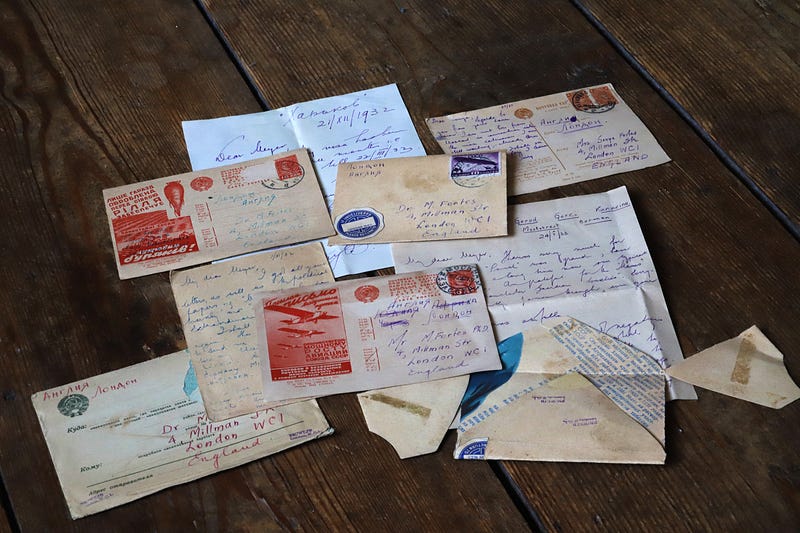
Berman and my grandfather had been close friends and mountaineering buddies at the University of Cape Town in South Africa. In the early 1930s, my grandparents lived in London and they would send him regular packages of the Manchester Guardian, the Economist and books, receiving in return long detailed letters from Berman. “What a pity that you see this world here through rosy glasses of your press, that you never know the truth”, he wrote on 14th January 1933.
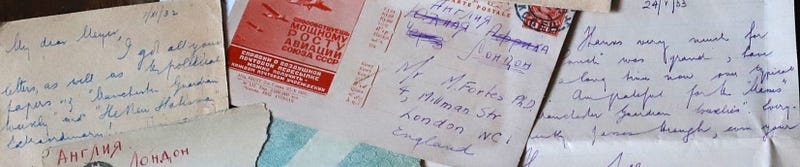
The conditions he observed were shocking. Berman wrote on 2nd February 1933 “This is the 4th day without a grain of bread. We none [of us] got it… It is cold. My best horse died today from meningitis. Two more are ill. How much longer?”
Bread and work
Working overnight on site one day, he and his team took shelter in a barn.
“I lived through the night. Till 3 am I walked up and down, then lay on the floor and shivered and, never mind frozen feet, lay on and on. I think I slept too. So that is how Russian workmen live and grumble not! No man under the whole universe would bear it! They did not undress and did not say a word. They assembled round each of the two stoves and dozed. Quiet, painfully quiet. They told one another tales, so beautifully naïve, much like Turgenev’s A Sportsman’s Sketches. They took off their woollen boots to dry them. Not one of them had a sock or sign of a stocking — half dirty, white rags around the feet…They speak very little, they never part from one another, they eat, drink the sauce!”
Half of their bread rations had been stolen. They were each given just one slice of bread, which was frozen and glistening with icicles. Berman described how he, like they, ate it with alacrity, washed down with a single cup of hot water.
Berman was no stranger to challenging conditions. Before working in Russia he had been employed at a large railway project in the underdeveloped Orange Free State of South Africa. That project, too, was massively behind schedule and undertaken by impoverished, poorly fed workers, in adverse weather conditions (“24 days of rains!”). But he had never seen anything quite like this, where he witnessed men scavenging for scraps to feed their families.
“The scenes at the stolovaia [canteen], of workmen digging potato peel in rubbish heaps. Workmen of the bridge!…How can a foreman work and stoke two boilers working eight hours and getting for his labour 800 g black bread and money to buy in a filthy stable-like (worse than Native African Eating Rooms) stolovaia: a plate of cabbage soup — meatless — and two spoonfuls of porridge (kasha)?! What is the result? People sleep while at work, people curse everyone, people grumble, shout and curse. Nerves are drawn to a pitch of collapse.” (7th February 1933).
He felt guilty that he, as a foreigner, was able to go to the Torgsin, the foreign currency store, and buy sugar, tea, honey, butter and jam. Berman sometimes had to get actively involved in the supply of food, to fight to feed his own team.
“I am in the Stanitza now and the main object was to get money… and what is more important, bread cards for members of workers’ families. Every month gets worse and worse so that this month…one card to be divided between 4 workmen and their families… Remember there is nothing else. So all my new arrivals, all specialists of high grade, are simply leaving me!…I returned back last night, late at midnight, frozen to death, two and a half hours on a wintry road, snow and wind. I have with me today 40 cards…A great achievement — the right to issue 40 cards ie. 40 x 400 grams bread to my men daily. [For] this I left the works for one and a half days, I fought desperately, felt like giving up and returning to you.” (6th March 1933).
Although conditions were desperate on his bridge-building project, Berman was aware that things were even worse in the villages.
“Members of the kolkhoz [collective farm] had had no flour or bread given to them for two or three months, because they have not carried out their plan of food tax. They live on sour cucumbers, pickled cabbage and a little potatoes…On such semi-alive men is being built successfully (?) the Five Year Plan!” (17th February 1933).
The workmen were very vulnerable. They needed a bread card, but also a daily ‘zhiton’ or report from their manager. If they were late for work, or made some mistake, they risked a negative report, which meant they would not get food that day. Berman was a reluctant participant in this system, on which he commented “…also adds huge levels of bureaucracy. There are 700 men and shift changes every 8 hours. For each one, a zhiton has to be issued. Everyone complains and curses, but the system carries on…This is how by this colossal heavy controlling machine every man is made to work. Even if only officially…!”
Berman could not bring himself to use his authority to withdraw bread — and recognised how pointless it was
“I saw [a man] sleeping standing with his cleaning rod in his hand, pale as death, with bones sticking out into eternity! What terrible eyes! The boiler was about to go bust. There was no water in the boiler and a calamity of first magnitude was imminent! What can you do? Can you take anything away from him? Can you fine him? Have you given him and are you giving him anything that you can take away from him when he defaults?” (8th February 1933).
In the final stages of building, they were further beset by flooding as the snows melted, working 14–16 hours a day to keep up.
“If we fail, we all go to jail, if not, we survive and possibly rest for a while. So now I spend my time on the work in cold blizzards, frost and storms, as well as under fair conditions, within the space of a hectare or two of ground. Just driving the Russians on and on to the limit of exhaustion…People work here for bread only, the 800/600/400 grams of bread daily, for no other food is obtainable from the stores.” (6th March 1933).
Terrible though it was, this situation was better than the alternatives. Later that month, Berman wrote that the job was finished and the workers were being laid off. “It is awful to witness the scenes of men left destitute, for being with money, but without cards for bread, they may as well starve until they get another job.” (30th March 1933).
Unable to bear another posting in Ukraine, Berman lobbied his employers and in May 1933 was relocated to Nizhni Novgorod. In Kharkov, where he went to get his papers for his journey, he saw horrific queues of starving humanity, four blocks long, guarded by armed militia men.
“The province of Kharkov has just (very late!) carried out its bread tax and is allowed to trade in bread. You have bread on commercial prices, 15 times that of standard state prices, but 7 times cheaper than the forbidden [black market] trade.” (22nd March 1933). When he finally left for Lugansk, he witnessed more desperation from the train “All along the line beggars prey upon us, appealing for bread, for food. Shocking stench! Shocking! Abhorrent!” (14th May 1933).
Berman often reflected that he was lucky to be protected from the worst of the conditions. As a foreign worker, he was given better quarters, pay and rations, as well as access to the torgsin, where he could buy foods unavailable to his colleagues. He also recognised that his privileged status meant he could avoid the worst of the bureaucracy. With less fear of retribution, he was able to stand up to managers and the political elite around him, sometimes winning small battles for his team. He developed a shrewd understanding of how to play the system successfully.
“I would like today to dwell upon one or two false notions you have of the Soviets…There is no fear here of being well dressed. On the contrary, the better, the cleaner, the more unlike the others you are dressed, the more weight you carry in Soviet society. If you are well dressed, you will be let in a building quicker; you will buy a ticket without a queue; you will enter the buffet of a Railway Station. The peasants and the workmen will give way to you…Not so with eating. Here one has to be more careful….It is inadvisable to carry with one more than one day’s bread ration. A whole loaf of bread that you may get perhaps for several days would cause such an event, that all passers-by would stop and look at you. That is black bread. I can safely say that my life would be in great danger if I were to be seen in possession of merely one slice of white bread. Such a thing has not been seen here since 1928. Here in a wheat growing area!” (1st April 1933).
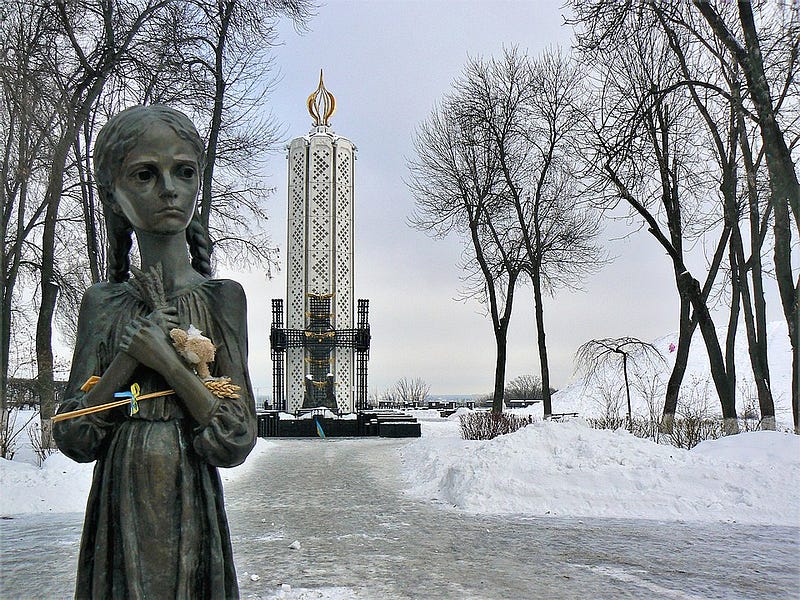

It took many decades for the world to find out the scale of the atrocities of the Holodomor. Even now, knowledge of the famine is limited. Since independence, Ukraine has been able to open up its archives and enable historians to research the horrific events of 1932–33. In 2008 a national Holodomor monument was built in Kiev. It is to be hoped that the testimonies of people such as Jones and Berman will mean future generations can learn about this tragedy.
