
Teresita
The healer venerated as Santa Teresa of Cabora, Mexican Joan of Arc and Queen of the Yaquis
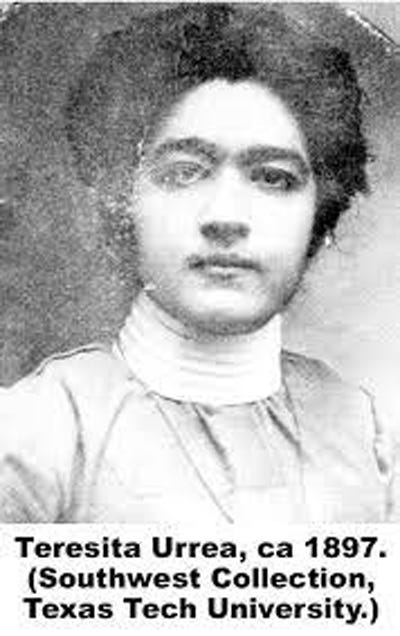
In 1889, a young girl was overcome with a mysterious affliction. Some say it was a response brought on by an attack from a rejected suitor. She fell ill to the degree she took no sustenance and descended into a coma-like state. Nothing could be done by the ranch’s curandera, the local doctor, or the ever-present praying women circled around her bed. As her skin grayed and shriveled, her father had to face a reality. She was quickly slipping away.
On the twelfth day, he instructed his men to build a coffin. When finally her breath ceased, heart stilled and no pulse could be found, all knew the worst had happened. After the ritual washing of the body, she was clothed in white and laid on a table in a room with candles, the coffin nearby. There she would be placed the next morning. The women began their overnight vigil, praying as they would.
Suddenly about midnight, there was a scream from one of the women who glanced up from her bowed head. There was a slight flickering of the girl’s closed eyes and movement in her body. Then more screams from the rest and a rush out the door…for the girl slowly sat up and began looking around the room disoriented.
Over the next three months, she remained in a trance-like state. Her weakened condition returned to normal over that time, but for much of it she had to be cared for and fed. She showed no interest in food and displayed no emotions or interest in anything. Remaining in her room, she withdrew into herself or sometimes gazed into space as though seeing beyond this dimension.
One day, the fugue lifted as quickly as it came. She began to heal the afflicted merely through her presence, gaze of her eyes, vibration of her words, and laying on of hands. And somehow…she correctly foretold futures. None of these capabilities existed previously.
She was 17 years old. Her name was Teresa Urrea, affectionately known as Teresita, the illegitimate daughter of Cayetana Chávez and Tomás Urrea. Soon she would become widely known throughout Mexico, the US, and elsewhere, as Santa Teresa of Cabora and, in some circles, the Mexican Joan of Arc and Queen of the Yaquis.
Teresita’s mother was a Tehueco Indian, 14 years old at her daughter’s birth. Her father was a wealthy landholder of Spanish lineage, a patron owning several ranches. At 15, she was taken into Don Tomás’ home where she made the transition to a girl of privilege — for which she cared little — while alternately being schooled in herbalism by Huila, the ranch’s curandera. Her heart rested with those who had the least, and the Mayo and Yaqui Indians of the Sonoran region.
Teresita first began her healing ways with mothers during childbirth, easing pain and moving babies in dangerous birthing positions. But quickly the incidents moved on to other ailments. There was an uncanny similarity to some of the stories of Jesus. A paralyzed man found he walked after her quiet urging and touch. A deaf boy suddenly was able to hear. There were countless others. Now, such fantastic tales could easily be dismissed were it not for the fact that they were corroborated by eyewitnesses and consistent over time. When she was unable to dispel disease, she instilled peace and readiness for passing.
Word spread like wildfire. It wasn’t long until the sick and their families — in the thousands — made the pilgrimage, setting up camp to wait for audiences with Teresita. In all her short lifetime, she accepted nothing from people for her work. Life for Santa Teresita of Cabora — declared so by the people she served, bringing anger from the Catholic Church — her father, or any of those associated with the Urrea ranch would never be the same again.
The Yaqui and Mayo Indians uplifted her as their champion. Word made its way to northern Chihuahua, and the ears of Cruz Chávez, a rebel mestizo and religious fanatic in the remote village of Tomochic. Chávez and his followers made their own journey to consult Teresita. Thereafter, he kept correspondence with her until his death during the siege and massacre of Tomochic, perpetrated by Porfirio Díaz, president of Mexico, and the federal army.
Although Teresita’s message was always one of peace and tolerance, she was blamed for the Tomochic uprising, a precursor to the Mexican Revolution. Later discovery of letters between Chávez and Teresita proved her innocent of any inciting. However, the Mexican government continued to hold her accountable for subversive activities regarding the insurgence of the Yaqui and Tomochi and feared her influence.
At the age of 19, this devout young woman — an Innocent in so many ways — was arrested by the federales. Threatened with execution, she opted for exile over the border to the US. Don Tomás left his wife, mistress, many children, and properties behind and accompanied her. Over the next years, Teresita would first be exploited by a “medical company” for their own gain. Next was a political activist-publisher, a longtime family friend, in support of his cause against Porfirio Díaz. She would live in Arizona, Texas, California, New York, and travel across the US.
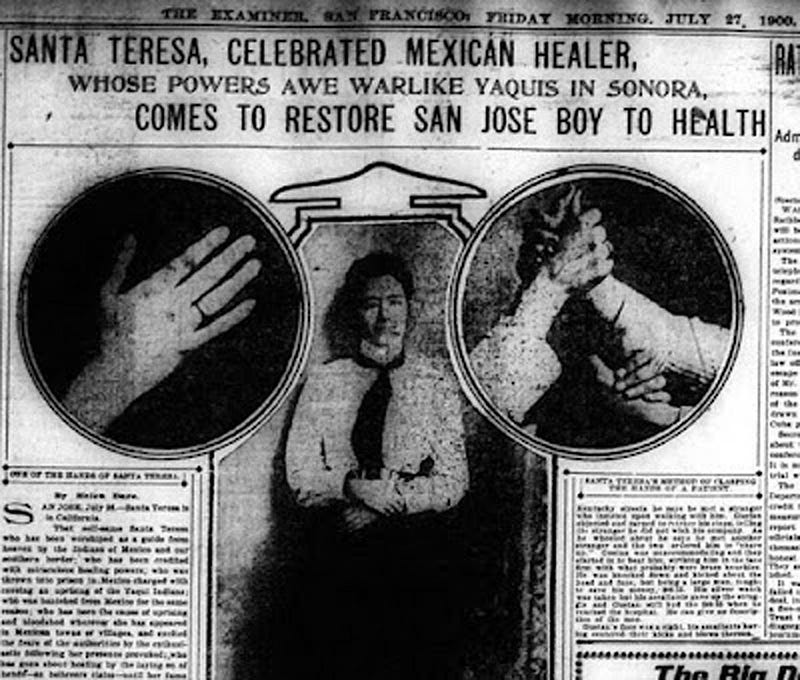
Santa Teresita of Cabora would finally return to the small town of Clifton in eastern Arizona where she would live out her days. There she was diagnosed with tuberculosis and passed in 1906 at 33 leaving two young children. Having healed so many, she was unable to heal herself. She is buried next to her father. Teresita remains venerated.
I will admit to a fascination with Teresita, her life being well documented. I’m not the only one. William Curry Holden, historian, and archaeologist, researched her life for 20 years, speaking to those remaining who had known her. He went to the places she had frequented, along with unearthing newspaper articles of the time. His investigation culminated in Teresita, a straightforward biography published in 1978 that reads like a good novel.
Author Luis Urrea discovered he was Teresita’s great-nephew after a colleague suggested it so in 1978. He thought back to what he considered interesting but false family stories he’d heard as a boy. An aunt in Tijuana described an ancestor who could heal and fly. After that, he found there were books about her. His lengthy novels The Hummingbird’s Daughter (2005) and Queen of America (2011) fill in any gaps left by Holden with lyrical language and story.
I’ve read all three of these books but left wanting more. One day, I will be making a pilgrimage over to Clifton in search of any lingering presence Teresita may have left.
This article first appeared in The Lifepath Dialogues in February 2019.