
Tensions in the Aegean Sea: Germany is going it alone… as always!
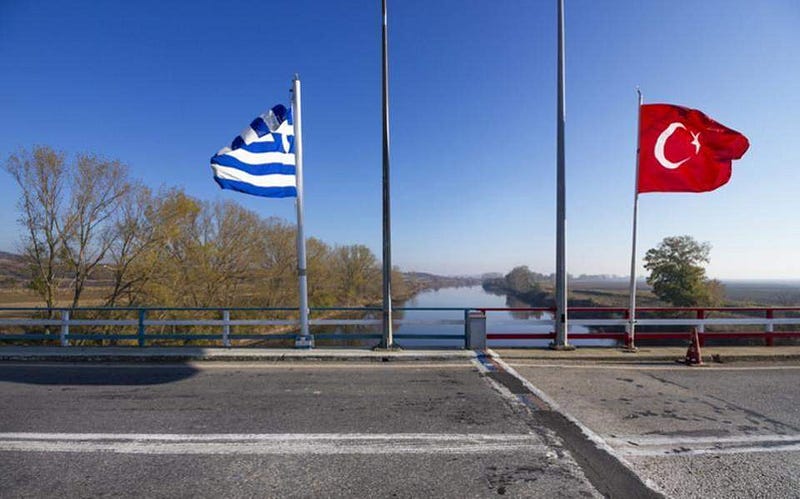
Thursday August 13, France deployed two ships of the French Navy and two Rafale single-seaters in the eastern basin of the Mediterranean, while calling for “calm” the forces present. This deployment of French troops takes place amid heightened tensions between Athens and Ankara on the one hand, in the Aegean Sea, and between Nicosia and Ankara on the other hand, off Cyprus.
The next day, Friday August 14, the German government announced “to take note” of the French deployment. A way of saying coldly to Paris that its naval air forces will be left alone 2,000 km from their coasts, with the only point of support being the Greek aerodromes and ports.
This is yet another demonstration that what prevails in the real functioning of the Brussels machine is the national interest, and that alone, and not a “European solidarity” which the rhetoric of the European Union is beating our ears to. length of time. Another demonstration also that the current French government, naive, is unable to free itself from this rhetoric to defend its well-understood national interest, unlike its German neighbor, yet presented as a model to be followed in all sectors.
Further humiliation: the German government spokesman announced the opening of trilateral negotiations with the Turkish and Greek governments, thus showing a desire to marginalize French diplomacy in an insidious but real way. At the same time, our military draws on its resources in the name of the integrity of the rights of a member state, without our having any vested interests in the Aegean Sea.
Unfortunately, this asymmetry is nothing new. As usual in recent years, Germany lets us cash in the expenses and take military risks when it rakes in the successes and gains (here diplomatic). Once again, “European solidarity” is only the screen of the German national interest.
It is long-lived when it comes to consolidating the colossal German trade surplus, but turns out to be non-existent as soon as a so-called “friendly country”, located on the border of the EU, carries out military maneuvers in the waters of his neighbor, yet himself a member of NATO.
The sovereignty of Greece extends over almost all of the archipelagos of the Aegean Sea. But she sees this exclusive economic zone (EEZ) being regularly violated by Turkish buildings, because Turkey claims a westward extension of its own EEZ, which would enclose a myriad of Greek islands, including the great Rhodes.
The conflict is compounded by the inability of the two states to project their territorial waters to the 12 nautical mile limit allowed by the UN, casus belli for both parties.
Turkish claims on the micrasian continental shelf in the Kastelorizo prospecting area are also a cause of strong tensions between the countries of the Aegean Sea, as well as for Cyprus (traditionally oriented towards Athens) which is home to British military bases and, now, French. The hydrocarbon-rich subsoil of this prospecting area explains these successive demonstrations of force.
Germany, on the other hand, enjoys centuries-old proximity to Turkey. There is no doubt that it feels torn between its European commitments and its bilateral relations. In her concise statement, however, she admits her refusal to sacrifice the latter to the former, proof, if necessary, that realpolitik takes precedence over its appetite for a European political community.
In conclusion.
1. France must stop obsessing over a neighbor chaining up humiliations and refusals, acting only in its national interest to the detriment of those of its so-called partners.
2. The masquerade of the “Franco-German couple” should no longer deceive anyone.
3. It is time for France to realize that, in the European “great game”, its ideological hard-line gives it only one role: that of “the great stripped”.
Let us take back military and diplomatic control!