
Ten Dystopian Nightmares Actualizing Today
Dystopian tech that is already in development
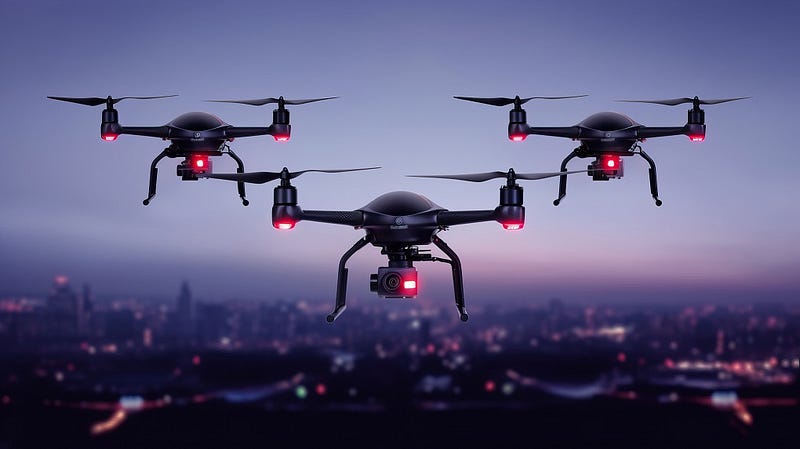
In recent years, Silicon Valley has been churning out a plethora of innovative technological marvels. However, with the likes of Amazon, Google, and Facebook at the forefront, some of these inventions have been associated with invasive features such as private data tracking. This leaves one to ponder the possibility of even more intrusive surveillance technology being developed. Let’s take a look at ten nightmarish dystopian tech coming to life.
The Amazon Ring Home Security System Is a Privacy Nightmare
Home security systems have been a thing for a very long time. Many tech companies, such as Amazon and Google, have thrown their hat into the security game, providing their own products for homeowners to utilize. And while some of these products, like Google Nest, may seem rather tame, others come with a host of surveillance questions. Amazon’s new Amazon Ring is one such product raising plenty of eyebrows in the tech world.
The Amazon Ring is a camera pod designed to fly around and monitor a house while its inhabitants are gone. The pod is equipped with sensors that can automatically detect home intruders and alert homeowners and law enforcement. However, the fact that it can monitor you at any time has some comparing it to Big Brother. Amazon has stated that the pod only monitors when in motion, though it’s always connected to Amazon servers.
Smart Caskets will post your likeness to social media, even after death
Funeral arrangements seem like the absolute last place that smart technology would play a role. However, one company has already gotten the ball rolling on that front, introducing digital smart coffins. Perfect Choice Funerals came up with the idea after doing intensive research on both technology and funeral intersection. They noticed that friends and family of the deceased often use social media to share photos of their loved one’s funeral, which led to the creation of the smart casket.
These caskets come equipped with LCD screens, displaying a deceased one’s photos and messages received on a social media platform of one’s choosing. This, in turn, keeps the loved one’s presence connected to the digital world long after death. It’s a fairly creepy invention, nonetheless, and raises questions about whether always-on social media connectivity has gone too far. The dead will truly have no rest if they’re allowed to continue posting on Facebook long after their mortal coil has been extinguished.
This AI app looks at your background information to determine who’s a “risky” babysitter
Babysitting is a tough job; finding a trustworthy babysitter can be just as difficult. While there’s no easy way to find the absolute perfect babysitter, some solutions to the problem are probably best avoided. Predictim company has created AI software designed to comb your background history to determine babysitter eligibility. AI software, in general, remains a burgeoning and flawed technology that still has miles to go before it’s a true success story. In the case of Predictim, that AI ends up being just a little bit racially biased.
Brian Merchant of Gizmodo conducted tests on the software, using his Black babysitter and a White friend. His Black babysitter scored lower on the ranking than his White friend, despite the fact that both are well-trusted in his family. Of course, this doesn’t mean that the company or the CEO are racist. It only means that there are unfortunate biases in AI technology that still have to be patched out. In either case, software that can comb someone’s entire background history and assess risk factors hits a little too close to dystopian.
Deep Voice technology lets anyone clone anyone else’s voice
Deep-fake technology is scary. Many demonstrations of it have already proved quite convincing, and the tech will only get more advanced as time passes. The capabilities of deep fake AI are near endless, from creating fake celebrity photos to spoofing the voices of influential figures. That last one has already been used by a few criminals who made off with millions of dollars.
Audio deep-fake technology utilizes artificial intelligence and audio samples to recreate anyone’s voice. Thieves managed to trick a bank manager into wiring $35 million to a U.S. bank account in 2020. The manager had no idea that the voice on the phone wasn’t the account holder but rather an artificially created robot voice made to resemble his. Over 17 thieves made off with the funds, which led to the U.S. organizing a hunt for the would-be criminals. This showcases the dangers that deep voice technology poses. Anyone could mimic one’s voice and steal their identity outright, a chilling thought.
Dove drones in China spy on citizens
Chinese government and law officials are currently experimenting with drone birds that can spy on citizens. This is part of a program named “Dove,” an initiative by Northwestern Polytechnic University professor Song Bifeng, who worked on stealth fighter jets. These drones have movement that’s frighteningly similar to how real-life doves fly, up to 90%. That means that the average human is likely to have a more difficult time spotting them in the air at first glance, especially since their wings are almost entirely silent in motion.
These drones can be used for many purposes, such as catching criminals or spying on everyday citizens. Currently, the technology is in the small-scale development stage, but its potential remains frightening. In fact, there are already military and law enforcement applications for it, according to the company that produces the birds. Even in concept, the plans for it going forward are terrifying.
Police officers in China are using facial recognition sunglasses
Facial recognition technology is becoming frighteningly more common. The ability to determine one’s identity with advanced security cameras can be dangerous in the wrong hands. This technology has now extended itself to Chinese law enforcement, which is being equipped with facial recognition sunglasses. These glasses were introduced in Zhengzhou, China, in 2018 and aided in capturing seven criminals at the time.
These gadgets are being used throughout the city in everyday places, like train stations, stores, and anywhere else with busy crowds. Most frightening is that the Chinese government has also installed millions of cameras to use facial recognition technology in efforts to make it almost impossible to evade capture. The implications of this technology are scary, as it has the potential to strip citizens of their privacy and freedom, leading to widespread human rights abuses that could go unnoticed and unchallenged.
Boston Dynamics is making robots that can fight humans
Boston Dynamics has established a prominent reputation in the field of robotics by developing highly agile and sophisticated robots such as BigDog, WildCat, and Spot, among many others. These remarkable robots have gained global recognition and fascinated the public with their incredibly lifelike behavior, accurately mimicking the movements of both humans and animals. Nevertheless, not everyone is impressed. Some fear these robots may turn into a real-life SkyNet and rebel against their human creators.
A 2019 video from Boston Dynamics depicting robots fighting humans doesn’t ease these concerns. In the video, testers pummel the robots, which then retaliate with a startling degree of force. The authenticity of the video was so convincing that Corridor, the production company, had to clarify that no humans or machines were injured during its filming. The potential applications of this technology are enormous, as it could be utilized for military or law enforcement purposes.
Singapore has patrol robots that monitor “undesirable behavior”
In 2021, Singapore conducted a three-week trial of two robots that have the ability to blast warnings at individuals engaging in “undesirable social behavior,” joining an array of technology the country is using to track its inhabitants. Singapore has long aimed for a tech-driven “smart nation”; however, activists claim that privacy is being sacrificed and people have little control over what happens to their data. The robots on wheels are equipped with seven cameras and can detect the aforementioned “undesirable social behavior,” including smoking in prohibited areas, breaching coronavirus social-distancing rules, and improper bicycle parking.
During the trial, one of the “Xavier” robots weaved its way through a housing estate and stopped in front of a group of elderly residents watching a chess match, blaring out a robotic voice demanding they keep one-meter distancing and keep to five people per group. However, digital-rights activists have expressed concerns that these devices are the latest addition to Singapore’s surveillance culture. Singapore has 90,000 police cameras that are set to double by 2030, and the city may install facial recognition tech on lampposts. Singapore is known for its tight controls. While there’s a sense of unease surrounding intrusive technology, there’s growing concern that Singaporeans are being watched and have to be wary of what they say and do to a far greater extent than in other countries.
China’s social credit system rewards and punishes based on whether you’re a good citizen
Surveillance in China might have reached its peak point by implementing a social credit system. This differs from American-style credit scores in that it assesses citizens’ behavior and assigns them a moral ranking. This program, introduced in 2014, is an integral component of China’s market economy and social governance system. Its main objective is to promote the concept that maintaining trustworthiness is commendable while violating it is reprehensible. The National Development and Reform Commission, the People’s Bank of China, and the Chinese court system determine individuals, businesses, and government organizations’ ratings.
The private sector has developed its own rating systems, and millions of Chinese citizens have participated in the pilot program in recent years. The program is anticipated to become mandatory and standardized throughout the country, with each person given a unique code to determine their real-time social credit score. Violations such as poor driving or unpaid debt may cause a person’s social rating to decline. The social credit system is projected to eventually be fully operational and integrated. To enhance the legal framework for the credit system, the Chinese government’s state council has issued a draft law for the establishment of the social credit system.
Amazon tech tracks workers for productivity and automates firings
Everyone’s favorite online retailer Amazon might be in serious hot water over dystopian work conditions, such as automated firing and productivity quotas. Obtained documents have shown that Amazon fired hundreds of employees at a single facility for failing to meet productivity quotas, with numbers suggesting the company may be firing more than 10% of its staff annually for productivity reasons. The process appears to be deeply automated, with the system tracking individual productivity and generating warnings or terminations without the input of a supervisor.
This reliance on automation is a major cause for concern, as the absence of a human supervisor could lead to extreme errors and machine cruelty. Shocking statistics reveal that thousands of Amazon employees in North America may lose their jobs annually for not moving packages quickly enough. Critics claim that fulfillment center workers are subjected to extreme working conditions, with some being expected to pack hundreds of boxes per hour and facing termination if they fail to meet the required speed.
References
(1) bbc.com/news/technology-54285692
(2) mentalfloss.com/article/70154/smart-casket-design-keeps-corpses-connected-social-media
(3) gizmodo.com/predictim-claims-its-ai-can-flag-risky-babysitters-so-1830913997
(4) reviewgeek.com/100638/thieves-used-deepfake-voice-technology-to-pull-off-a-35-million-bank-heist/
(5) businessinsider.com/china-is-testing-creepy-dove-drones-to-monitor-citizens-2018–6
(6) bbc.com/news/world-asia-china-42973456
(7) popularmechanics.com/technology/robots/a28068919/robot-fights-humans/
(8) theguardian.com/world/2021/oct/06/dystopian-world-singapore-patrol-robots-stoke-fears-of-surveillance-state
(9) businessinsider.com/china-social-credit-system-punishments-and-rewards-explained-2018–4
(10) theverge.com/2019/4/25/18516004/amazon-warehouse-fulfillment-centers-productivity-firing-terminations


