Roleplaying Games
‘Ten Candles’ is the Perfect Halloween RPG
I heard about Ten Candles for the first time on a podcast. It was discussed in hushed tones, with all hosts agreeing that it was really good, some even calling it their favorite RPG, but without anyone sharing any real information on what it was. Elsewhere on the internet, I heard about it again and again, that it was a definitive horror RPG experience, that it was a favorite one-shot RPG, that there was almost nothing else like it. My interest thoroughly piqued, I went to the publisher’s website, read two sentences of their description, and smashed the buy button. Everyone was right, Ten Candles was a pitch perfect horror RPG.
For a horror RPG, atmosphere is everything. A good horror RPG should feel like a good ghost story: faces just visible in the dim, flickering light; quiet conversation; a little tickle of excitement and fear in the pit of your stomach; a sense that anything might happen in this little circle, and that for a little while, the world outside the circle ceases to exist. Ten Candles is dripping with that atmosphere.
Ten Candles is played by a GM and 3–5 players, with no prep. Everyone is arranged in a circle, with ten votive candles and a fireproof bowl in the middle of the group. The game plays like a ritual.
Players create characters together, lighting the candles as they do so. Everyone writes a virtue or positive trait on one card, and a vice or negative trait on another. They pass one to the right and one to the left. Then the GM introduces the story.
It always begins the same: ten days ago, the world went completely and inexplicably dark. Five days ago, They arrived, picking off anyone who strays away from the light. It’s the situation that changes. Players may find themselves at a resort when the world goes dark, or in a fallout shelter, or even in a space station.
Players design a character based on the module, their virtue, and their vice. Light three more candles and create a Moment. This is the game’s term for a scene where your character might find hope. It is a scene that your character is angling to play out during the game. Success in this scene grants that player an extra die with a greater chance at success in the future. Failure causes them to lose all hope. You light three more candles and design what’s called a Brink. This is what a character is capable of at their darkest. These are then passed to the right. What this ends up meaning is that in addition to knowing your own Brink, you (and your character by extension) know the Brink of the person to your right. You also know that the person to your left knows your Brink. The exception is the person to the right of the GM, whose Brink is unknown to all but the GM. The person to the left of the GM gets to do something special as well: they get to invent a trait for Them: the mysterious enemy in the darkness.
With all that done, you light the final candle, turn out the lights, and leave a final recording, in character, for anyone who might find it later. Then you say the magic words.
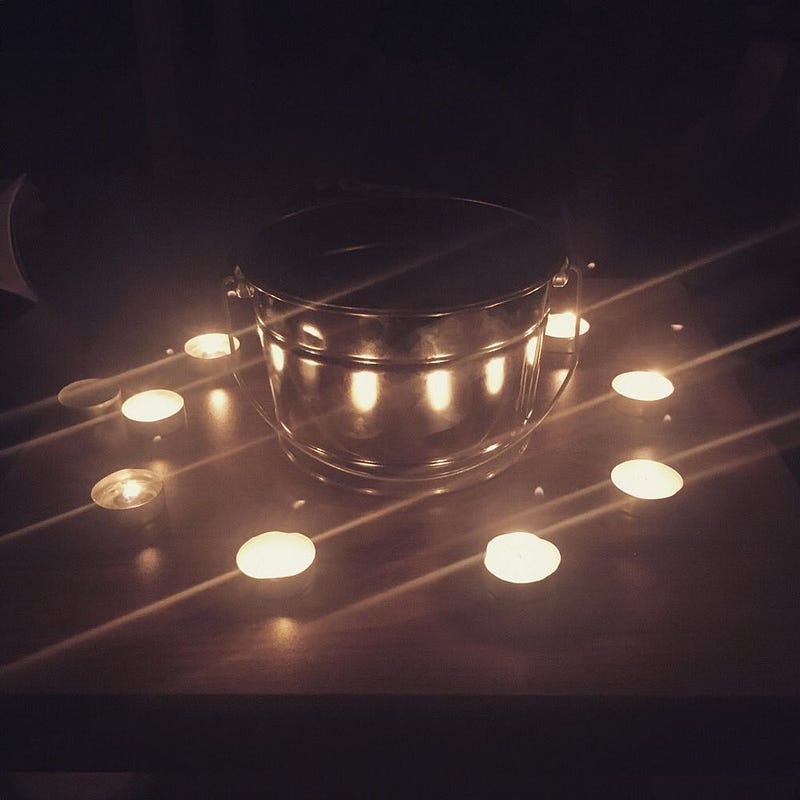
Yes, there are magic words. In between every scene, the GM starts by saying “These things are true, the world is dark.” to which the players respond “And we are alive.” Then, for every candle remaining, everyone in the circle gets to establish a truth about the forthcoming scene. It can be about where the scene takes place, about items they’ve picked up along the way, anything. In this way, players get a degree of control over the narrative, but they remain powerless to prevent the inevitable. The line about “And we are alive” is important, because by the end of the game, it will no longer be true. Ten Candles describes itself as a “tragic horror” game. In other words, no one gets out alive. During the final scene, with only one candle remaining, the players are picked off one by one, dying as soon as they fail a roll.
Scenes end when a candle goes out. A candle can go out on its own, or it can be snuffed out as a result of a failed roll from the players. It cannot be relit, so if someone sneezes and it blows out a candle, that scene ends. When all the candles are out, and thus all the players are dead, the GM says “These things are true, the world is dark” and in the silence left by the now-dead characters, the GM has a final flourish: they play the audio that the players recorded at the start of the session. In the sessions I’ve run, this has been a definite crowd pleaser, and an emotional way to end an evening. Some groups have reported tears, but I haven’t been so lucky yet.
Ten Candles works because of its subtle theatricality. It allows the GM to set the stage. By shrouding everything in darkness, it sets a spooky tone while also keeping players off their pesky phones. Bold groups can use the fireproof bowl to burn the index cards that make up the characters. These are burned to change rolls for another shot at success. This also creates a brief flash of light that fades into what feels like an even deeper darkness.
Because the players get to help set the scene and at least one of them gets to determine the nature of Them, players feel invested in the story, and a certain amount of pressure is taken off the GM. Some no-prep games feel more like rushed-prep games, making the GM think on the fly, but this is truly a group effort. As the game goes on, the player’s dice pool shrinks and the GM’s grows, and certain rolls can cause the players to lose or win narrative control in the scene. Still, the GM gets control more often than not. This helps to sell the game’s core theme of hope and despair. In the first scenes, players succeed constantly, but the scenes get shorter and shorter, and the room gets darker, until at the very end, the room is pitch black: just darkness, the smell of candle smoke, and the sound of the player’s voices on the recording. It creates a real feeling that the story told is a group effort, one shared by everyone in the group, with the GM simply directing the action.
I’ve played this game both with a group of people brand new to RPGs and with my own D&D group. Both groups enjoyed it and found their way around easily. By the middle of the game with newbies, they were fully immersed, creating stunning scenes that remain some of my favorite horror game memories. In particular, I remember them rushing to get to a boat to escape their island resort, only for them to miss it. As the boat left the dock, the lights on deck failed, and when they flashed on again, the entire deck was awash in blood. In this game’s final scene, my wife’s character, alone on a rowboat with a lantern that was running low on fuel, decided to simply turn it off and leap into the water, accepting the inevitable. We snuffed the last candle as she sank below the waves. I wouldn’t trade that game experience for anything.
There are a host of excellent horror games for your gaming group. A lot of people like to run Curse of Strahd (even though it’s like, wildly racist, and the little edit they recently released doesn’t actually fix anything), but let me encourage you to put down the d20 and pick up a candle. A truly incredible story awaits you, in the darkness.


