
TemporalNet And Stable Diffusion: The Next Game-Changer For AI Video Creation?
New approach aims to improve temporal consistency in AI-generated videos
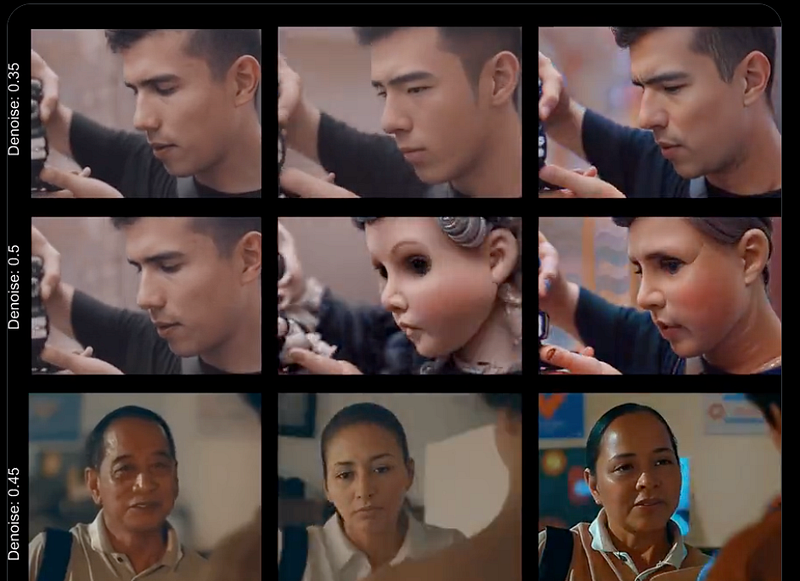
Only a month ago, ControlNet revolutionized the AI image generation landscape with its groundbreaking control mechanisms for spatial consistency in Stable Diffusion images, paving the way for customizable AI-powered design. Building on this success, TemporalNet is a new approach tackling the challenge of temporal consistency, which could equally transform AI video generation.
What is Temporal Consistency?
While prior to ControlNet there was no efficient way to tell a diffusion model which parts of an input image to keep and which to manipulate, this changed with the ability to use sketches, outlines, depth maps, or human poses as control mechanisms when working with Stable Diffusion. Spatial consistency got solved.
With video, the issue is not only spatial consistency between two images but consistency between multiple frames over time.
You may have seen this temporal consistency problem in action when watching AI-generated videos with abrupt changes, flickering, or other inconsistencies.
Achieving temporal consistency is critical to producing high-quality video, and that’s exactly what TemporalNet aims to improve:
Compare this to other attempts at AI video creation, like ControlNet Video or Modelscope’s Text-2-Video:
The Power of TemporalNet
Ciara Rowles, who initiated this approach, introduces it as follows:
TemporalNet is a ControlNet model designed to enhance the temporal consistency of generated outputs […]. While it does not eliminate all flickering, it significantly reduces it, particularly at higher denoise levels. For optimal results, it is recommended to use TemporalNet in combination with other methods.
(Source: https://huggingface.co/CiaraRowles/TemporalNet)
Examples on Twitter:
The main advantage of TemporalNet is that it significantly reduces flickering and inconsistencies. And it’s certainly an exciting development to watch, as it has the potential to bring us closer to fully customizable, high-quality AI video creation.
Make sure to join Tales Of Tomorrow where we will soon feature a deep dive into TemporalNet and follow Ciara Rowles, ToyXYZ, and others experimenting with this approach.
Links
- The current version of TemporalNET on Hugging Face:
- Twitter feed with the latest posts about TemporalNET
- Article about ControlNet:
➡️ For more information about AI & Creativity, follow me on Twitter or Medium (use my referral link to get full access to all my articles and those of thousands of other writers).
➡️ If you like my content, why not leave a “clap” at the end of this article, so more people can see it?


