
The Reflective Eclectic
Telehealth Psychotherapy
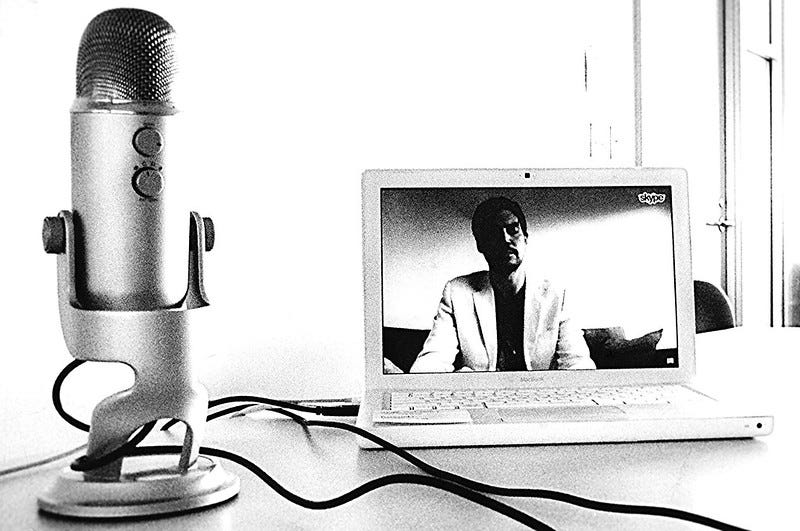
A man I talked to the other day seldom looked me in the eye. His gestures were not in rhythm with the things he was saying. At times, he skipped half the words in a sentence. Once, he disappeared entirely and went on talking as if we were still together. He seemed oblivious to many things I said to him. His face froze. Reactions were delayed. Was this a bizarre psychotic I was talking to? An individual with autism? Someone with something to hide? No, it was just an ordinary day in an extraordinary time of social distancing. It was what’s called a psychotherapy session thanks to the wonders of telehealth technology.
I’ve got to assume I was just as peculiar to him as he was to me.
If we had a transcript of the session, everything would look just fine; but everything wasn’t fine. We were out of tune. The one thing every client should be looking for in a therapy session, and every shrink should strive to create, is attunement. There’s very little attunement in telehealth sessions. We’ll have to see whether it matters.
How do you know when you are in tune with the person you are with? At its most basic level, attunement is the same as listening. Irrelevant comments, dumb questions, awkward pauses, and bad dad jokes are signs you’re out of sync. So is monopolizing, firehosing, shaggy dog storytelling, stonewalling, and when you just don’t get it. You should notice when the other has something to say and give him a chance to say it. You should be able to, at any time, summarize what the other just said. If you can’t, then you are not attuned because you haven’t been listening.
But attunement goes further than just listening. It also refers to how you relate your bodies to each other. Watch any two people who are fully engaged in conversation and you will see they are mirroring each other in the way they sit or stand, the gestures they make, and the expressions on their faces. They will speak at similar volumes and rates. Even their breathing may be synchronized. All this is done unconsciously, of course. When you’re with someone who mirrors you, you feel comfortable and at ease. When they don’t, it’s like you are out of step. You are not well attuned.
We shrinks use attunement to a therapeutic advantage. If you come into my office wringing your hands, speaking loudly, breathing rapidly, and leaning forward in your chair, I’ll begin to match you to some degree. I may not wring my hands, but I’ll clasp them. I’ll lean forward and talk fast and more loudly than I do normally. All this communicates that I’m with you, you are not in it alone. It shows empathy. If I were to lean back, talk slowly, whisper, and open my arms, you might start to get the feeling I don’t care or don’t understand. You may conclude we’re a poor fit.
Once I establish the connection by these non-verbal means as well as verbal, I can then begin to use our connection to calm you down. I would never, ever just tell you to calm down; that would guarantee you’ll remain anxious. Instead, I’ll calm myself down. I’ll begin to open my hands, slow my breathing, reduce my volume, and sit back. If I had been mirroring you, you’ll begin to mirror me. When you let go of your hands, slow your breathing, reduce your volume, and sit back; low and behold, you’ll start to feel less anxious.
This is what we can do with our ability to attune. Unfortunately, attunement is often not easy. It’s challenging to be attuned to someone whose thoughts and feelings are intense, outlandish, lifeless, or threatening. That’s what makes anxious, depressed, manic, or psychotic people so lonely. They are out of tune wherever they go, so nobody can sing with them. That’s why we shrinks get paid the big bucks. We know how to get attuned to people, even the hard ones, and we can use this ability to subtly influence them to sing on key.
How well does attunement work in a telehealth session? Before you’re going to talk about something that’s shameful, contentious, or complicated, you’d better be sure you have a clear line of communication first. You’d better be attuned.
There are lots of problems with telehealth. The computer world is a lot like the automobile world was in the first decades of its existence, when roads were poor, cars broke down frequently, and nobody knew how to drive. Computer people have been concentrating on being the first to develop bells and whistles while paying no attention to things as basic as reliability and the capability of consumers to use their products. The world wide web does not cover the whole world, it crashes regularly, and few people are adept at handling an app they don’t use every day.
More often than not, my calls get dropped, the video freezes, or the sound disappears. When that happens, whatever we had been talking about has to be put on hold while we tend to the technology. Many clients, sheltering in place with family members, don’t have a private place to talk where the Wi-Fi reaches. All this makes it that much harder to talk about difficult things. I suspect, many don’t even try.
To the extent that both myself and the client succeed in getting online, staying online, and keeping a good audio connection, then I’m able to listen. But listening is only part of attunement. In a telehealth session, it is possible to mirror the loudness of speech and, to some extent the rate of breathing, but lag times result in my reactions arriving to you later than you would expect. This changes the meaning of the reaction. I seem a little off. Are you going to feel comfortable talking to me when I seem a little off?
There’s no question about it, telehealth is not the same as meeting face-to-face. It’s impossible to be fully attuned in the same way. That is not to say that telehealth is worthless or that the liabilities outweigh the conveniences. It also doesn’t mean we can’t adjust.
We could end up adjusting to telehealth in the same way that most of us have adjusted to using the telephone. It’s impossible to attune in the exact same way on the phone as it is in person, also; but it is still possible to attune. On the telephone, you must disregard the reliance you have on seeing the other person and let your sense of hearing take over. Will it be possible to overlook the lag times, bad connections, and interrupted service we get in telehealth in the same way that we let go of the need to see someone when we pick up the phone?
For that matter, maybe we should just go back to meeting in person, even though we must wear masks to do so. As it is now, it’s hard to be attuned to someone wearing a mask. But humans are eminently adaptable. Our need to be attuned is so great that we will find a way, despite hardships. If we needed to, we would learn to read eyes as well as we read mouths.
I suspect it will be harder to learn to adjust to telehealth than it is to adjust to the telephone or talking to someone who’s wearing a mask. The reason is because telehealth pretends to be the same as face-to-face contact. Telehealth offers the promise of face-to-face contact without actually delivering on what is meaningful about it. Telehealth is like interacting with a poorly programed robot of the person while being told you’re seeing the real thing.
Therefore, I call on web developers, app designers, and internet providers to recognize they have not yet found the way to connect people. Solve the problems of reliability and consumer interface you breezed by on your way to designing the smart phone, so we can truly be with people we can’t be with. Don’t claim you’ve found a way to do that when you haven’t.
For the rest of us, learn how to tune in to the music, despite the noise. Have your robot schedule a session with my robot and have them see if they can help you feel better.
Keith R Wilson is a mental health counselor in private practice. Read more of The Reflective Eclectic and his other stuff .


